c. 790 – 1066
Weapons and the shield wall
Free men own weapons and by custom carry them at all times. A farmer fights with a spear, a round wooden shield of 75 to 90 cm and an axe or a long knife, the seax, and a wealthy man adds a sword, a helmet and a mail shirt. Helmets and mail are rare finds, and a 10th-century grave at Gjermundbu in Ringerike gives the only helmet and mail shirt from Scandinavia that can be reconstructed, while a helmet of the same century comes from Yarm in Yorkshire.
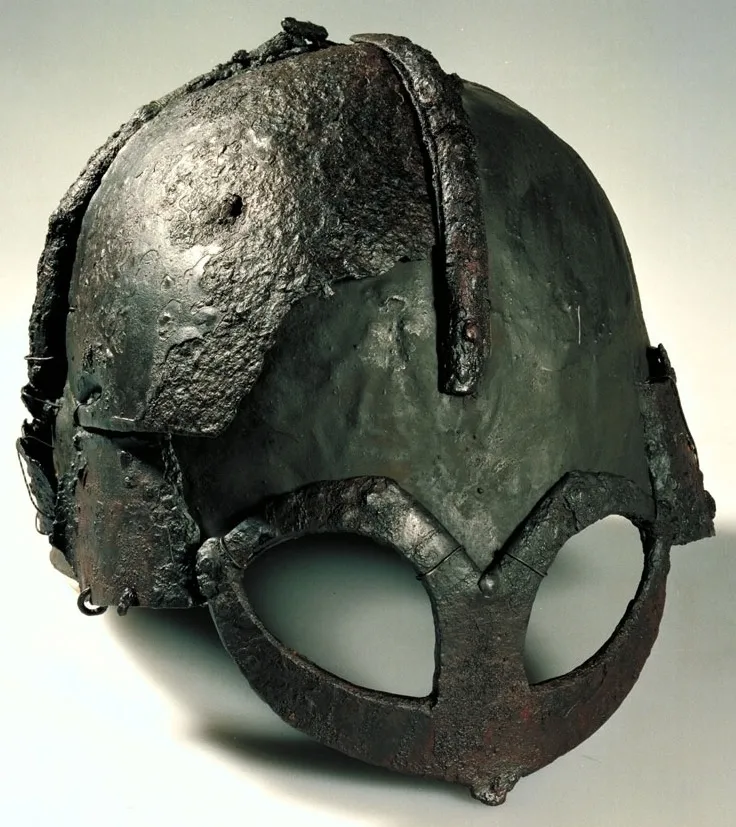 The 10th-century helmet from the grave at Gjermundbu, Museum of Cultural History, OsloWikimedia Commons, NTNU Vitenskapsmuseet, CC BY 2.0 (Gjermundbu helmet - cropped.jpg)
Swords are costly and pass from one generation to the next. About 170 blades of the 9th to 11th centuries carry the inlaid Frankish name +VLFBERHT+ and probably come from the Rhineland. Carolingian laws forbid selling weapons to foreigners, so most of these blades travel north as loot, ransom or contraband, and three reach Volga Bulgaria. The axe is the commonest weapon, and an axe inlaid with silver lies in a grave at Mammen in Jutland, built of timber felled in the winter of 970–971.
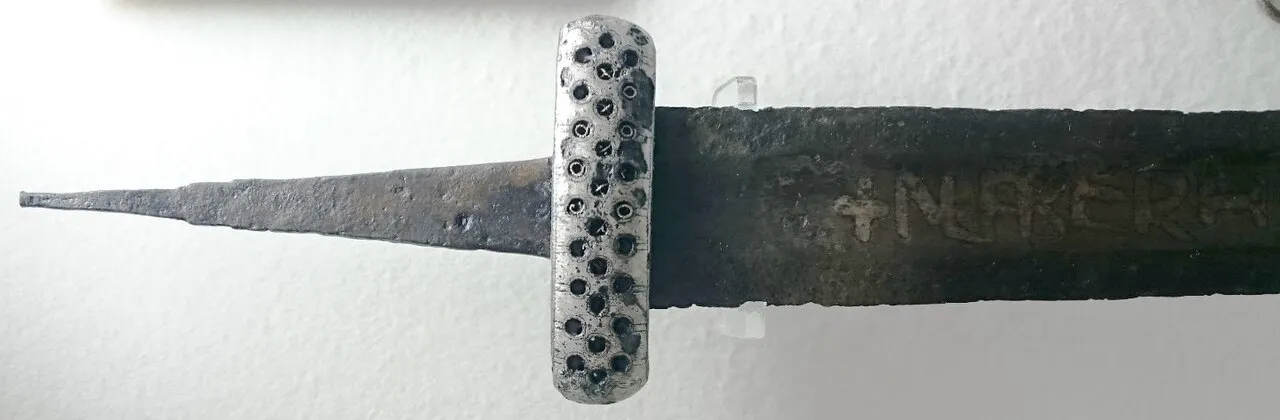 Hilt and inscription of a 10th-century Ulfberht sword, one of three found in Volga Bulgaria, history museum in KazanWikimedia Commons, Dbachmann, CC BY-SA 4.0 (Ulfberht sword Kazan.jpg)
In battle men stand in a shield wall, the skjaldborg or shield fort, with the best-armed warriors in the front ranks, and fights open with arrows and thrown spears. The levy, the leiðangr, divides the coast into ship districts, each of which builds, crews and supplies a warship for two or three summer months, and the Older Gulating Law requires each man to bring an axe or a sword, a spear and a shield, and each rowing bench a bow and 24 arrows. Kings and jarls keep a sworn retinue, the hird, and Cnut's housecarls in England live under a law of their own. The ring fortress of Trelleborg on Zealand, built from timber felled in 980, may have held a garrison of royal housecarls.
Skaldic poems and the sagas, written down in the 13th century, tell of berserkers who fight in a trance-like fury. The earliest mention is in Thorbjörn Hornklofi's poem for Harald Fairhair from the late 9th century, which places berserkers and wolf-skinned úlfheðnar in his fleet at Hafrsfjord. Jarl Eiríkr Hákonarson outlaws berserkers in Norway in 1015, and the Icelandic law code Grágás sentences them to outlawry.
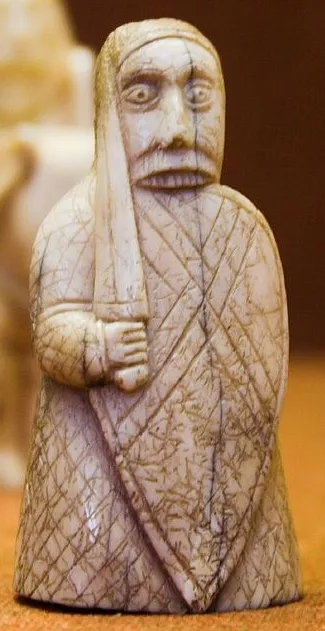 A warrior piece from the Lewis chessmen, often called a berserker, carved in walrus ivory probably in Norway about 1150–1200, British Museum, LondonWikimedia Commons, Rob Roy, CC BY 2.0 (Beserker, Lewis Chessmen, British Museum.jpg)
Sources
- Anne Stalsberg, “Herstellung und Verbreitung der Vlfberht-Schwertklingen. Eine Neubewertung”, Zeitschrift für Archäologie des Mittelalters 36 (2008), pp. 89–118.
- Sverre Bagge, From Viking Stronghold to Christian Kingdom: State Formation in Norway, c. 900–1350 (2010), pp. 72–74.
- R. Ewart Oakeshott, The Archaeology of Weapons: Arms and Armour from Prehistory to the Age of Chivalry (1996).
Prev: Runes and runestonesNext: Harald Fairhair and Hafrsfjord