980–1054
Vladimir and Yaroslav, 980–1054
On his way home from the Danube in 972 Sviatoslav is ambushed and killed by the Pechenegs at the Dnieper rapids. His son Yaropolk of Kiev kills his brother Oleg in 977, and Vladimir, prince of Novgorod, flees over the sea. He comes back with a Varangian army, takes Polotsk and kills its ruler Rogvolod, then takes Kiev, by the Primary Chronicle in 980.
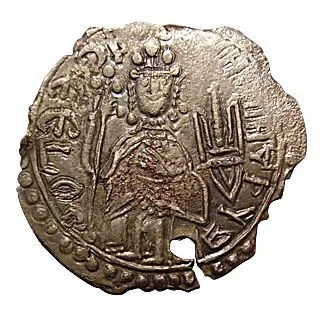 A silver coin of Vladimir showing the prince enthroned beside the trident sign of his house, Odesa Numismatics MuseumWikimedia Commons, Влад Федченко, Public domain (Coin of Vladimir the Great.JPG)
In 987 the generals Bardas Skleros and Bardas Phokas rise against Emperor Basil II, who asks Vladimir for help. Vladimir sends him 6,000 warriors in return for the hand of Basil’s sister Anna and agrees to become a Christian. In 988 he takes the Byzantine town of Chersonesos in the Crimea and is baptised there. The 6,000 help Basil defeat Phokas in 989 and form the core of the Varangian Guard.
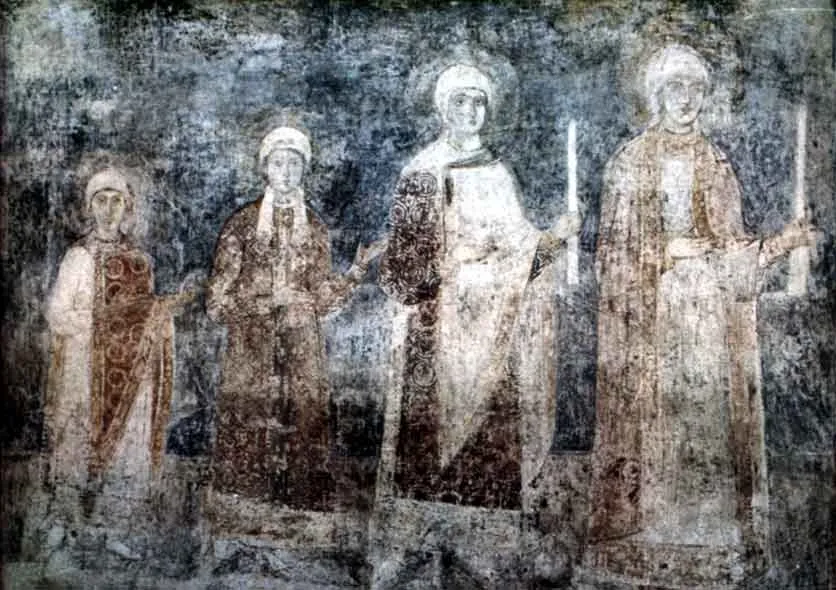 Daughters of Yaroslav, a fresco of the 11th century in St Sophia's Cathedral, KievWikimedia Commons, unknown artist, Public domain (Daughters of Yaroslav the Wise.jpg)
Yaroslav, prince of Novgorod since 1010, refuses tribute to his father in 1014 and brings Varangians from over the sea. After Vladimir’s death in 1015 he fights his half-brother Sviatopolk, who is backed by Bolesław I of Poland, and holds Kiev from 1019. In the same year he marries Ingegerd, daughter of King Olof Skötkonung of Sweden, and gives her Ladoga, which her kinsman Ragnvald Ulfsson rules. His daughters marry Harald Hardrada of Norway, Henry I of France and Andrew I of Hungary.
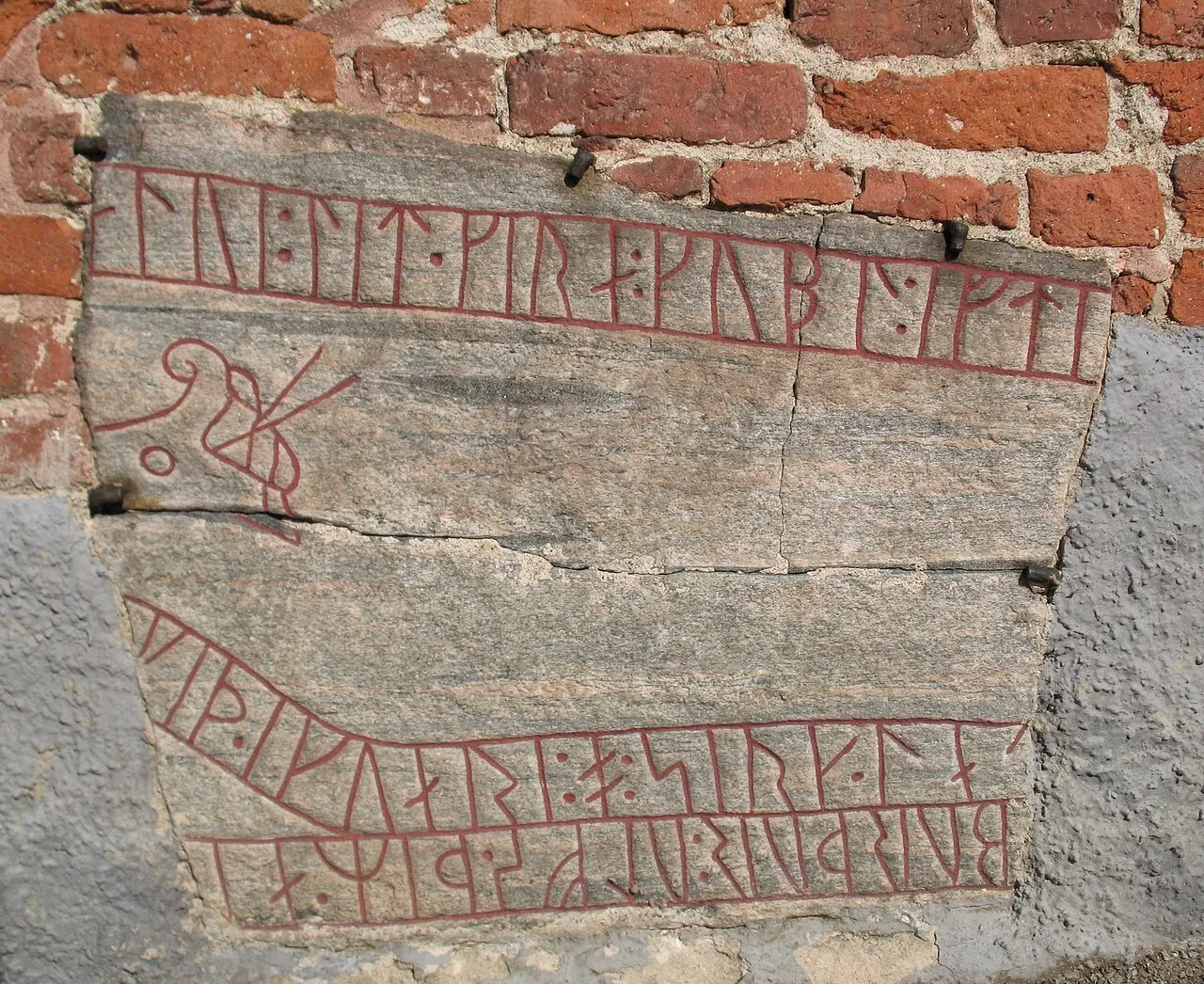 Runestone Sö 281 in the wall of Strängnäs Cathedral, one of the Swedish stones that name Ingvar, 11th century, photographed in 2008Wikimedia Commons, Berig, CC BY-SA 3.0 (Sö 281, Strängnäs.JPG)
Around 1041 the Swede Ingvar leads an expedition east to Serkland, the land of the Saracens. Few of his men return, and 26 runestones in Sweden name men who died with him. In 1043 Yaroslav’s son Vladimir sails against Constantinople, and Michael Psellos, who sees the battle, writes that the Byzantine fleet destroys the Rus' boats with Greek fire, while the Rus' chronicles blame a storm. Yaroslav dies in 1054.
Sources
- The Russian Primary Chronicle: Laurentian Text, translated by Samuel H. Cross and Olgerd P. Sherbowitz-Wetzor (1953), years 6480 to 6562.
- Raffaele D'Amato, The Varangian Guard 988–1453 (2010).
- Michael Psellos, Chronographia, on the Rus' attack of 1043.
Prev: The last battle and the peaceNext: The Faroes and Iceland, c. 800–870