August 1013 – April 1014
Sweyn Forkbeard takes England
In August 1013 Sweyn Forkbeard comes to England with his son Cnut, this time to conquer it. He lands at Sandwich and sails at once round East Anglia, into the Humber and up the Trent to Gainsborough. Northumbria and the Five Boroughs of the north Midlands submit to him, and he forbids plundering until his army has crossed Watling Street into the south.
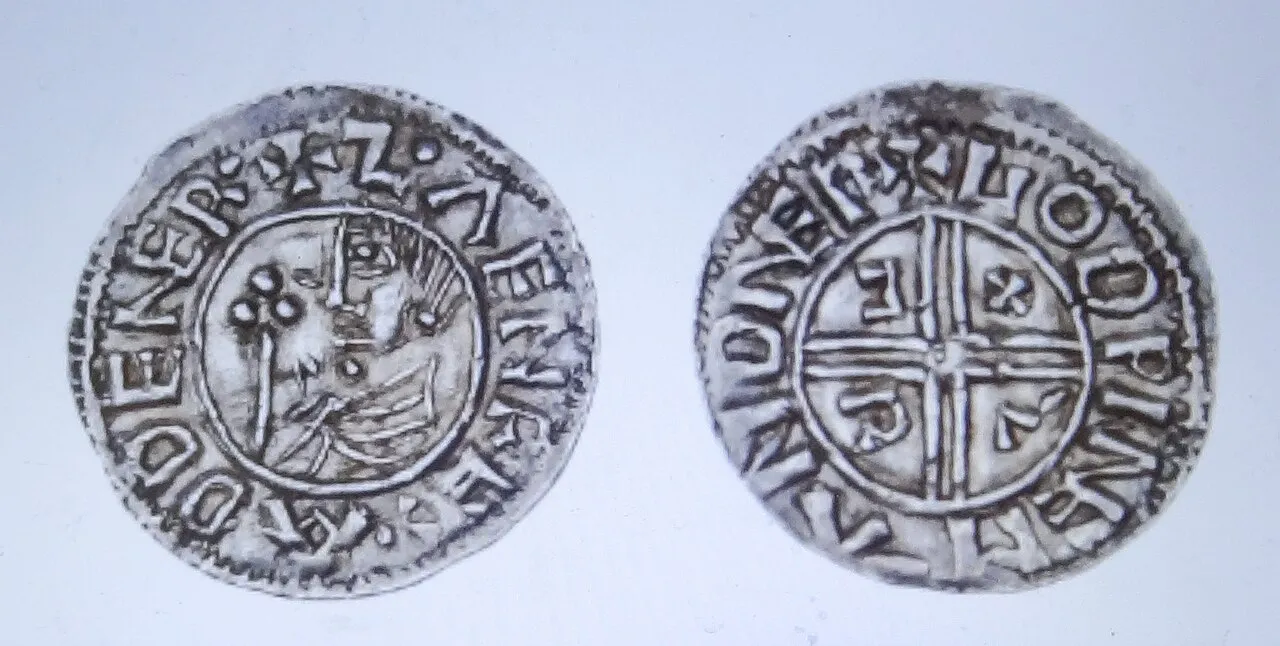 A silver penny of Sweyn Forkbeard of about 995 with the legend SVEN REX AD DENER, the first Danish coin to name its kingWikimedia Commons, Ola Myrin, Public domain (Coin of King Swein Forkbeard.jpg)
Oxford and Winchester surrender, but London, held by Æthelred and Thorkell, beats off Sweyn’s attack with heavy losses. Sweyn turns west to Bath, where the thegns of the south-west submit, and London gives in after them. By December he is accepted as king and demands payment and provisions for his army through the winter.
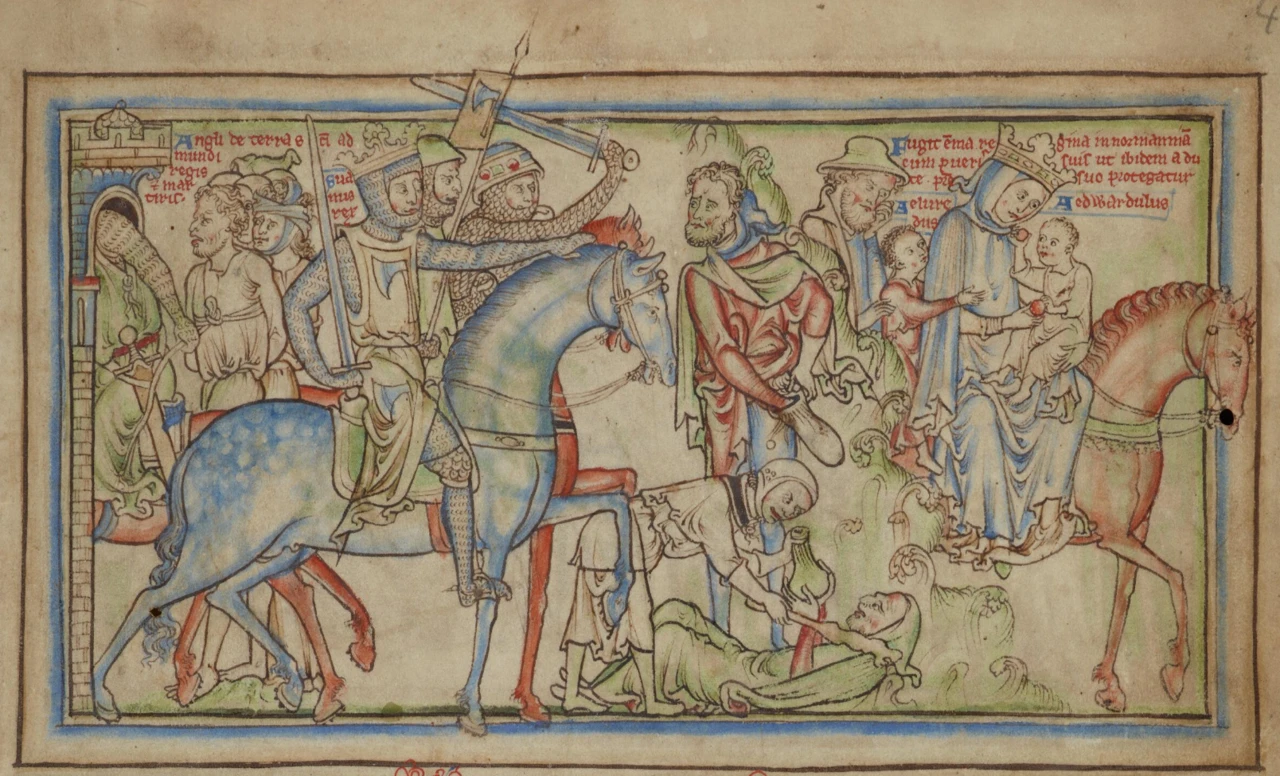 Sweyn conquers England while Queen Emma flees to Normandy with her sons, in Matthew Paris’s Life of St Edward the Confessor, about 1255Wikimedia Commons, Matthew Paris, Public domain (Cambridge, University Library, MS Ee.3.59, fol. 4r.png)
Æthelred sends Queen Emma and their children to her brother, Duke Richard II of Normandy, spends Christmas on the Isle of Wight and follows them. Sweyn dies at Gainsborough on 3 February 1014 and is buried at York. The Danish fleet chooses Cnut as king, but the English councillors send for Æthelred, on condition that he rule more justly than before.
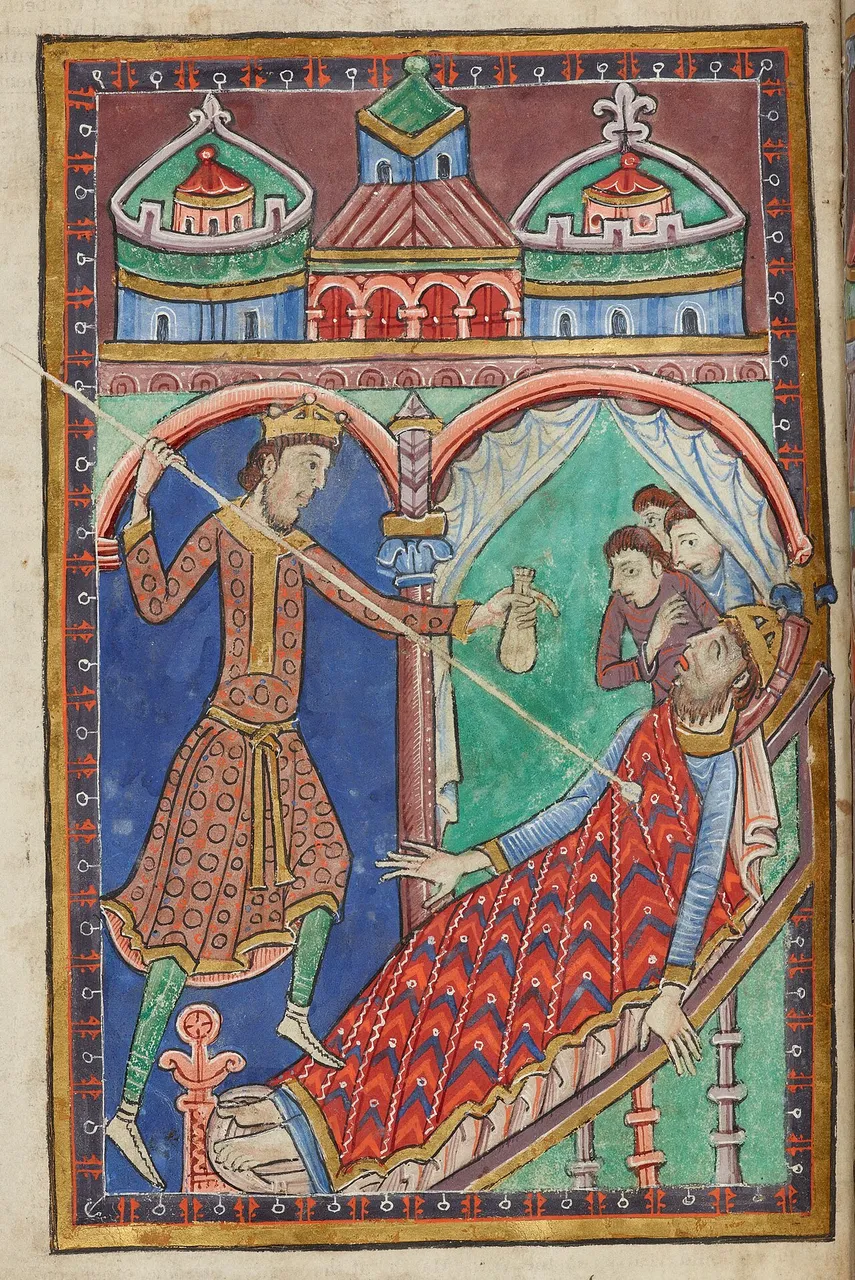 St Edmund kills King Sweyn, a legend told in a copy of Herman the Archdeacon’s Miracles of St Edmund of about 1130Wikimedia Commons, unknown illuminator, Public domain (St Edmund the Martyr killing Sweyn of Denmark.jpg)
Æthelred returns in Lent, and in late April he leads an army north against Cnut in Lindsey. Cnut sails away, and at Sandwich he puts ashore the hostages given to his father with their hands, ears and noses cut off. Thorkell’s fleet at Greenwich is paid 21,000 pounds.
Sources
- Anglo-Saxon Chronicle, versions C, D and E, 1013 and 1014.
- Alistair Campbell (ed.), Encomium Emmae Reginae (1949).
- Ian Howard, Swein Forkbeard’s Invasion and the Danish Conquest of England, 991–1017 (2003).
Prev: St Brice’s Day and Thorkell’s armyNext: Cnut and Edmund Ironside