25 September 1066
Orri’s storm
Late in the battle Eystein Orri, who is betrothed to Harald’s daughter Maria, comes up with the men left at the ships at Riccall, about 26 km to the south. They have run the whole way in full armour, and some are said to collapse and die of exhaustion. Eystein takes up the fallen banner and leads a counter-attack, which Norwegian tradition calls Orri’s storm. It checks the English and almost breaks their line, until Eystein is killed.
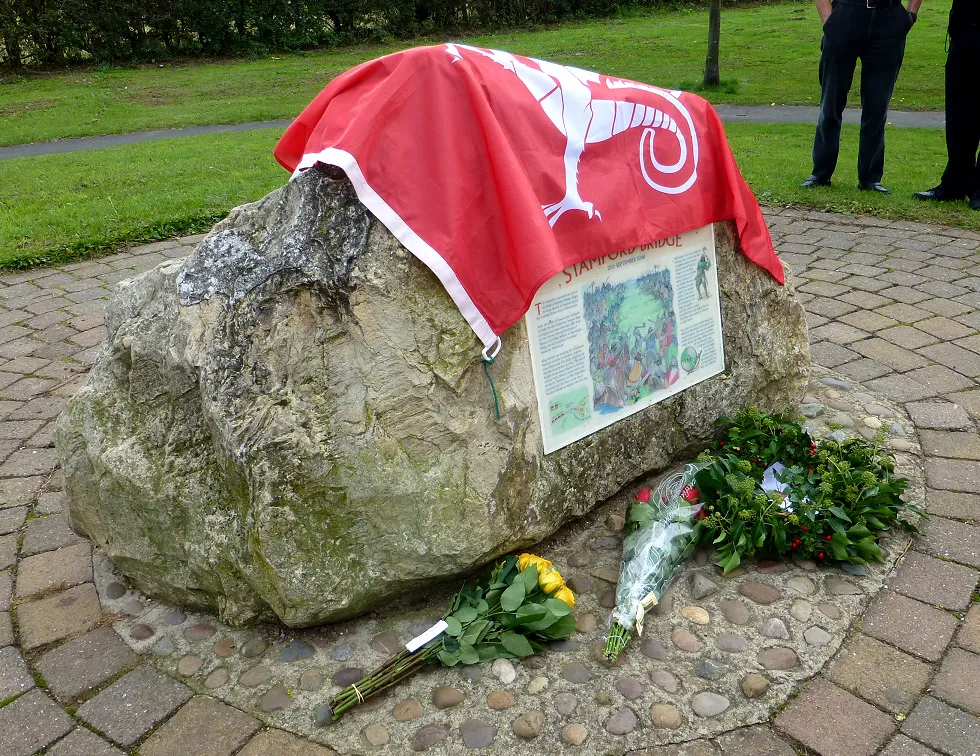 The battlefield memorial at the end of Whiterose Drive, Stamford Bridge, on the anniversary in 2013Wikimedia Commons, Æthelred, CC BY-SA 3.0 (Stamford Bridge Battlefield Memorial.jpg)
The Norwegians break and flee, and the English pursue them. The Anglo-Saxon Chronicle says that some drown as they cross rivers. Harold grants a truce to Harald’s son Olaf and Paul Thorfinnsson, Earl of Orkney, who pledge never to attack England again. Of a fleet of more than 300 ships, 24 carry the survivors to Orkney, where they spend the winter.
Tostig is buried at York Minster. Orderic Vitalis, writing decades later, says that the field can still be recognised by the piles of bones left on it.
Sources
- Michael Swanton (ed. and tr.), The Anglo-Saxon Chronicles (2nd ed. 2000), p. 199.
- Snorri Sturluson, King Harald’s Saga, tr. Magnus Magnusson and Hermann Pálsson (1966).
- Kelly DeVries, The Norwegian Invasion of England in 1066 (1999).
Prev: The shield wallNext: William lands in Sussex