c. 790 – 1100
Jarls, farmers and thralls
The Eddic poem Rígsþula, preserved in the 14th-century Codex Wormianus, tells how the god Ríg fathers three sons, Thræll, Karl and Jarl, the ancestors of the thralls, the free farmers and the nobles. Scholars date the poem anywhere from the 10th to the 13th century. Law codes and graves show the same three ranks, with many grades between them and some movement from one to another.
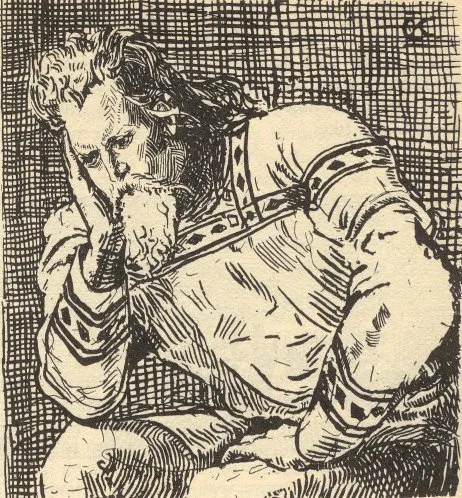 Jarl Haakon Sigurdsson of Lade, a drawing by Christian Krohg of the late 1890sWikimedia Commons, Christian Krohg, Public domain (Håkon jarl.jpg)
Most free men are farmers who own their land, cattle and weapons and work the farm with their household and thralls. Jarls and chieftains hold large estates and keep halls for their followers, and in Norway the jarls of Lade rule Trøndelag and Hålogaland. At Borg in Lofoten a chieftain's house enlarged in the 8th century is 83 m long, the largest Viking Age building found in Norway. At Stöng in Iceland ash from the volcano Hekla buries a farm and its longhouse, probably in the eruption of 1104.
Thralls are born to thrall parents, fall into bondage through debt or crime, or are taken in war, and by some estimates they make up a quarter of the population. A master can free a thrall, and the freed family owes loyalty to its former master for two generations. Dublin, founded in 841, grows into the largest slave market in western Europe by the 11th century, and at Hedeby Archbishop Rimbert of Bremen (died 888) sees a crowd of Christian captives led away. Ibn Rustah, a Persian geographer of the 10th century, writes that the Rus' raid the Slavs and sell the captives at Bulgar on the Volga and in the Khazar lands.
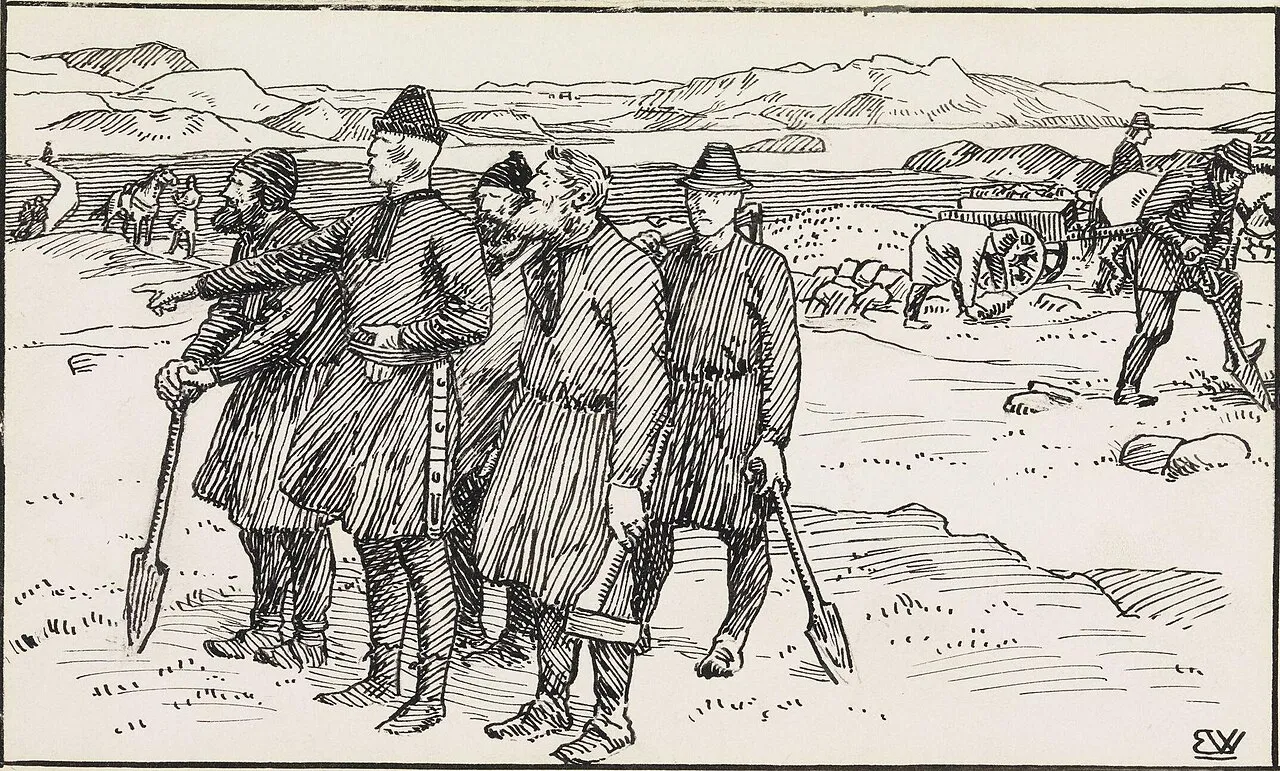 Erling Skjalgsson sets his thralls to day work, a drawing by Erik Werenskiold of 1899 for Snorri Sturluson's Heimskringla, National Museum, OsloWikimedia Commons, Erik Werenskiold, Public domain (Erik Werenskiold - Erling set his Thralls to Daywork - NG.K&H.B.05040 - National Museum of Art, Architecture and Design (cropped).jpg)
A free married woman runs the household as húsfreyja, the lady of the house. By the Icelandic Grágás and the Norwegian Gulating and Frostating laws she can own and inherit property and divorce her husband, and the Hillersjö stone in Uppland, carved between 1060 and 1100, records how Gerlög inherits the estate of her daughter Inga. Grave Bj 581 at Birka holds a woman over 30, buried about 940–950 with a sword, an axe, two spearheads, 25 arrowheads, two horses and a gaming set. A DNA study of 2017 confirms her sex, and scholars dispute whether the weapons mark her as a warrior.
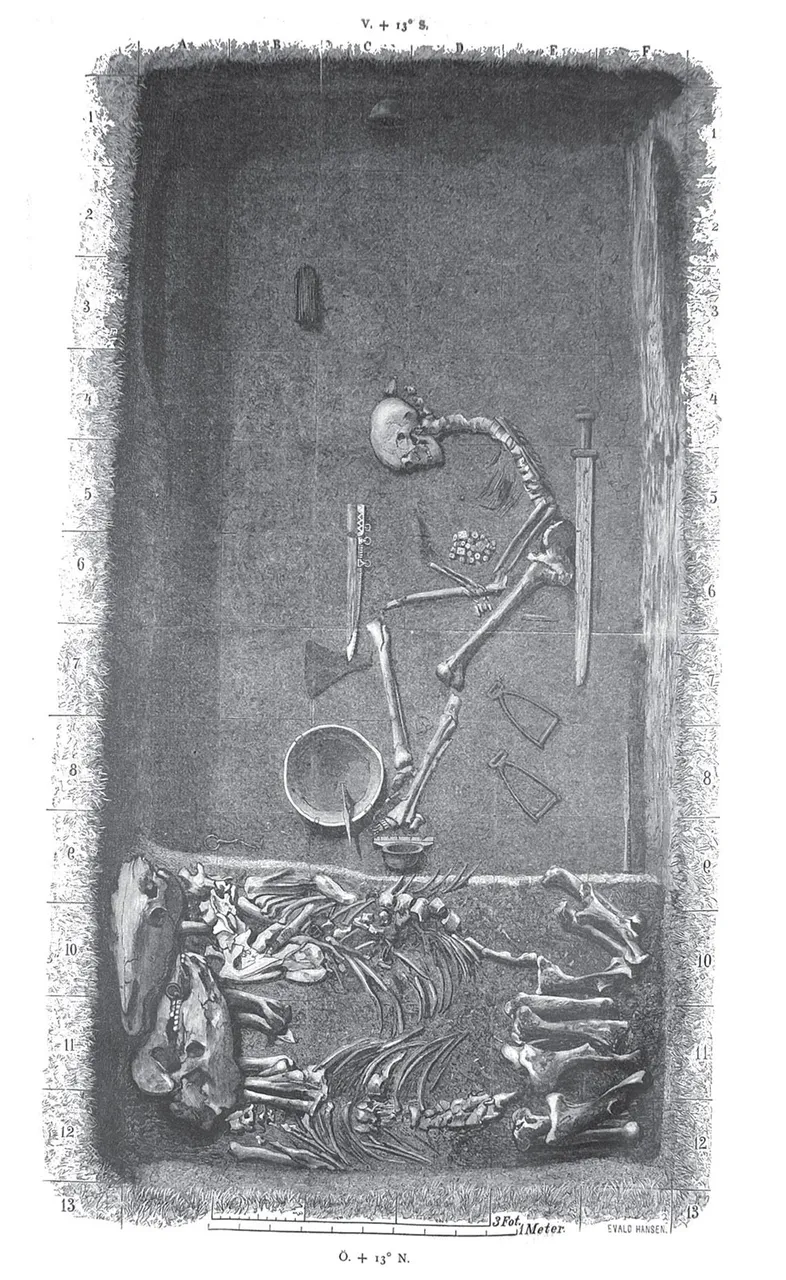 Grave Bj 581 at Birka as Hjalmar Stolpe recorded it, with the sword, the axe, the shield bosses and the two horses, drawn by Evald Hansen and published in 1889Wikimedia Commons, Evald Hansen, Public domain (Birka, Sweden Viking grave Bj 581 by Hjalmar Stolpe in 1889.jpg)
Sources
- Rígsþula, in the Codex Wormianus (AM 242 fol).
- P. H. Sawyer, Kings and Vikings: Scandinavia and Europe AD 700–1100 (2002).
- Charlotte Hedenstierna-Jonson and others, “A female Viking warrior confirmed by genomics”, American Journal of Physical Anthropology 164 (2017), pp. 853–860.
Prev: Vinland, c. 986–1010Next: The thing and the law