862–911
Rurik and Oleg, 862–911
The Primary Chronicle, compiled in Kiev around 1113, tells that in 860–862 the Chuds, Slovenes, Krivichs, Meryans and Ves drive the Varangians back over the sea and refuse them tribute. They soon fall to fighting among themselves and invite the Varangians to rule them. Rurik comes in 862 with his brothers Sineus and Truvor, who settle at Beloozero and Izborsk and die soon after. One version of the chronicle places Rurik first at Ladoga, another at Novgorod, where he rules until his death in 879.
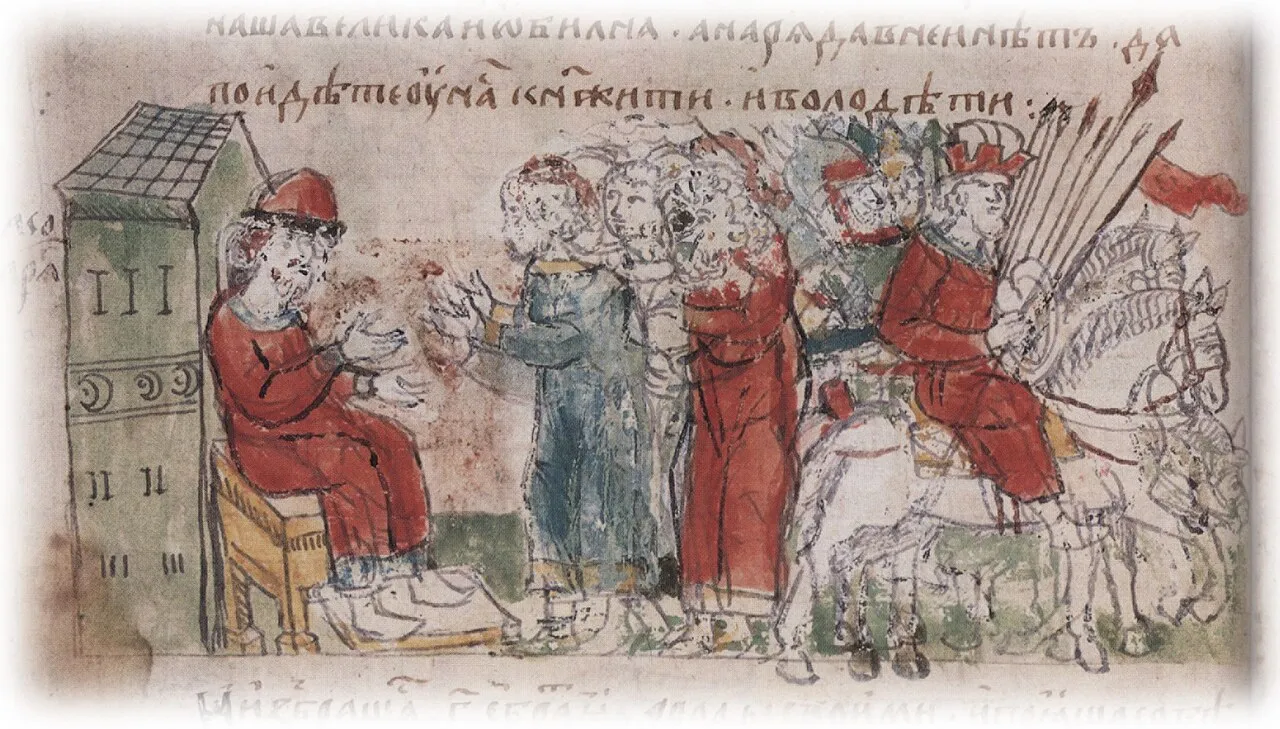 The envoys of the Slavic and Finnic tribes before the Varangians, and the Varangian princes setting out, a miniature of the Radziwiłł Chronicle, late 15th centuryWikimedia Commons, unknown artist, Public domain (Calling of varangians 01.jpg)
Oleg, a kinsman of Rurik, rules for Rurik’s young son Igor. By the chronicle’s account he takes Smolensk and Lyubech in 882 and comes down the Dnieper to Kiev, where two of Rurik’s followers, Askold and Dir, rule. He hides his warriors in the boats, lures the two out and kills them, and makes Kiev his seat. The city lies on the route from the Varangians to the Greeks, which runs from the Baltic up the Volkhov and the Lovat, over portages to the Dnieper and down its rapids to the Black Sea and Constantinople.
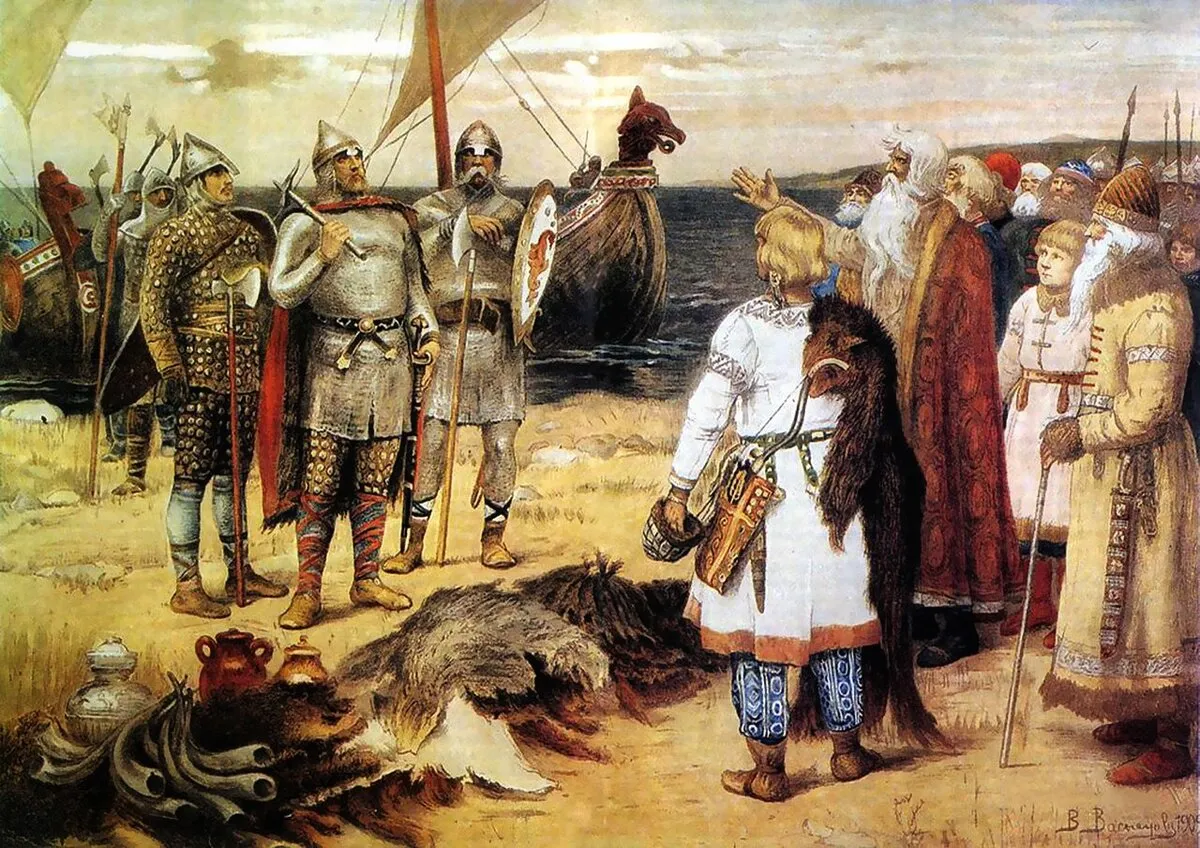 Rurik and his brothers land among the Slavs, a painting by Viktor Vasnetsov, early 20th centuryWikimedia Commons, Viktor Vasnetsov, Public domain (Prizvanievaryagov.jpg)
Under 907 the chronicle tells of Oleg sailing against Constantinople with 2,000 boats. The Byzantines close the Golden Horn with chains, so he puts his boats on wheels and moves them overland to the walls, and the emperor pays 12 grivnas for each boat. No Byzantine source mentions the campaign, and some historians date it to 904.
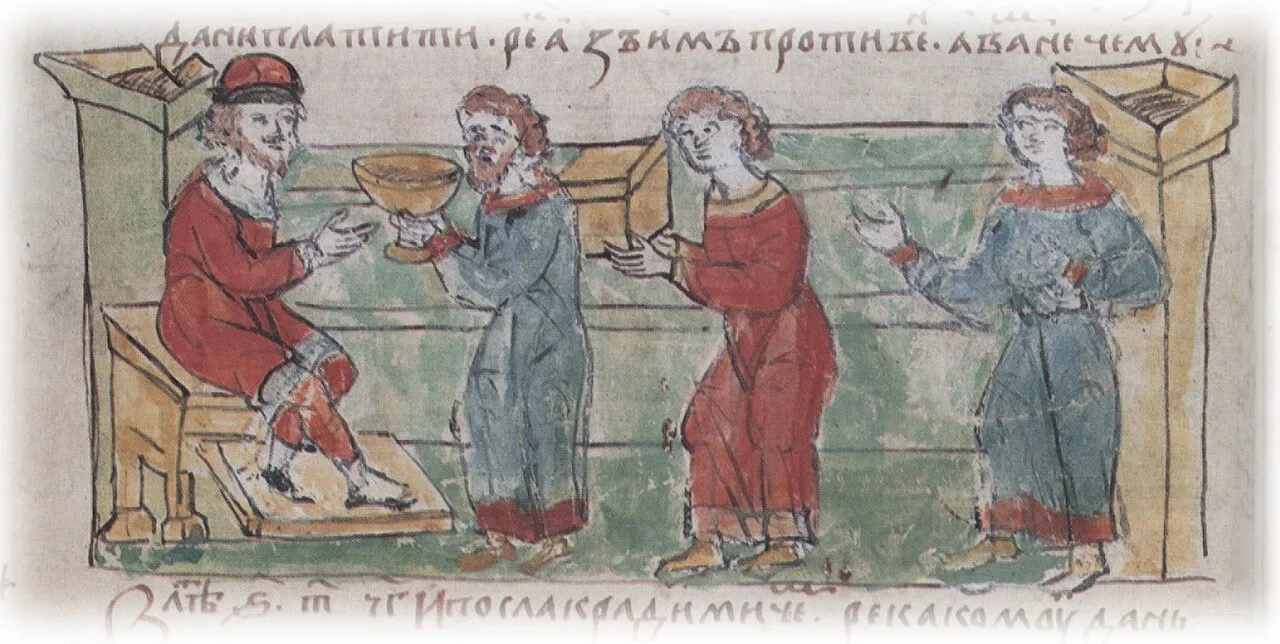 Subject peoples bring tribute to Oleg, a miniature of the Radziwiłł Chronicle, late 15th centuryWikimedia Commons, unknown artist, Public domain (Приношение князю Олегу дани покоренными народами.jpg)
The chronicle also preserves the text of a treaty of 911 with Emperor Leo VI, whose Rus' envoys all bear Norse names, among them Karli, Ingjaldr and Farulfr. The agreement of 907 before it sets rules for Rus' merchants, who lodge in the quarter of St Mamas and enter Constantinople unarmed, no more than 50 at a time. Oleg dies in 912, and the chronicle tells that a snake crawls out of the skull of his dead horse and bites him.
Sources
- The Russian Primary Chronicle: Laurentian Text, translated by Samuel H. Cross and Olgerd P. Sherbowitz-Wetzor (1953), years 6368 to 6420.
- Simon Franklin and Jonathan Shepard, The Emergence of Rus 750–1200 (1996).
- Władysław Duczko, Viking Rus: Studies on the Presence of Scandinavians in Eastern Europe (2004).
Prev: The Rus' at Constantinople, 860Next: The Volga route, 913–943