c. 800 – 1150
Runes and runestones
By the late 8th century the runic alphabet has shrunk from 24 signs to 16, the younger futhark, written in a long-branch Danish form and a short-twig Swedish and Norwegian form. About 3,000 runestones survive from the Viking Age, some 2,700 of them in Sweden and more than a thousand in Uppland alone, against about 250 in Denmark and 50 in Norway. Most are memorials to the dead raised by their kin, and the custom ends around 1100.
The Rök stone in Östergötland, carved in the early 9th century, carries the longest runic inscription in stone, about 760 characters. Varinn raises it for his dead son Vámóðr, and parts of the text are in cipher, name Theodoric the Great and allude to myths now lost. At Jelling King Gorm raises a stone for his wife Thyra, and their son Harald Bluetooth raises a larger one with a figure of Christ, saying that he won all Denmark and Norway and made the Danes Christian.
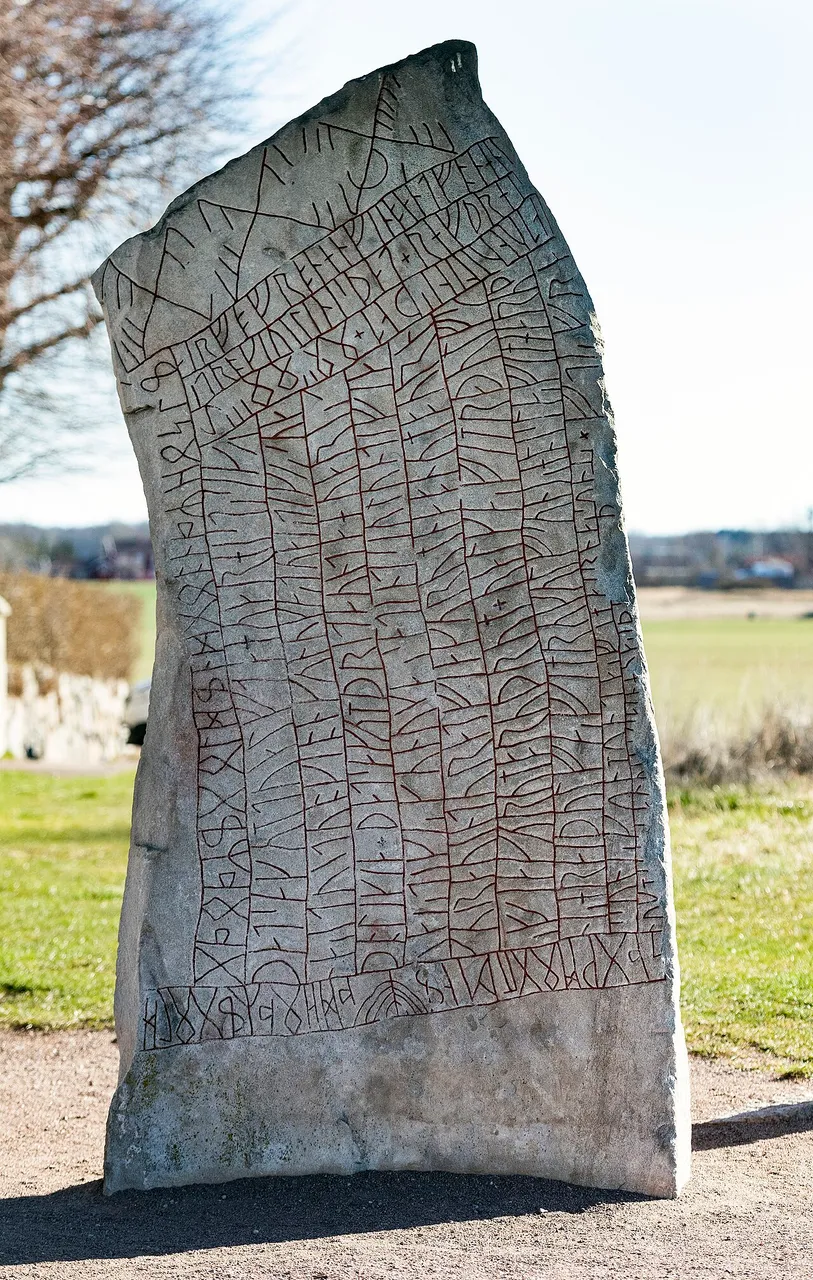 The Rök stone beside the church at Rök in Östergötland, carved in the early 9th century, photographed in 2020Wikimedia Commons, Arkland, CC BY-SA 4.0 (Rökstenen Ög 2020 3.jpg)
Most Swedish stones date from the 11th century, and in Uppland about 70 per cent carry crosses or Christian prayers. About 30 remember men who went to “Greece”, the Byzantine Empire, many of them in the Varangian Guard, and about 26 remember men of Ingvar's expedition to Serkland in 1036–1041. At Gripsholm Tóla raises a stone for her son Haraldr, Ingvar's brother, who “travelled manfully far for gold” and died in Serkland, and at Ed a former captain of the Guard, Ragnvaldr, has runes cut in a boulder.
Norse travellers leave runes far from home. In a gallery of Hagia Sophia in Constantinople someone carves a name of which “-ftan”, Halfdan, can still be read, and in the second half of the 11th century Scandinavians cut two long inscriptions in serpent bands on the marble lion of Piraeus, which the Venetians carry off to Venice in 1687. In the 12th century Norsemen break into the Neolithic tomb of Maeshowe in Orkney and carve more than 30 inscriptions on its walls, the largest group of runic inscriptions in one place.
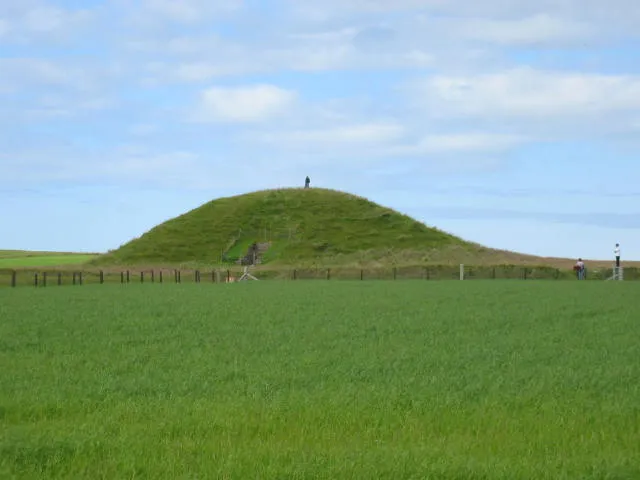 The mound of Maeshowe in Orkney, a Neolithic tomb whose chamber Norsemen covered with runes in the 12th centuryWikimedia Commons, unknown author, Public domain (MaesHowe.jpg)
Sources
- Per Holmberg, Bo Gräslund, Olof Sundqvist and Henrik Williams, “The Rök Runestone and the End of the World”, Futhark 9–10 (2020), pp. 7–38.
- Sigfús Blöndal and Benedikt S. Benedikz, The Varangians of Byzantium (2007).
- Elisabeth Svärdström, “Runorna i Hagia Sofia”, Fornvännen 65 (1970), pp. 247–249.
Prev: Silver and tradeNext: Weapons and the shield wall