July 885 – October 886
Sigfrid’s fleet on the Seine, 885–886
In the summer of 885 Danish bands gather at Rouen under Sigfrid and Sinric. Sigfrid asks Charles the Fat, emperor and king of West Francia since 884, for a payment and is refused. The fleet rows up the Seine past the fortified bridge at Pont-de-l’Arche and reaches Paris on 24 November. Abbo, a monk of Saint-Germain-des-Prés who lives through the siege inside the city, writes of 700 ships and 30,000 to 40,000 men. Modern historians put the fleet at about 300 ships.
 Count Odo defends Paris against the Northmen, a painting by Jean-Victor Schnetz of 1834 to 1836 for the Galerie des Batailles at VersaillesWikimedia Commons, Jean-Victor Schnetz, Public domain (Siege of Paris (885–886).jpeg)
Paris is the walled Île de la Cité. Under the Edict of Pîtres of 864 a bridge has been built to each bank, the Grand Pont to the right bank and the Petit Pont to the left, each guarded by a tower at its bank end, and the two bridges close the river to ships. Odo, Count of Paris, and Gozlin, Bishop of Paris, hold the city with about 200 men-at-arms by Abbo’s count. Sigfrid asks Gozlin to let the fleet pass upriver in return for sparing the city, and Gozlin refuses.
The siege lasts through the winter. In February 886 Henry of Franconia comes with an army from East Francia, makes one attack and withdraws. In April Sigfrid takes 60 pounds of silver and leaves with his men, and the other leaders keep up the siege. Gozlin dies on 16 April as disease spreads in the city. Odo slips out to seek help from the emperor and fights his way back in, and Henry of Franconia is killed in the Danish ditches before the city on 28 August.
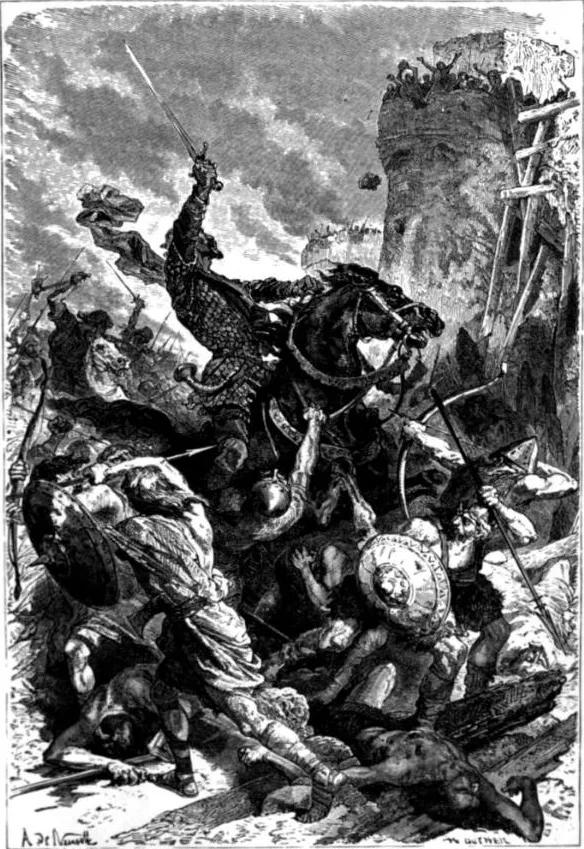 Odo fights his way back into Paris through the besiegers, an engraving by Alphonse de Neuville for François Guizot’s History of France, 1883Wikimedia Commons, Alphonse de Neuville, Public domain (EudesParis.jpg)
Charles the Fat arrives with the imperial army in October 886 and camps at Montmartre. He negotiates: he promises the Danes 700 pounds of silver, paid in the spring of 887, and lets them winter in Burgundy, which is in revolt against him. The Parisians refuse them passage under the bridges, so they haul their ships overland to the Marne, sail up the Seine and the Yonne and besiege Sens. After Charles’s death in 888 the West Frankish nobles elect Odo king.
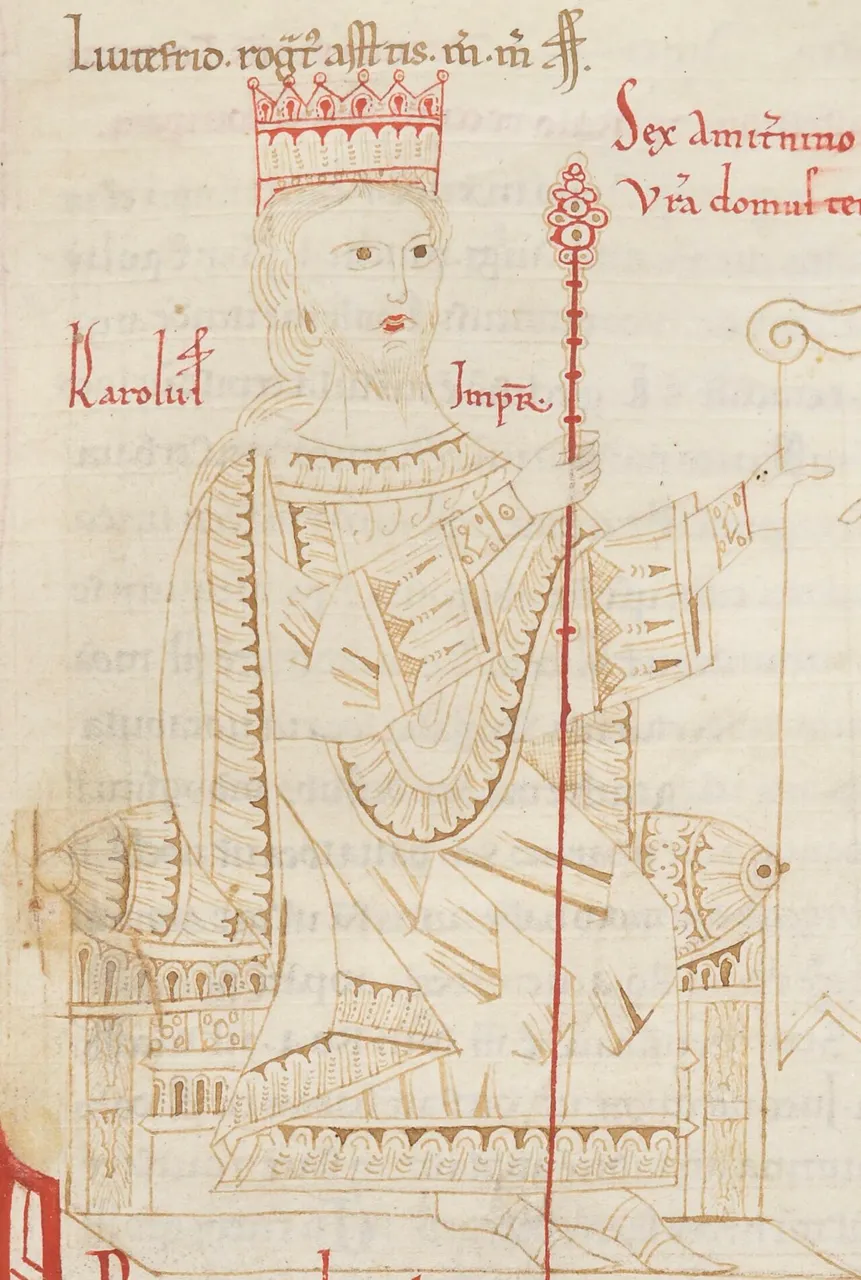 The emperor Charles the Fat on his throne, a drawing in a manuscript of the 12th century, Bibliothèque nationale de France, Latin 5411Wikimedia Commons, Johannes Berardi, Public domain (Emperor Charles III the Fat.jpg)
Sources
- Abbo of Saint-Germain-des-Prés, Bella Parisiacae urbis, book 1.
- Simon MacLean, Kingship and Politics in the Late Ninth Century: Charles the Fat and the end of the Carolingian Empire (2003).
- Si Sheppard, The Viking Siege of Paris: Longships raid the Seine, AD 885–86 (2022).
Prev: The Great Army in Francia, 879–884Next: The assault on the tower, November 885