845
Paris and Hamburg, 845
In March 845 a fleet of 120 ships with more than 5,000 men enters the Seine under a chieftain whom the Frankish sources call Reginherus, or Ragnar, tentatively identified with the legendary Ragnar Lodbrok. Charles the Bald had granted him land at Turholt in Flanders around 841, and he had lost it again. On the way upriver the fleet raids Rouen.
Charles the Bald divides his smaller army between the two banks to protect the royal abbey of Saint-Denis. The Vikings defeat one division and hang 111 prisoners on an island in the Seine, and the rest of the army withdraws. On Easter Sunday, 29 March, the Vikings enter Paris and plunder it.
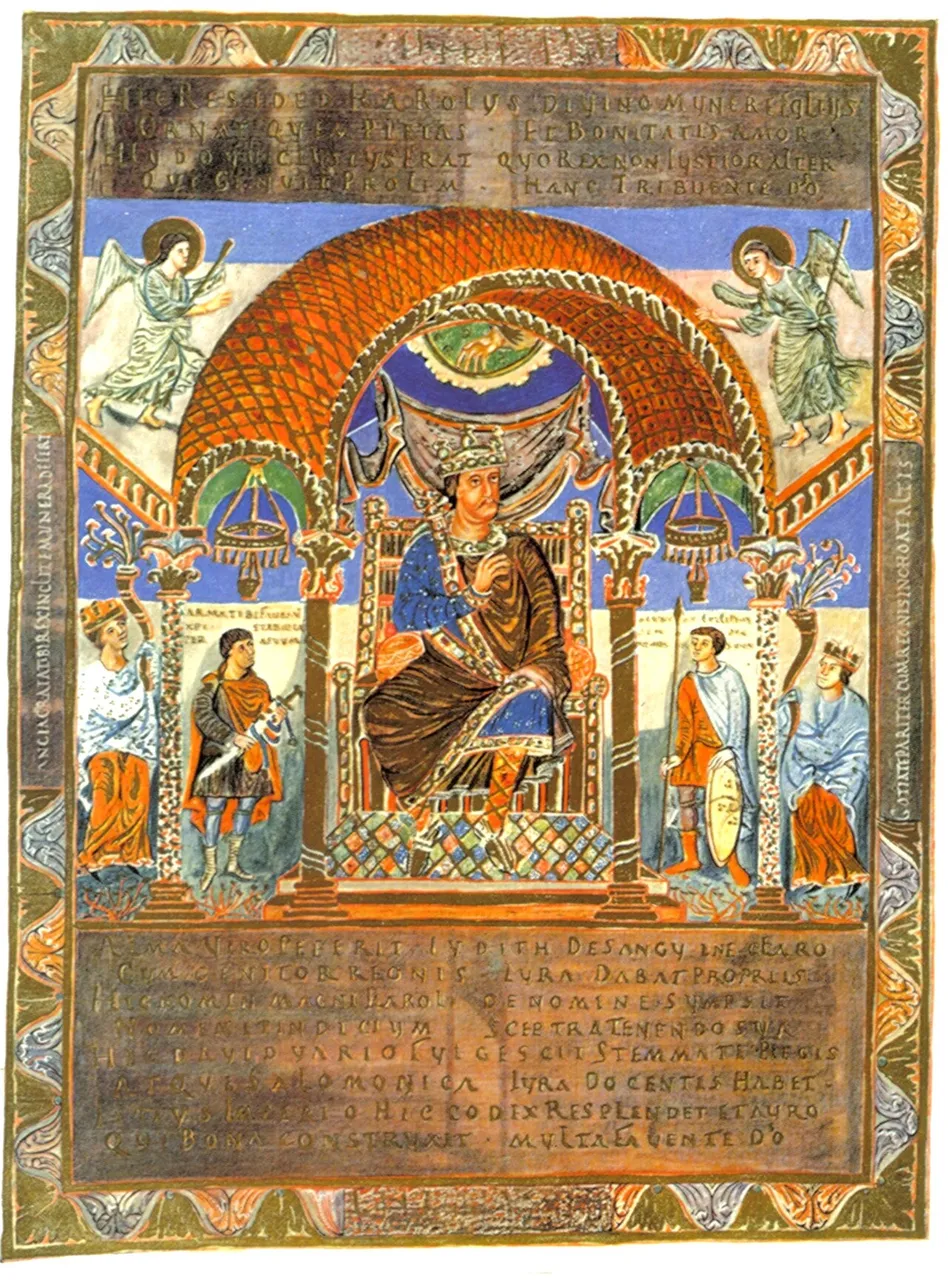 Charles the Bald enthroned, a miniature of the Codex Aureus of St. Emmeram made at Reims about 870, Bavarian State Library, MunichWikimedia Commons, unknown artist, Public domain (Karl II der Kahle.jpg)
Plague breaks out in their camp. Charles pays them 7,000 pounds of silver and gold, about 2,570 kg, the first of 13 such payments by the Franks. The fleet withdraws and plunders the abbey of Saint-Bertin and other places on the coast on the way home.
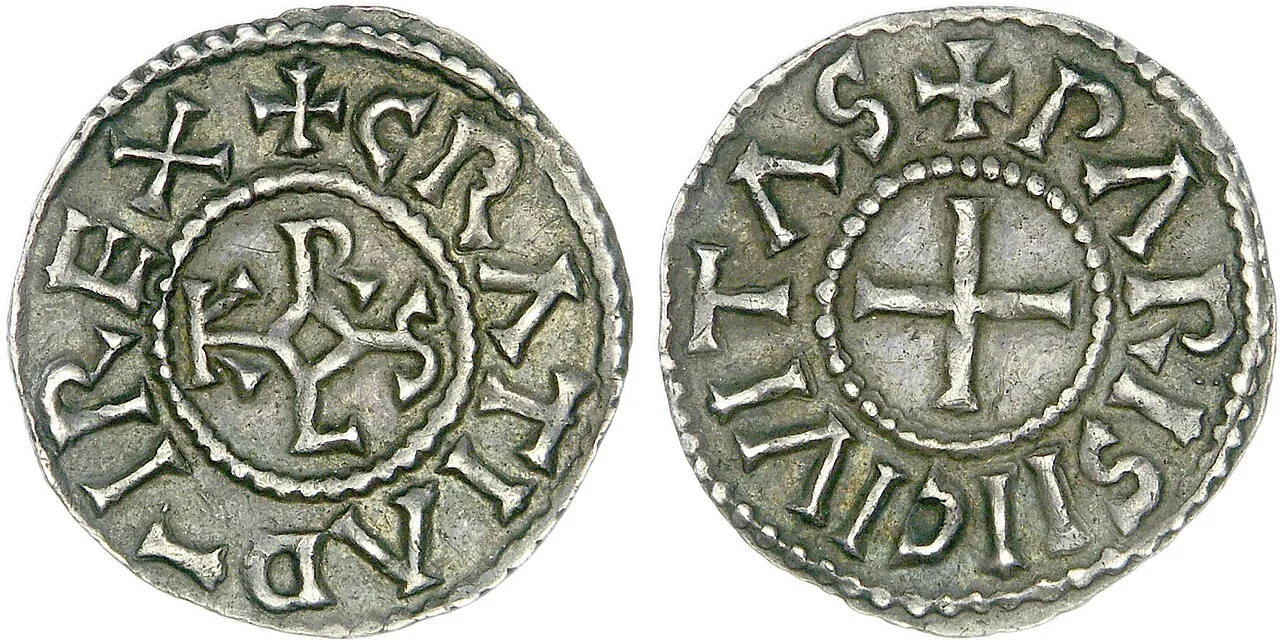 Silver denier of Charles the Bald struck at Paris, with his monogram and the legend PARISII CIVITASWikimedia Commons, cgb.fr, CC BY-SA 3.0 (Denier de Charles II le Chauve.jpg)
In the same year King Horik’s Danes sail up the Elbe and burn Hamburg, a town of about 500 people and since 831 the seat of Ansgar’s archbishopric, destroying the church with its treasures and books. Louis the German sends Count Cobbo to Horik, who agrees to peace and promises to return the captives and the treasure.
Sources
- Annals of St Bertin, year 845.
- Eric J. Goldberg, Struggle for Empire: Kingship and Conflict under Louis the German, 817–876 (2006).
- Peter Sawyer (ed.), The Oxford Illustrated History of the Vikings (2001).
Prev: Nantes and Seville, 843–844Next: Björn and Hastein in the Mediterranean, 859–861