995–1000
Olaf Tryggvason and Svolder
Olaf Tryggvason is the son of Tryggvi Olafsson, a king in Viken, and by the sagas a great-grandson of Harald Fairhair. The sagas, written from the 1190s on, have him grow up at the court of Vladimir in Rus’ and raid round the Baltic and the British Isles. English sources name him as a leader of the fleet at Maldon in 991, and in 994 he and Sweyn Forkbeard attack London without success and raid the south-east until they are paid 16,000 pounds. Olaf is confirmed with King Æthelred as his sponsor and promises never to come back to England as an enemy.
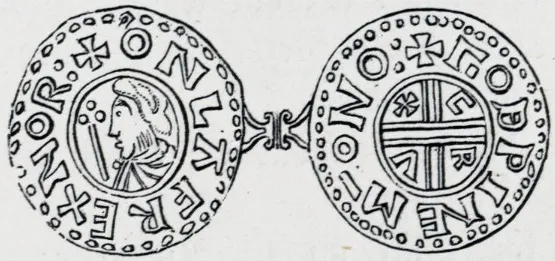 A silver penny of Olaf Tryggvason with the legend ONLAF REX NOR, drawn by Ole Andreas ØverlandWikimedia Commons, Ole Andreas Øverland, Public domain (Olav Tryggvasson mynt.jpg)
In 995 Olaf is in Norway, where the people of Trøndelag have risen against Haakon Jarl. By the sagas’ account Haakon hides in a pigsty at the farm of Rimul and is killed there by his slave Kark. Olaf is hailed as king and converts the country to Christianity by force, and in 997 he founds his seat at Nidaros, the later Trondheim.
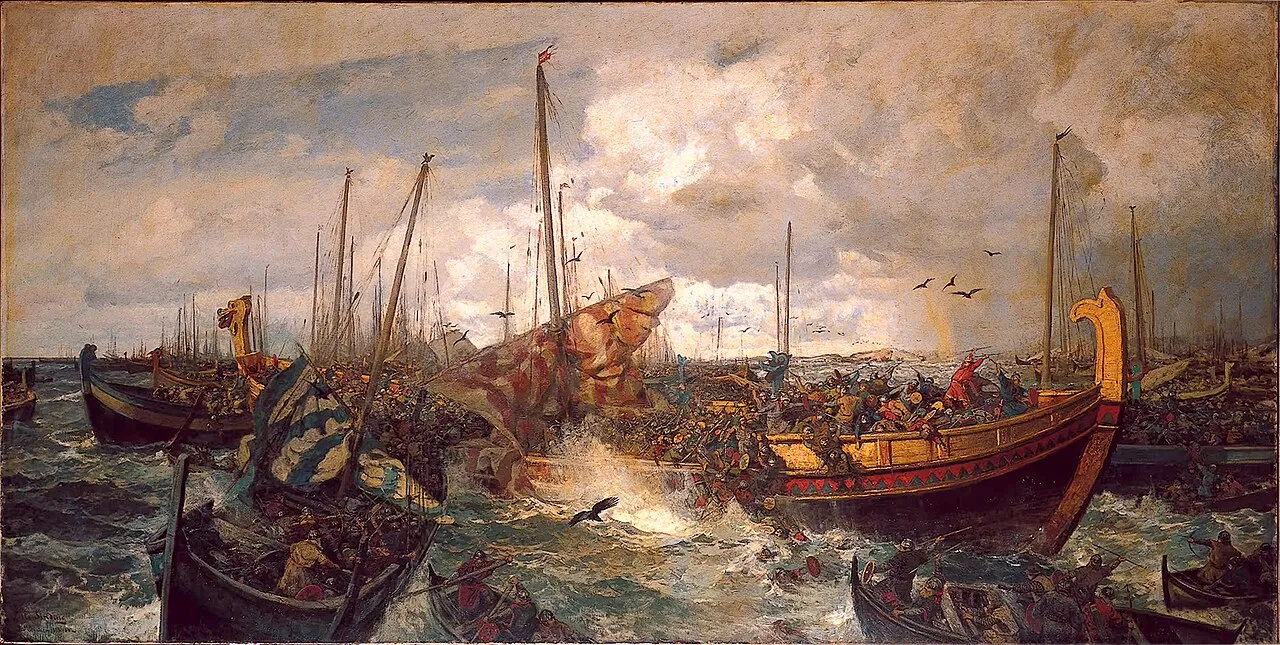 The Battle of Svolder, painting by Otto Sinding, 1883 to 1884Wikimedia Commons, Otto Sinding, Public domain (Svolder, by Otto Sinding.jpg)
In September 1000 Olaf is ambushed at sea by Sweyn Forkbeard, Olof Skötkonung of Sweden and Eirik Hákonarson, Haakon’s son. The sagas give Olaf 11 ships against more than 70. His ships are taken one by one, the Long Serpent last, and Olaf leaps overboard. Adam of Bremen, writing about 1070, puts the battle in the Øresund, and the Icelandic sagas by an island called Svolder off the coast of Wendland, which some historians place near Rügen.
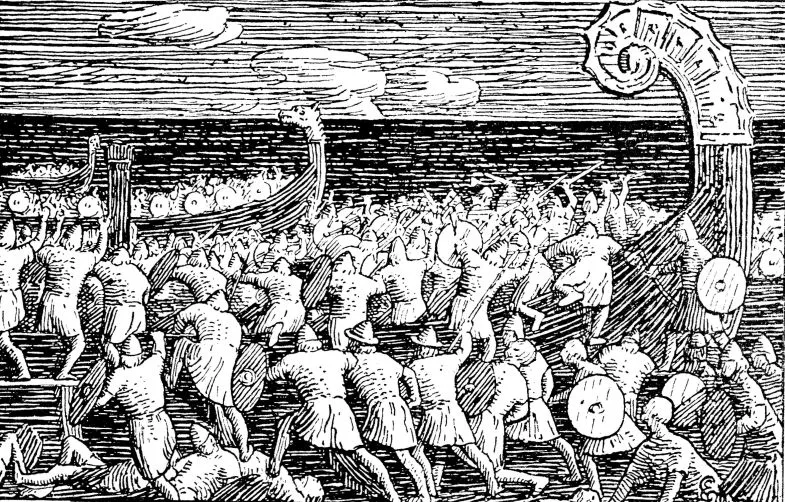 Eirik’s men board the Long Serpent, Halfdan Egedius’s illustration for the 1899 edition of Snorri’s sagas of the kingsWikimedia Commons, Halfdan Egedius, Public domain (Olav Tryggvasons saga - Eriks menn entrer Ormen lange - Halfdan Egedius.jpg)
After the battle Eirik and his brother Sveinn Hákonarson rule Norway as jarls under the Danish and Swedish kings. Rumours that Olaf reached the shore and lived on abroad persist for decades, and Oddr Snorrason records sightings of him as late as 1046.
Sources
- Adam of Bremen, History of the Archbishops of Hamburg-Bremen (1076).
- Oddr Snorrason, Saga of Olaf Tryggvason (about 1190).
- Snorri Sturluson, Heimskringla, Saga of Olaf Tryggvason.
Prev: Gorm and Harald BluetoothNext: Olaf Haraldsson