8th – 11th centuries
Ships and sails
Scandinavian ships are built clinker-fashion, of overlapping planks, from about 300 AD, and for centuries they are rowed. The Nydam ship, built in Denmark about 400, has no sail. Ships under sail appear on the picture stones of Gotland in the 8th century, and from then on the sail carries the ships of the North across the open sea.
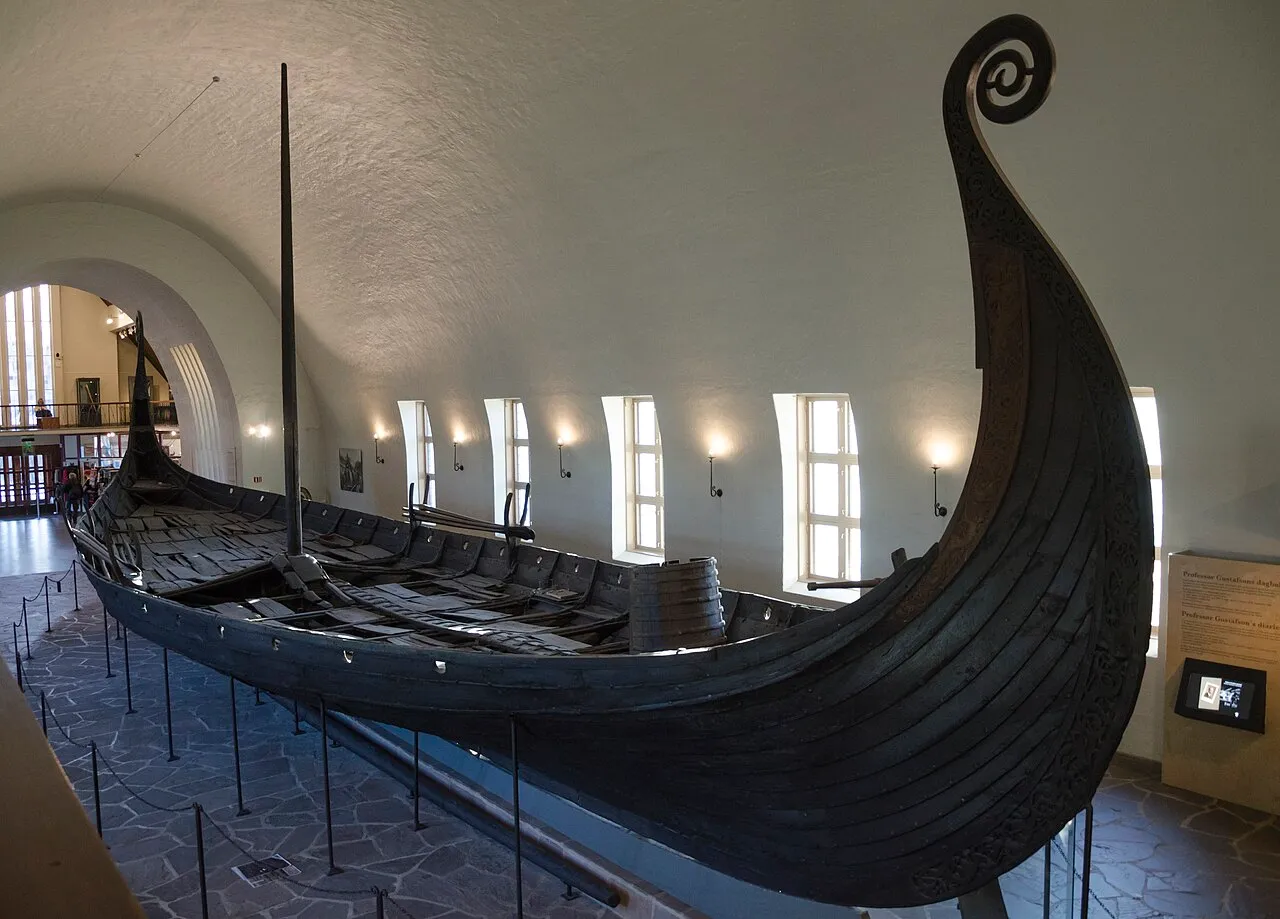 The Oseberg ship, buried in 834, in the Viking Ship Museum at Bygdøy, OsloWikimedia Commons, Petter Ulleland, CC BY-SA 4.0 (Osebergskipet 2016.jpg)
The Oseberg ship, buried in a mound near Tønsberg in the autumn of 834 together with two women, is 21.58 m long and 5.10 m wide. It has 15 pairs of oar holes for 30 rowers and a sail of about 90 m², and a modern replica reaches 10 knots. The Gokstad ship, built of timber felled about 890, buried in a mound at Sandefjord about 900 and dug out in 1880, is 23.80 m long, with 32 oars and a sail of about 110 m² that could drive it at more than 12 knots.
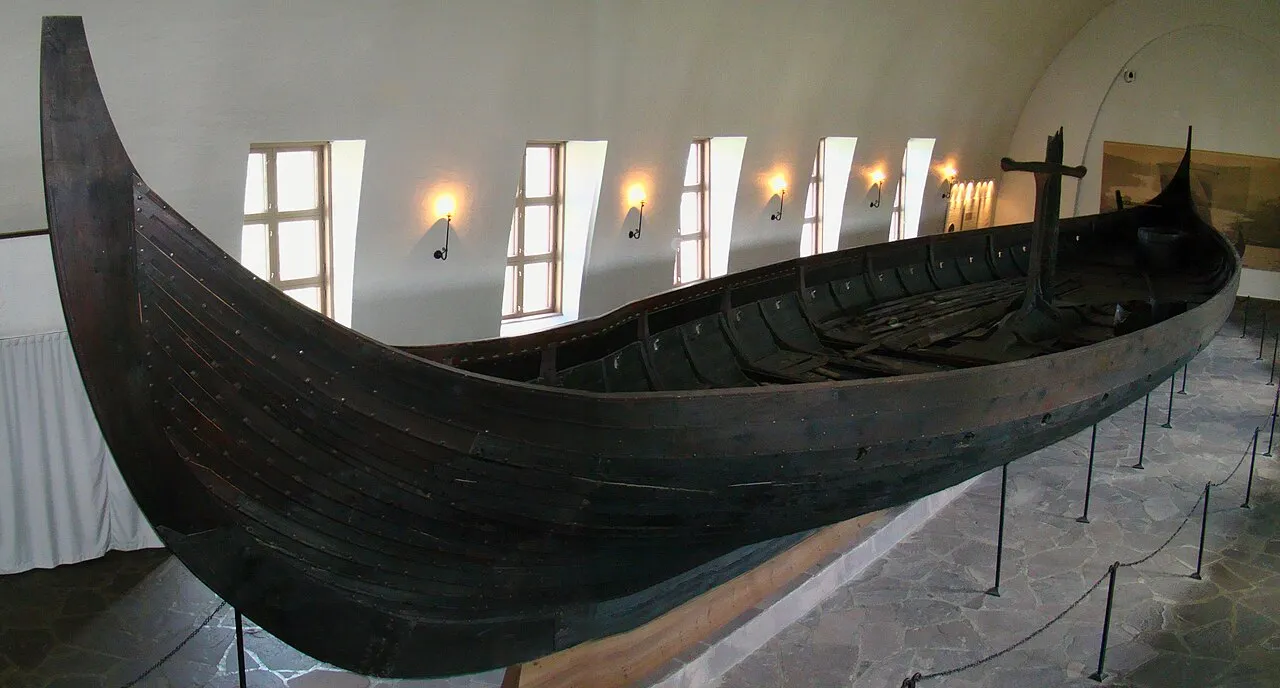 The Gokstad ship, 23.80 m long, in the Viking Ship Museum at Bygdøy, OsloWikimedia Commons, Bjørn Christian Tørrissen, CC BY-SA 3.0 (Gokstad Ship Side View.JPG)
Five ships sunk in the 11th century to block a channel of Roskilde Fjord are raised near Skuldelev between 1957 and 1962. Skuldelev 2 is a warship about 30 m long, built near Dublin about 1042 for 70 to 80 men, and under sail it could reach about 15 knots. Skuldelev 1 is a seagoing cargo ship 16 m long, built in western Norway about 1030, which a crew of six to eight could sail at up to 13 knots, and the 14 m Skuldelev 3 carries 4 to 5 tons in Danish waters.
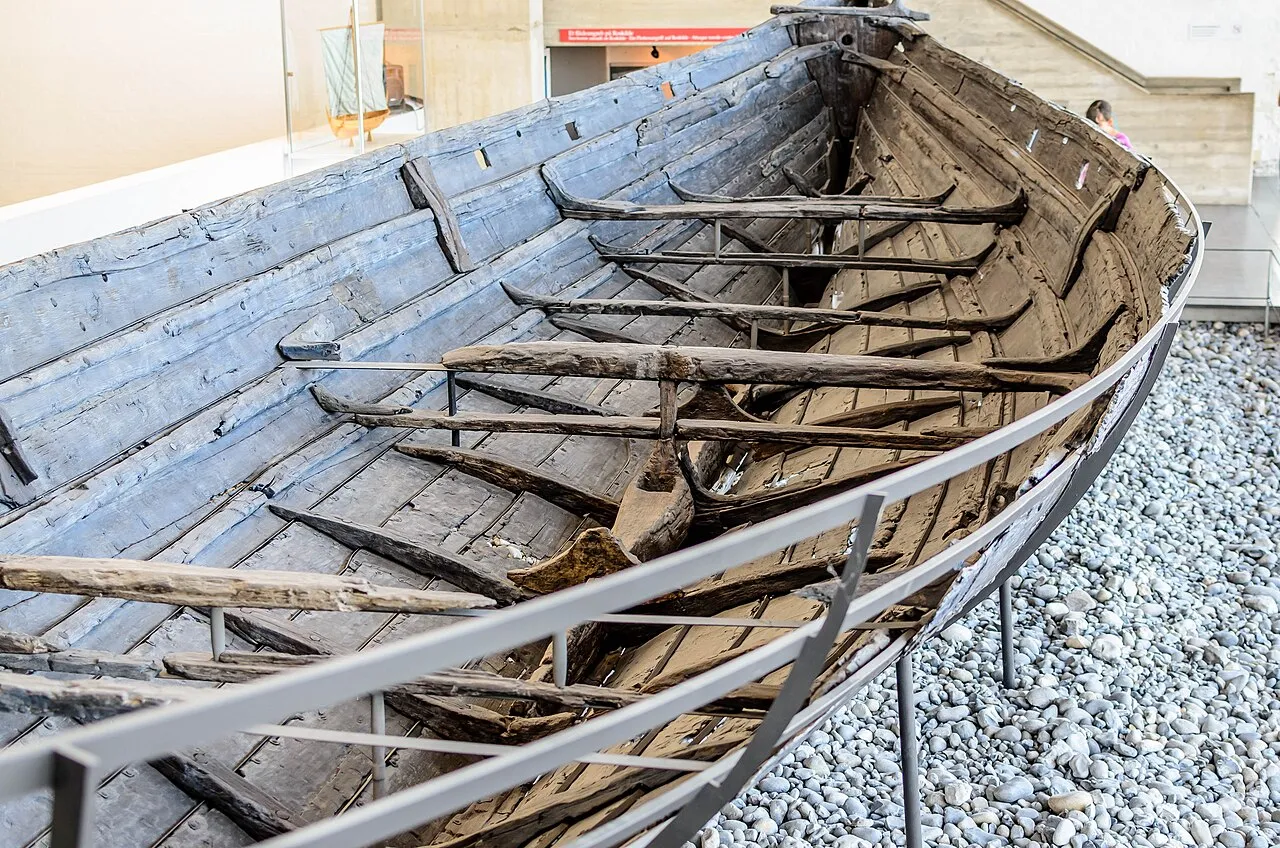 Skuldelev 3, a small cargo ship of about 1040, in the Viking Ship Museum at RoskildeWikimedia Commons, Bradley Rentz, CC BY-SA 4.0 (Skuldelev Viking ship at Vikingeskibsmuseet Roskilde, Denmark.jpg)
The longship is long and narrow, built for speed and for a large crew of warriors who row it and sail it. Its draught of about 1 m lets it land on beaches and go far up rivers, and it is light enough to be dragged over portages. The knarr is shorter, wider and deeper, relies on its sail with a few oars, and carries cargo, sheep and horses across the North Atlantic to Iceland and Greenland.
Sources
- A. W. Brøgger and Haakon Shetelig, The Viking Ships: Their Ancestry and Evolution (1951).
- Niels Bonde and Arne Emil Christensen, "Dendrochronological dating of the Viking Age ship burials at Oseberg, Gokstad and Tune, Norway", Antiquity (1993).
- Olaf Olsen and Ole Crumlin-Pedersen, Five Viking Ships from Roskilde Fjord (1978).
Prev: Scandinavia around 790Next: Lindisfarne, 793