c. 936–986
Gorm and Harald Bluetooth
Gorm the Old first appears in 936, when he receives Archbishop Unni of Hamburg-Bremen. He rules from Jelling in Jutland, perhaps over Jutland alone, and raises the smaller of the two Jelling stones in memory of his wife Thyra. The burial chamber in the northern mound at Jelling is built of timber felled in 958, and Gorm probably dies in the winter of 958 to 959.
Gorm’s son Harald Bluetooth raises the larger stone around 965 in memory of his parents. Its runes say that Harald won all of Denmark and Norway for himself and made the Danes Christian, and one face carries an image of the crucified Christ. Widukind of Corvey, writing in Harald’s lifetime, tells that a cleric named Poppa converted the king by carrying a heavy weight of heated iron without being burned. Harald moves his father’s body from the mound into a church beside it.
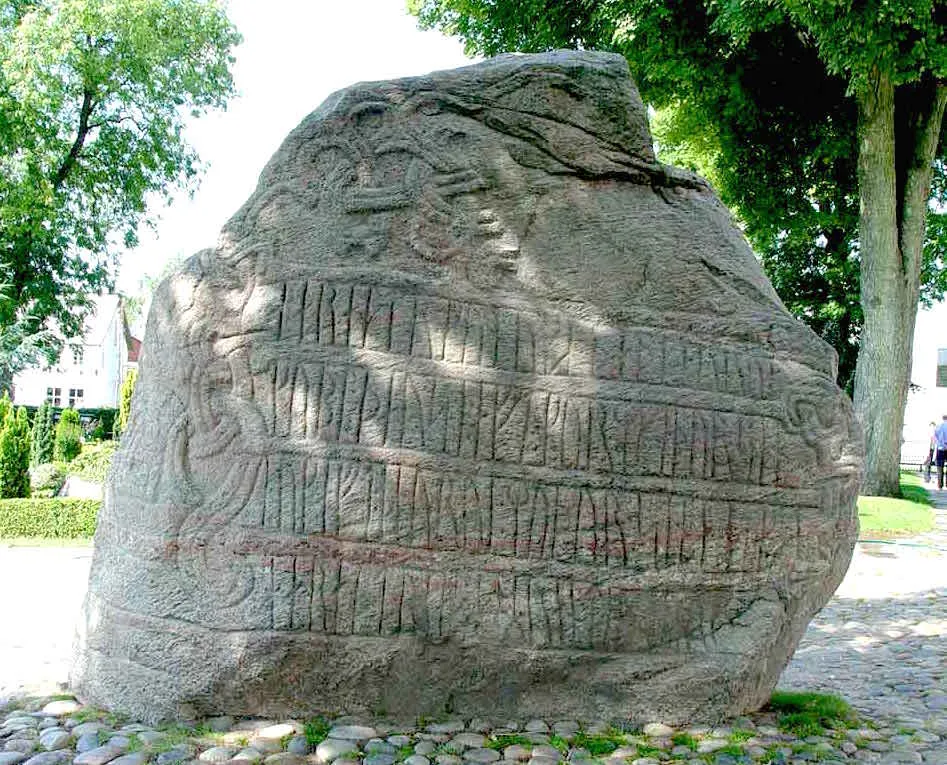 The runic side of the larger Jelling stone, raised by Harald Bluetooth around 965Wikimedia Commons, Jürgen Howaldt, CC BY-SA 2.0 de (Runenstein Blauzahn 2.jpg)
Harald strengthens the Danevirke, the rampart across the neck of Jutland, with a connecting wall built between 964 and 968. After the death of Emperor Otto I he attacks Saxony in 973, and Otto II strikes back in 974 and takes Hedeby and the Danevirke, which Harald regains in 983. Between about 970 and 980 Harald builds the ring fortresses of Aggersborg, Fyrkat, Nonnebakken, Trelleborg and Borgring, each a circular rampart with four gates and its houses laid out on one plan. The timber for Trelleborg was felled in the autumn of 980.
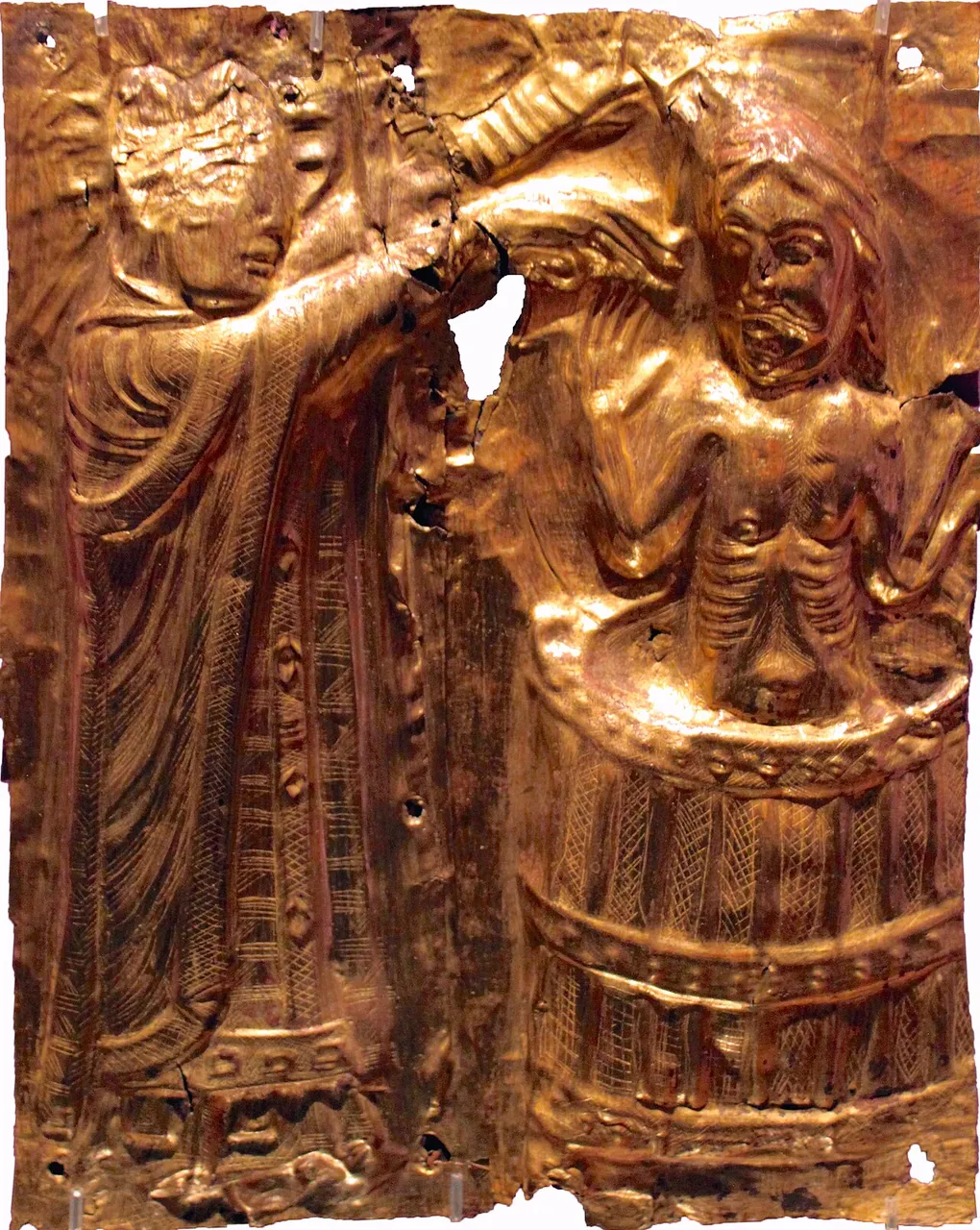 Harald Bluetooth baptised by the missionary Poppo, a gilded copper plaque from the altar of Tamdrup church, about 1200Wikimedia Commons, Anagoria, CC BY 3.0 (1200 Harald Blåtand anagoria.jpg)
In Norway Haakon Sigurdsson, jarl of Lade, rules from about 975 as Harald’s vassal but breaks with him, and by the sagas’ account he defeats a Danish fleet of Jomsvikings at Hjörungavágr, traditionally in 986. At about the same time Harald’s son Sweyn Forkbeard rebels and drives him out of Denmark. Adam of Bremen, writing a century later, says that Harald dies of his wounds at Jumne, the Jomsborg of the sagas, and is buried at Roskilde.
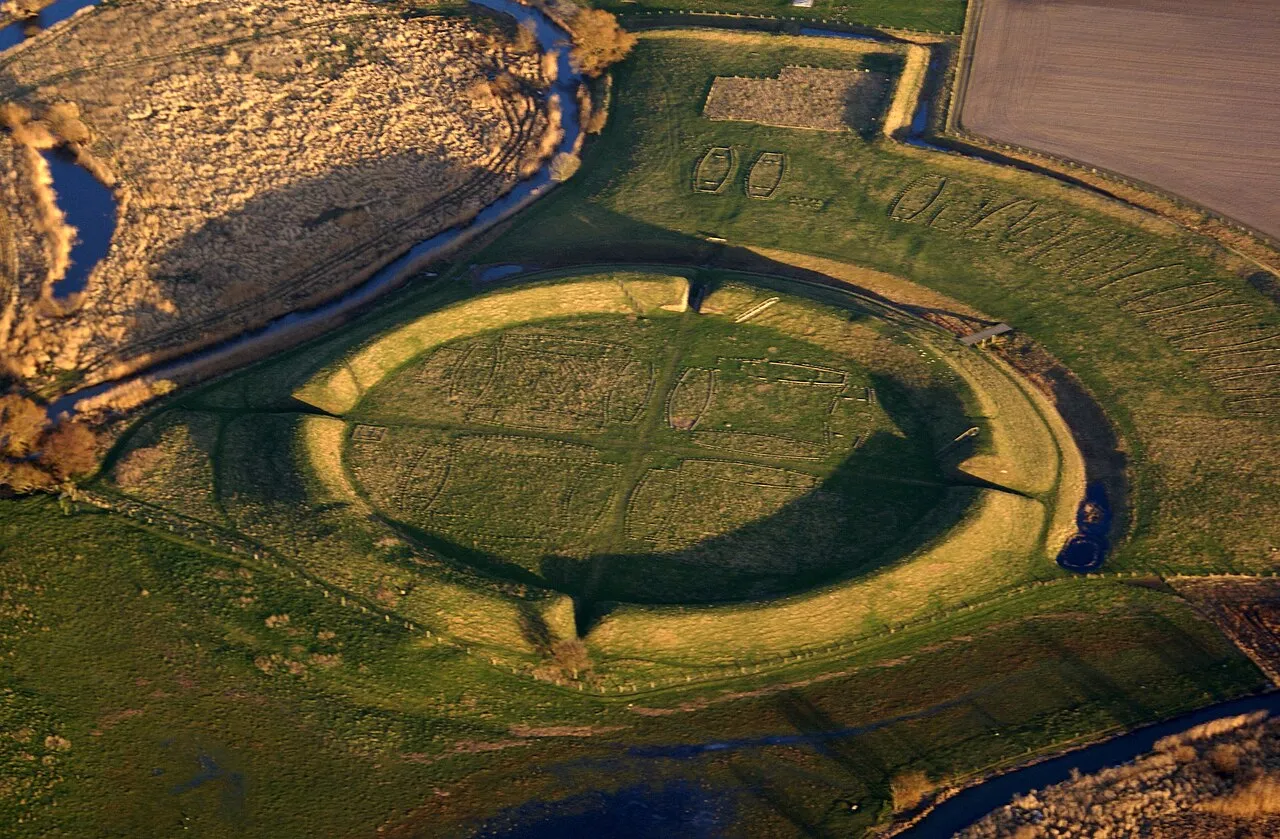 The ring fortress of Trelleborg near Slagelse from the air, with the outlines of its longhouses marked in the grassWikimedia Commons, Thue C. Leibrandt, CC BY-SA 3.0 (Trelleborg airphoto.JPG)
Sources
- The Jelling stones, runic inscriptions of King Gorm and King Harald.
- Widukind of Corvey, Deeds of the Saxons.
- Adam of Bremen, History of the Archbishops of Hamburg-Bremen (1076).
Prev: Harald Fairhair and HafrsfjordNext: Olaf Tryggvason and Svolder