914–919
The return to Dublin, 914–919
After 902 the Uí Ímair stay active around the Irish Sea. In 914 a large Viking fleet comes to Waterford Harbour, and the same year Ragnall, a grandson of Ímar, defeats a rival fleet under Bárid son of Oitir off the Isle of Man. In 917 Ragnall and his kinsman Sitric Cáech bring separate fleets to Ireland, Ragnall to Waterford and Sitric to Cenn Fuait on the border of Leinster, perhaps Confey near Leixlip.
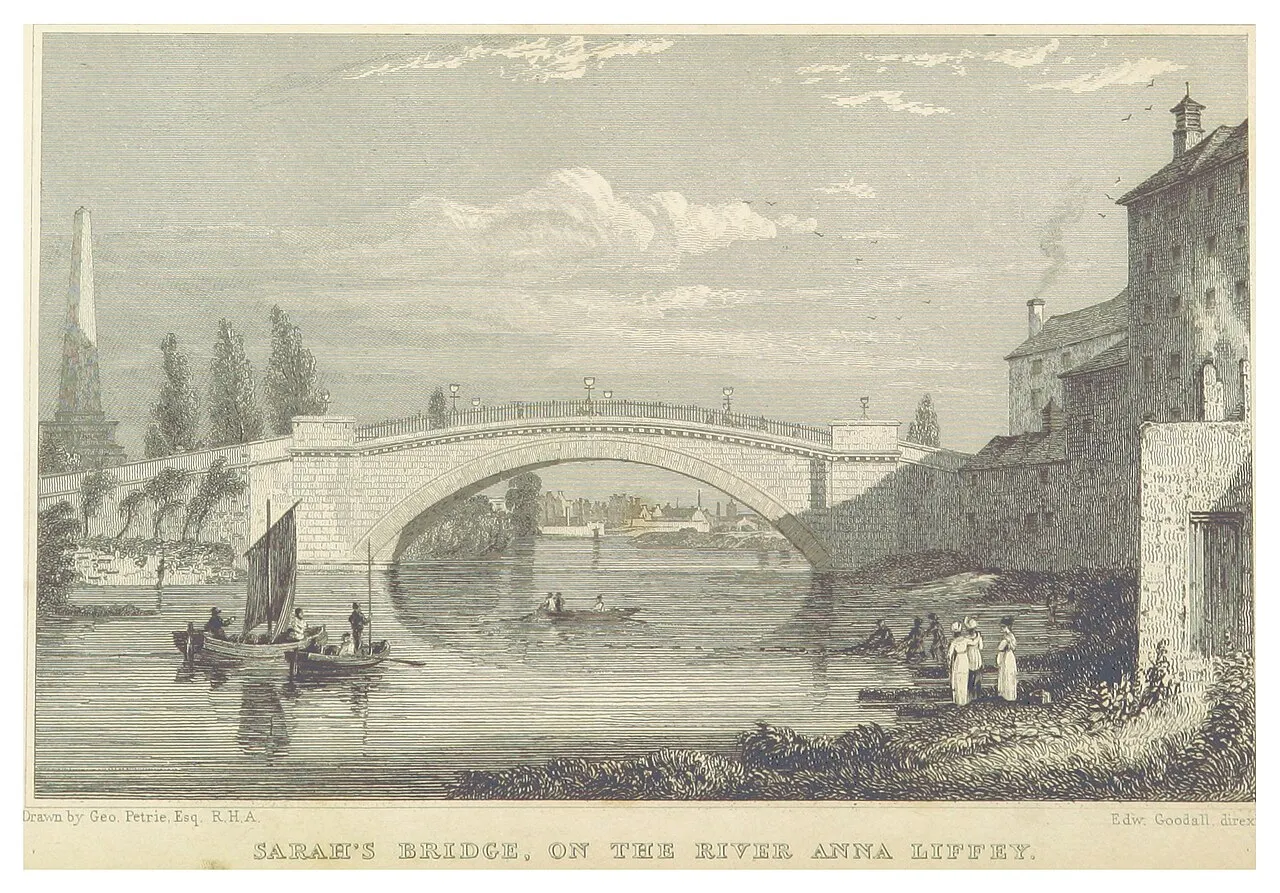 Sarah’s Bridge over the Liffey at Islandbridge, west of Dublin, drawn by George Petrie for a book on Dublin of 1837Wikimedia Commons, George Petrie, Public domain (DUBLIN(1837) p131 SARAH'S BRIDGE, ON THE RIVER ANNA LIFFEY.jpg)
Niall Glúndub, king of the northern Uí Néill and high king of Ireland, marches into Munster against them. On 22 August 917 his army fights the Vikings at Mag Femen near Clonmel from mid-morning until evening, when Ragnall comes up with more men. Niall asks the Leinstermen to besiege the Viking camp, and Sitric routs them at Cenn Fuait, where Augaire, king of Leinster, falls with about 500 men. Sitric then enters Dublin, and the Vikings hold the town again after fifteen years.
Ragnall leaves Ireland in 918 and becomes king at York. On 14 September 919 Niall Glúndub leads a coalition of Irish kings against Dublin, and Sitric meets them at Islandbridge, west of the town. The Vikings win, and Niall falls with five other kings, among them Áed mac Eochocáin, king of Ulster, and Conchobar, king of Meath.
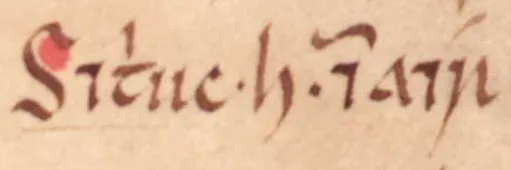 The name Sitriuc ua Ímair, Sitric grandson of Ímar, in a 16th-century copy of the Annals of Ulster, Bodleian Library MS Rawlinson B 489Wikimedia Commons, unknown scribe, Public domain (Sitriuc ua Ímair (Oxford Bodleian Library MS Rawlinson B 489, folio 29r).jpg)
In 920 Sitric leaves Dublin for York, where he follows Ragnall as king in 921, and their kinsman Gofraid takes over Dublin. Between 914 and 922 the Norse settle at Waterford, Cork, Wexford and Limerick as well as Dublin, and these places become the first large towns in Ireland.
Sources
- Annals of Ulster, entries for 914 to 921.
- Clare Downham, Viking Kings of Britain and Ireland: The Dynasty of Ívarr to A.D. 1014 (2007).
- Seán Duffy (ed.), Medieval Ireland: An Encyclopedia (2005).
Prev: Orkney and the Isles, c. 870–1014Next: Brian Boru and Glenmama, 968–1002