941–957
Igor, Olga and the Greek fire, 941–957
In 941 Igor, prince of Kiev, sails against Constantinople while the Byzantine fleet is away fighting the Arabs and the army guards the eastern frontier. Liudprand of Cremona gives him more than 1,000 ships. Emperor Romanos I has 15 old ships fitted with Greek fire, and when the Rus' surround them, the fire is shot through tubes onto their boats. Liudprand writes that the Rus' jump overboard, preferring water to fire, and sink under the weight of their armour.
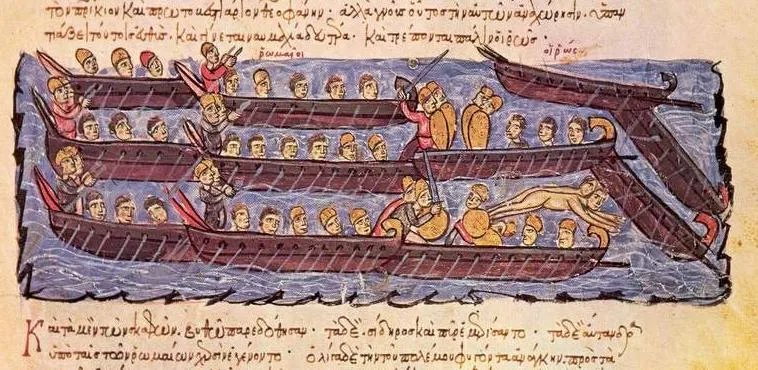 The Byzantine fleet drives off the Rus' attack of 941, a miniature of the Madrid Skylitzes, 12th centuryWikimedia Commons, unknown artist, Public domain (Byzantines repel the Russian attack of 941.jpg)
The rest of the fleet lands in Bithynia and plunder the country as far as Nicomedia. When the generals John Kourkouas and Bardas Phokas return in September, the Rus' move their fleet to Thrace, where the Byzantine fleet under Theophanes falls on it as it turns for home, and Greek sources say that only a few boats reach the Crimea. In 944 Igor sets out again and on the Danube accepts the tribute the Byzantines offer. The treaty of 944–945 lists 76 Rus' names, most of them Norse, and some of the envoys swear by their gods and others as Christians.
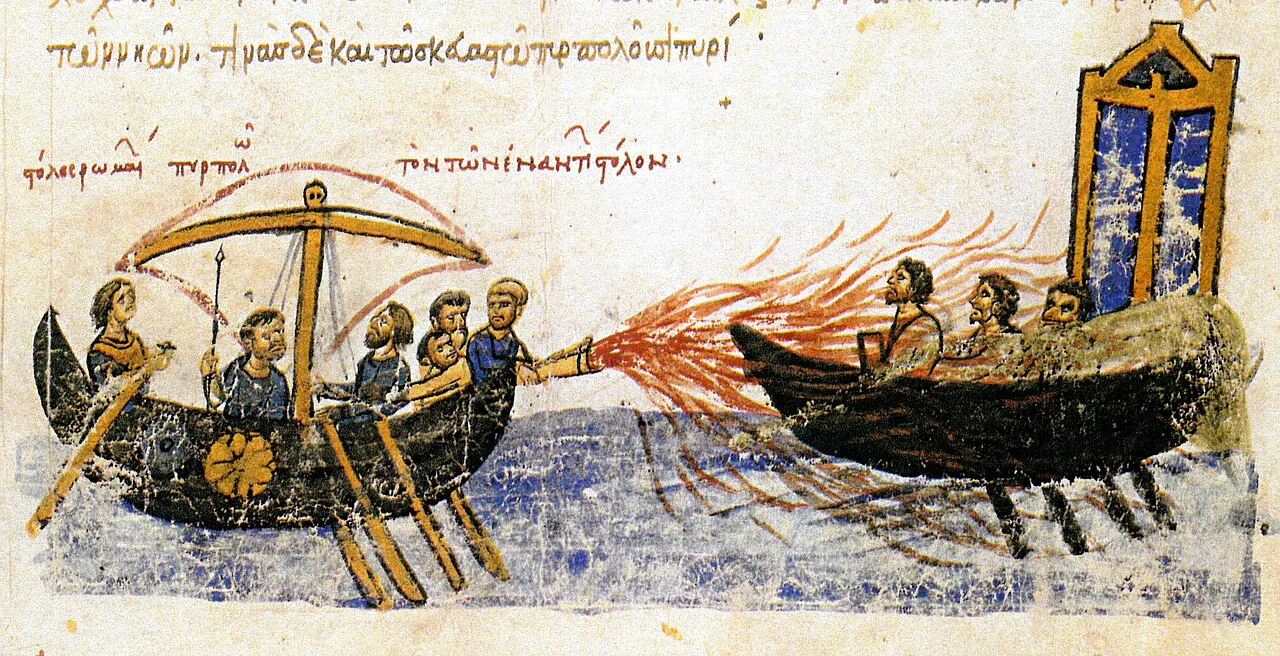 A Byzantine ship turns Greek fire on the fleet of the rebel Thomas the Slav in the 820s, a miniature of the Madrid Skylitzes, 12th centuryWikimedia Commons, unknown artist, Public domain (Greekfire-madridskylitzes1.jpg)
In 945 Igor goes to the Drevlians at Iskorosten for tribute, comes back for more with a small escort and is killed. His widow Olga rules for their three-year-old son Sviatoslav. The Primary Chronicle tells how she has the Drevlian envoys burned in a bathhouse and their men killed at a funeral feast, and how after a year’s siege she takes Iskorosten by a trick and burns it. She then fixes the tribute and sets up trading posts across the land.
Olga travels to Constantinople, where Emperor Constantine VII receives her with her retinue, 43 merchants and a priest named Gregory, as his Book of Ceremonies records. The Primary Chronicle and John Skylitzes say that she is baptised there and takes the name Helena. Slavonic sources date the baptism to 957, while Byzantine sources suggest that she was already a Christian when she came.
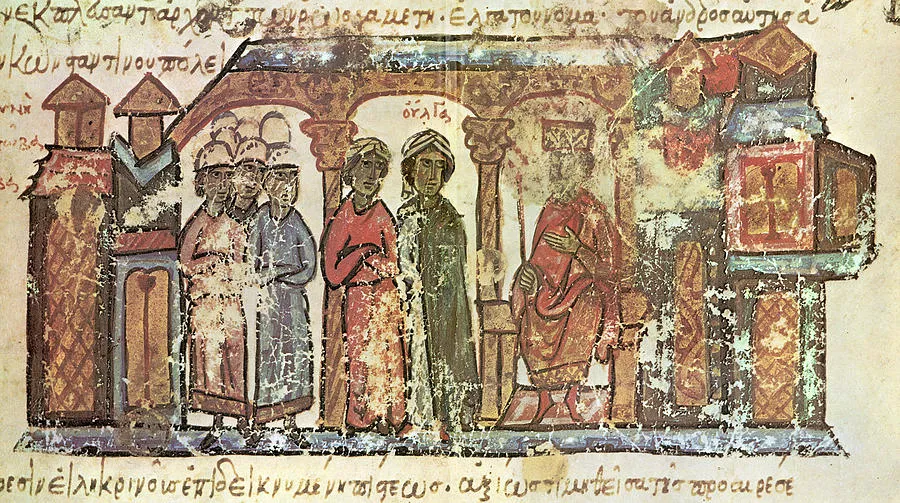 Emperor Constantine VII receives Olga and her retinue, a miniature of the Madrid Skylitzes, 12th centuryWikimedia Commons, unknown artist, CC BY-SA 4.0 (Reception by Emperor Constantine Porphyrogenitus of Princess Olga and her entourage.jpg)
Sources
- Liudprand of Cremona, Antapodosis.
- Constantine VII Porphyrogennetos, The Book of Ceremonies, on the reception of Olga.
- The Russian Primary Chronicle: Laurentian Text, translated by Samuel H. Cross and Olgerd P. Sherbowitz-Wetzor (1953), years 6449 to 6463.
Prev: The Volga route, 913–943Next: Sviatoslav, 965–970