1030–1065
Harald Hardrada, 1030–1065
Harald Sigurdsson, born about 1015 in Ringerike, is a half-brother of King Olaf Haraldsson. At fifteen he fights beside Olaf at Stiklestad on 29 July 1030, where Norwegians loyal to Cnut the Great defeat them, Olaf is killed and Harald is badly wounded. He escapes over the mountains to Sweden and reaches the Rus’ in 1031, probably at Staraya Ladoga. Grand Prince Yaroslav the Wise makes him a captain of his forces.
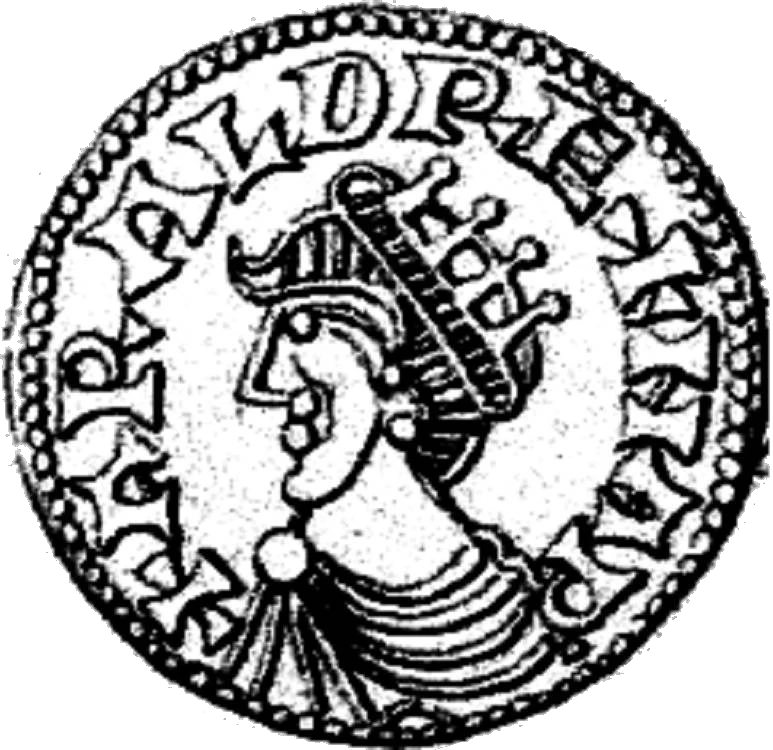 A penny of Harald inscribed ARALD REX NAR, king of Norway, struck by the moneyer Odinkar at Odense, drawn by C. I. Schive in 1865Wikimedia Commons, C. I. Schive, Public domain (Harold-III-Coin.png)
About 1034 Harald and some 500 men go on to Constantinople and join the Varangian Guard, the emperor’s guard of northern soldiers. He fights Arab pirates in the Mediterranean and their bases in Asia Minor, goes with George Maniakes to Sicily in 1038 and fights the Bulgarian rising of Peter Delyan in 1041. His skald Þjóðólfr Arnórsson credits him with eighteen battles. Harald sends his wealth to Yaroslav in Kiev for safekeeping.
In 1042 Harald escapes from Constantinople with two ships and returns to Kiev, where he marries Yaroslav’s daughter Elisiv. Early in 1045 he sails from Novgorod by Staraya Ladoga to Sigtuna and joins the Danish pretender Sweyn Estridsson against his nephew Magnus the Good, king of Norway and Denmark. In 1046 Magnus agrees to share the kingship of Norway in return for half of Harald’s wealth. Magnus dies in 1047, leaving Norway to Harald and Denmark to Sweyn.
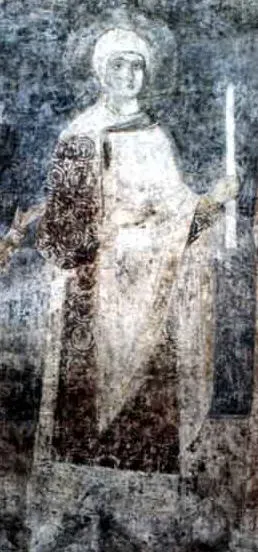 Elisiv, daughter of Yaroslav the Wise, in an 11th-century frescoWikimedia Commons, unknown author, Public domain (Elisiv of Kiev.jpg)
Harald claims Denmark as well and raids its coasts almost every year from 1048, and in 1049 he burns Hedeby. On 9 August 1062 he meets Sweyn’s fleet at the mouth of the river Nissan in Halland, and by Snorri’s account clears 70 Danish ships in a battle that lasts through the night. Sweyn escapes, and in 1064 the two kings make peace on the old borders. At home Harald breaks the opposition of the great families and the farmers of the Uplands, which earns him the name Hardrada, the hard ruler.
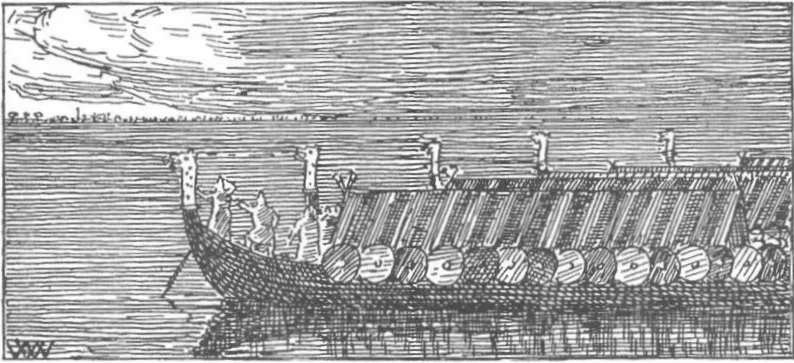 Harald’s fleet sights the Danish ships at dawn, drawing by Wilhelm Wetlesen for the 1899 Norwegian edition of HeimskringlaWikimedia Commons, Wilhelm Wetlesen, Public domain (Harald Hardraades saga-Dei saag danskeskipa-W. Wetlesen.jpg)
Sources
- Kelly DeVries, The Norwegian Invasion of England in 1066 (1999).
- Sigfús Blöndal, The Varangians of Byzantium, ed. Benedikt S. Benedikz (2007).
- Snorri Sturluson, Heimskringla, vol. 3, Magnús Óláfsson to Magnús Erlingsson, tr. Alison Finlay and Anthony Faulkes (2nd ed. 2016).
Prev: Cnut’s North Sea empireNext: Riccall and Fulford, 1066