c. 800 – 1100
Gods, temples and ship burials
The Norse worship many gods. Odin is the god of war, poetry, runes and the dead, Thor the god of thunder who guards gods and men with his hammer, and Freyr the god of fertility, peace and good harvests. Chieftains and kings lead the sacrifices, the blót, in their halls and at outdoor sites, since religious and secular authority lie in the same hands. Most of the myths survive in Eddic poems and in Snorri Sturluson's Edda, written down in Christian Iceland in the 13th century.
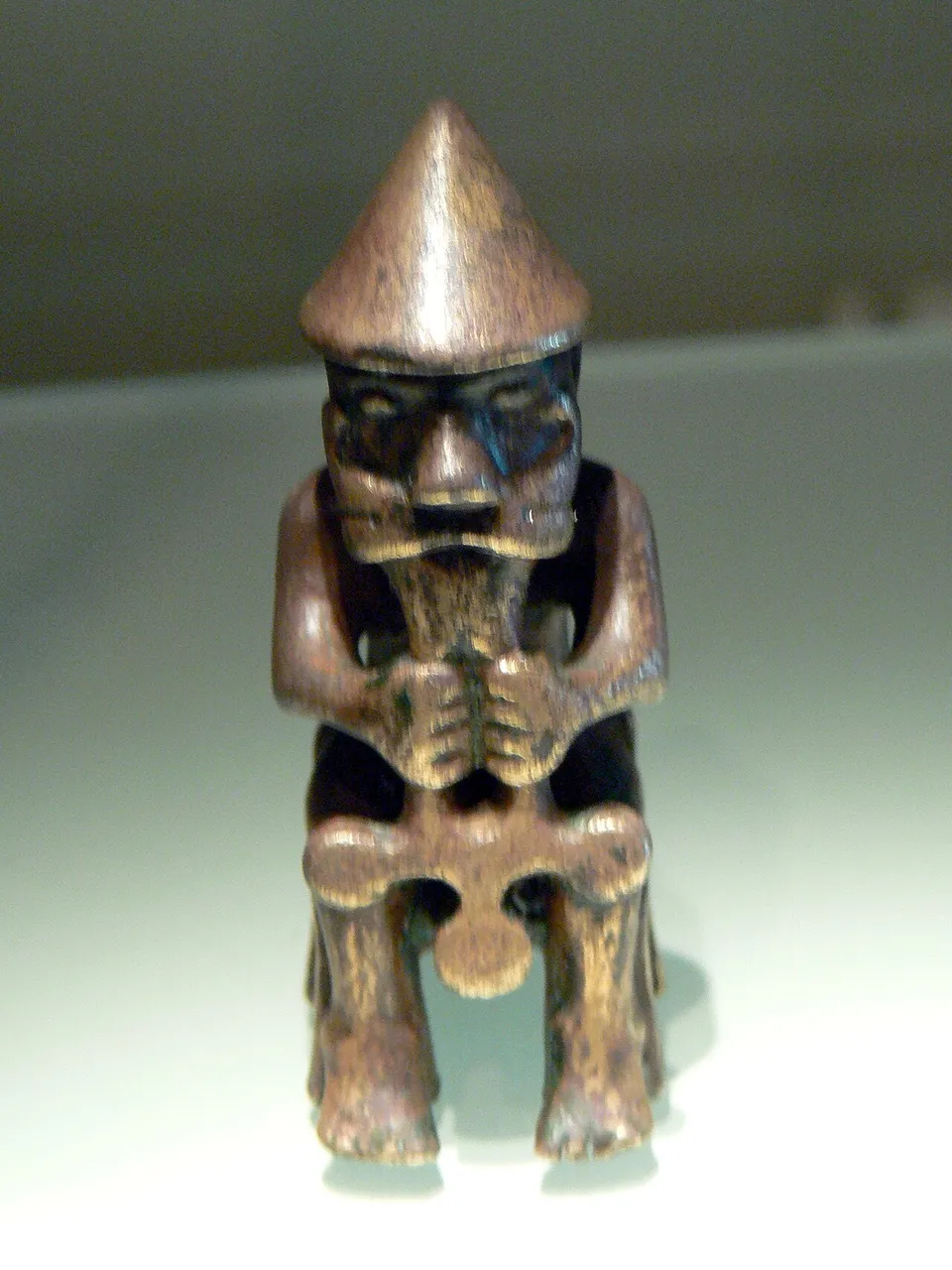 The Eyrarland figure, a bronze of about 1000 usually taken for Thor holding his hammer, National Museum of Iceland, ReykjavíkWikimedia Commons, Wolfgang Sauber, CC BY-SA 3.0 (Reykjavik - Thor-Figur 1.jpg)
Adam of Bremen, writing about 1070, describes a temple at Uppsala with statues of Thor, Wodan and Fricco, where every nine years men, dogs and horses are sacrificed and hung in a sacred grove. Excavations at Gamla Uppsala find royal mounds and a great hall but no temple on the scale he describes, and some scholars see his account as shaped by the Bible and by the church politics of his day. Thietmar of Merseburg writes of sacrifices every ninth year at Lejre, where excavations uncover halls 50 to 60 m long and a silver figure on a throne, perhaps Odin, made about 900. Cult buildings stand beside magnates' halls at Tissø on Zealand and Uppåkra in Scania, and at Mære in Trøndelag the remains of a temple lie under the medieval church.
Men and women of high rank are buried in ships with their goods and animals. The Oseberg mound in Vestfold, raised in the autumn of 834, holds two women in a 21.6 m ship with a carved cart, four sledges, 14 horses, an ox and three dogs. The Gokstad mound, raised about 900 for a man aged 40 to 50, holds a 23.8 m ship with 12 horses, six dogs and a peacock. At Ladby on Funen, Denmark's only known Viking ship burial, a chieftain of the early 10th century lies with eleven horses and his dogs.
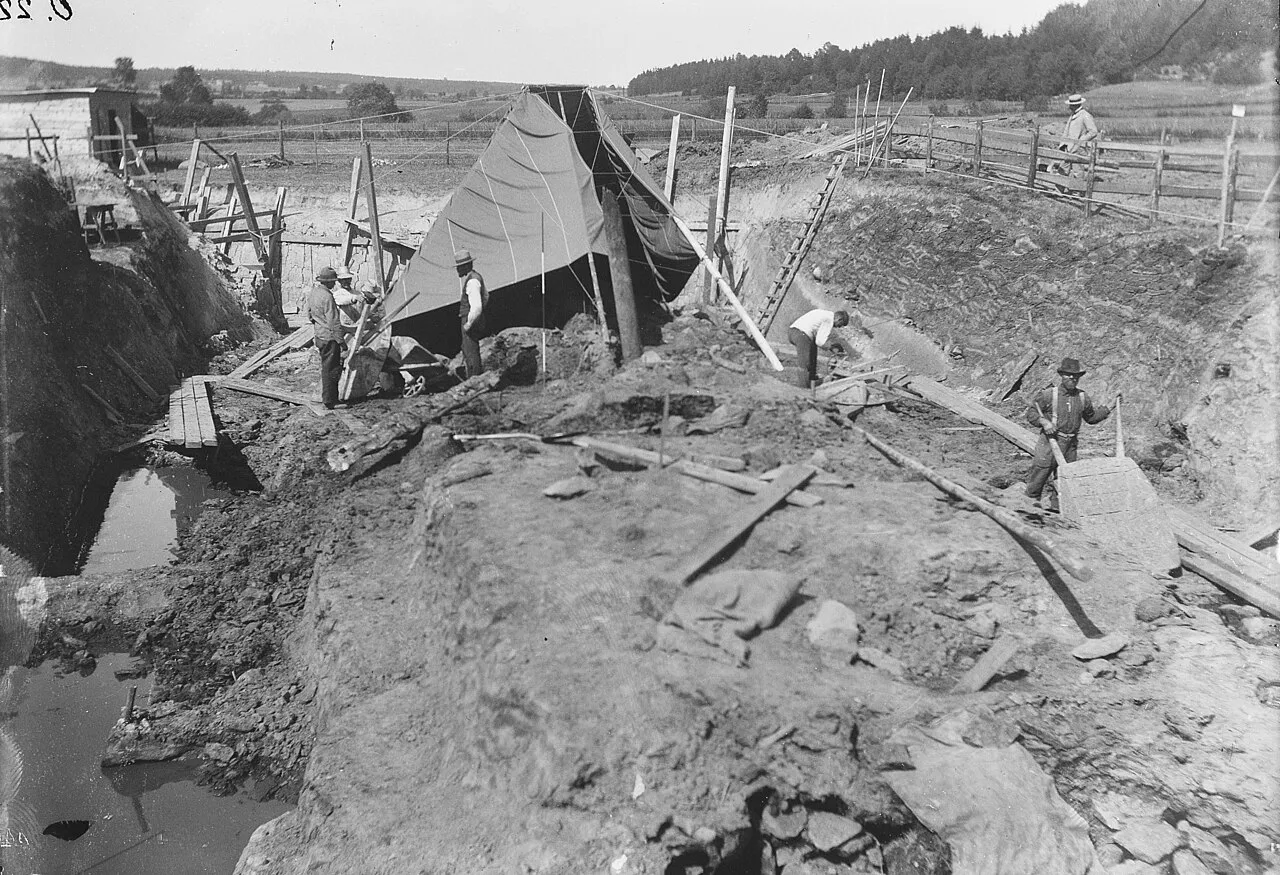 Excavation of the Oseberg burial mound near Tønsberg on 21 July 1904, Museum of Cultural History, University of OsloWikimedia Commons, Kulturhistorisk museum, UiO, CC BY-SA 4.0 (CfO0022 Oseberg utgraving 1904-07-21 Osebergskipet utgravning (Oseberg ship excavation 1904. Kulturhistorisk museum UiO Oslo, Norway. License CC BY-SA 4.0).jpg)
About 1,000 small pendants in the shape of Thor's hammer are found from the Nordic countries and England to the Baltic and Russia, and they may have spread in answer to the Christian cross. Ansgar's mission reaches Birka in 829, Harald Bluetooth makes the Danes Christian around 965, as his stone at Jelling records, and Iceland adopts Christianity at the Althing in 1000. A copper amulet of the 11th century from Kvinneby on Öland still calls on Thor and his hammer, and by the sagas' account King Inge the Elder ends the sacrifices at Uppsala in the 1080s.
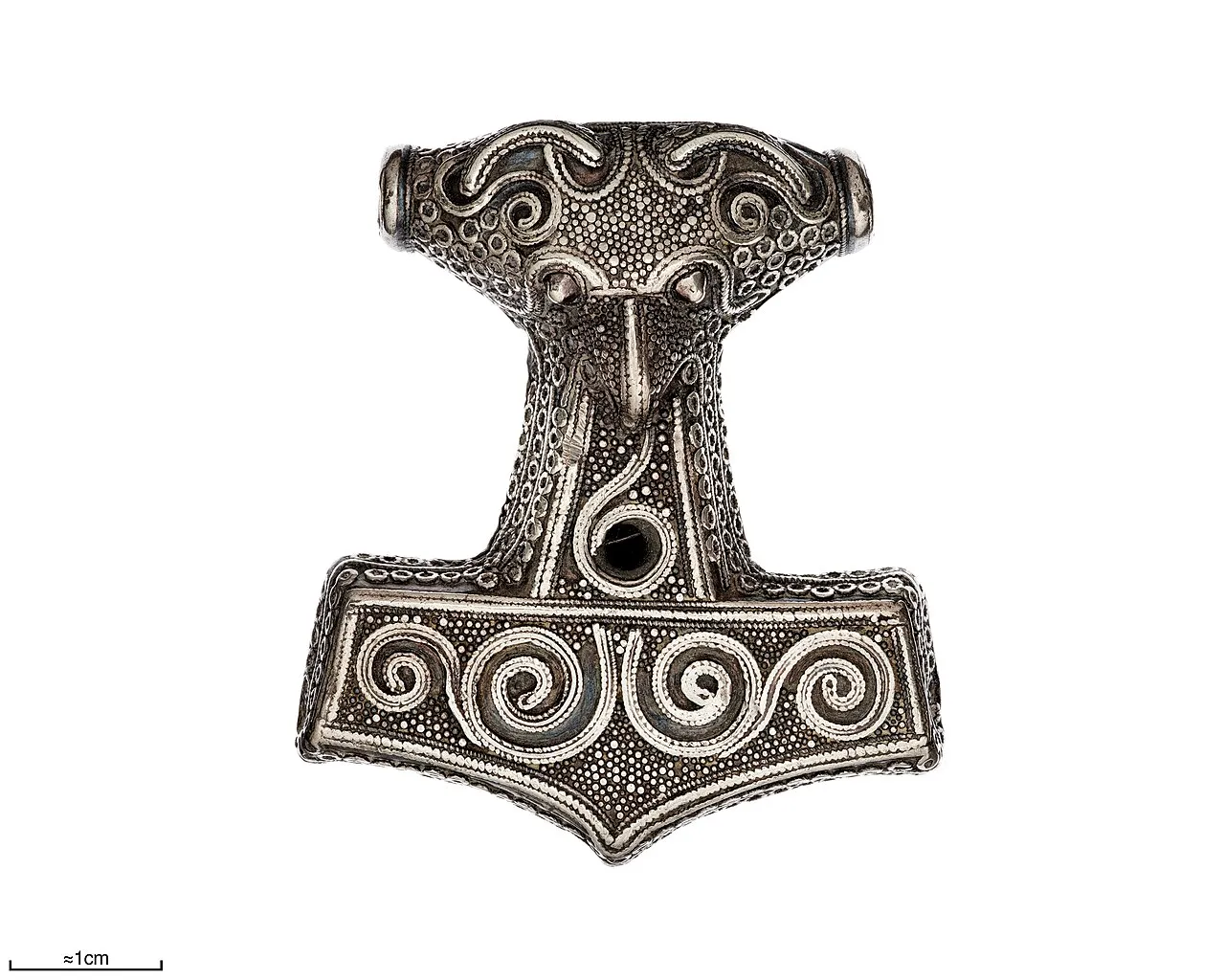 Silver Thor's hammer pendant with filigree from Scania, Swedish History Museum, StockholmWikimedia Commons, Ola Myrin, Statens historiska museum, CC BY 4.0 (Claes Kurck Skåne hammer - HST DIG55488 original.jpg)
Sources
- Adam of Bremen, Gesta Hammaburgensis ecclesiae pontificum, book 4.
- Rudolf Simek, Dictionary of Northern Mythology, translated by Angela Hall (2007).
- Niels Bonde and Arne Emil Christensen, “Dendrochronological dating of the Viking Age ship burials at Oseberg, Gokstad and Tune, Norway” (1993), pp. 575–583.
Prev: The thing and the lawNext: Silver and trade