878–886
Wedmore and the Danelaw, 878–886
Three weeks after the surrender Guthrum comes with 29 of his leading men to Alfred at Aller, near Athelney, and is baptised there with Alfred as his godfather, taking the name Æthelstan. Eight days later the unbinding of his chrism takes place at the royal estate of Wedmore, and Guthrum stays twelve days with the king, who honours him and his men with gifts. Asser is the only contemporary writer to tell of an agreement at Wedmore, which historians call the Treaty of Wedmore.
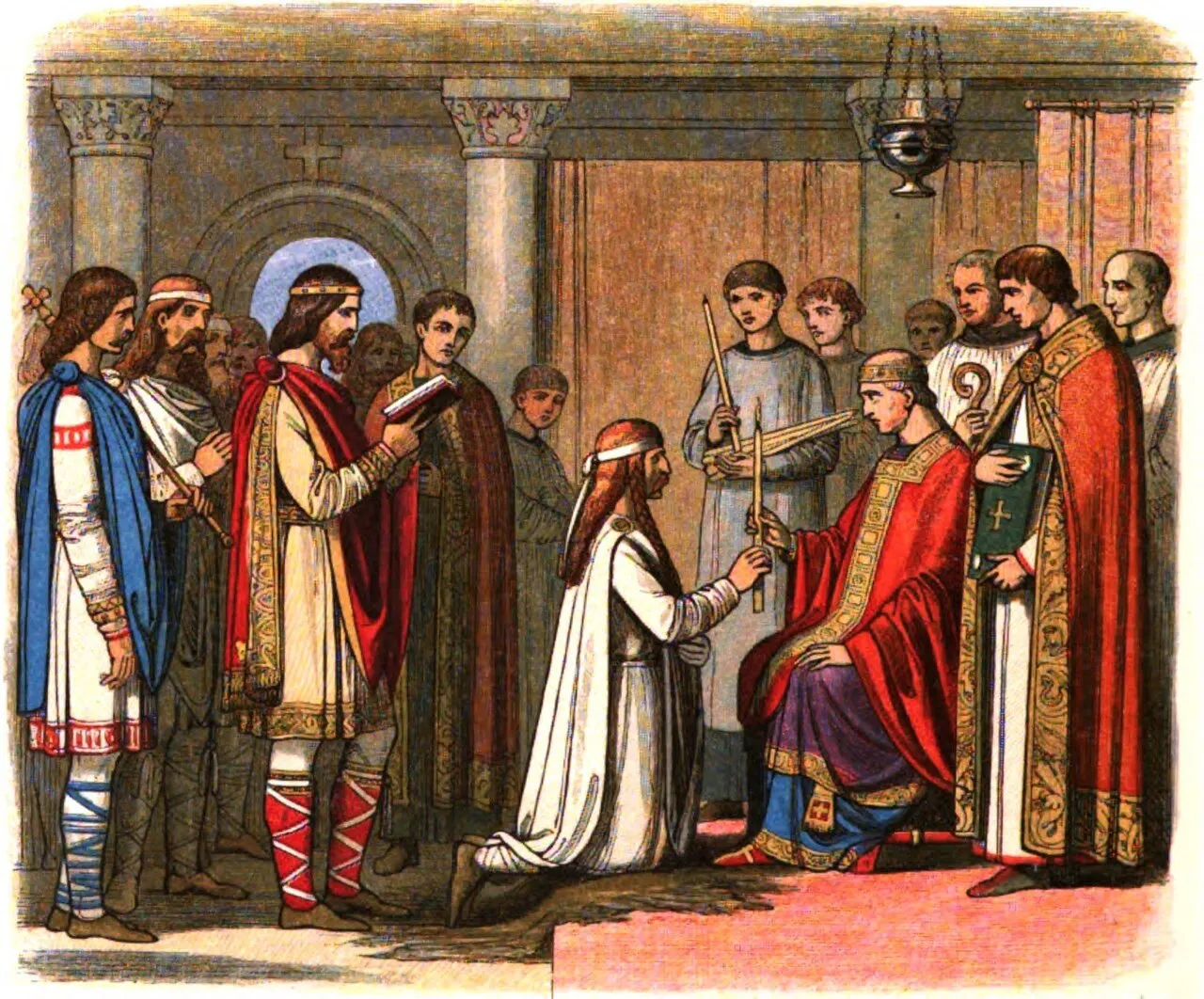 The baptism of Guthrum, from James William Edmund Doyle’s A Chronicle of England, 1864Wikimedia Commons, James William Edmund Doyle, Public domain (A Chronicle of England - Page 052 - Baptism of King Guthorm.jpg)
In 879 the Danish army leaves Chippenham for Cirencester in Mercia and stays there a year. In 880 it goes into East Anglia, settles there and shares out the land, and Guthrum rules it as king until his death in 890. His pennies carry his baptismal name, Æthelstan, and follow the model of Alfred’s coins.
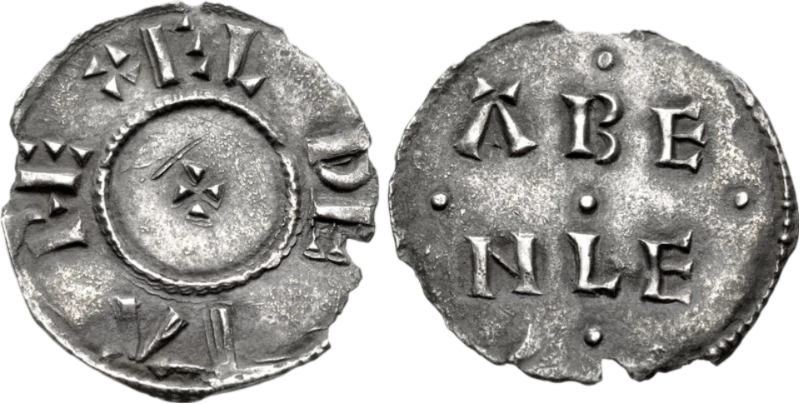 A silver penny of Guthrum struck in East Anglia under his baptismal name Æthelstan, about 880–890Wikimedia Commons, Classical Numismatic Group, CC BY-SA 2.5 (Æthelstan II Guthrum, silver penny; struck circa 879–890.png)
In 886 Alfred occupies London, restores the old Roman city and gives it into the keeping of Æthelred, ealdorman of the Mercians, and all the English not under Danish rule submit to him. At some date between 878 and 890 Alfred and Guthrum agree a treaty that runs their border up the Thames, up the Lea to its source, in a straight line to Bedford and up the Ouse to Watling Street. It puts the same value on the life of a slain Englishman and a slain Dane and sets rules for trade in slaves, horses and cattle between the two peoples.
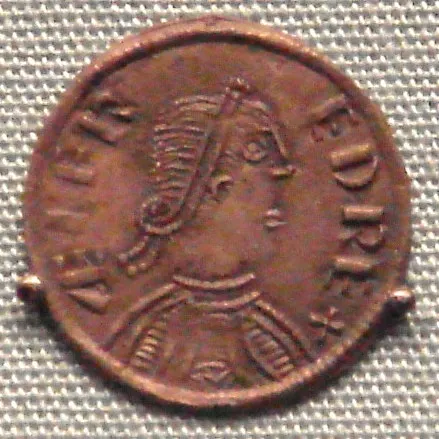 A silver penny of Alfred struck in London about 880, British MuseumWikimedia Commons, PHGCOM, Public domain (Alfred king of Wessex London 880.jpg)
Alfred builds a network of fortified places, the burhs, so that most people in Wessex live within about 15 miles of one. The Burghal Hidage, a list of the early 10th century or before, names some 30 burhs in Wessex and the hides assigned to each. One man comes from every hide, and four men guard every pole of wall, so Winchester and Wallingford, rated at 2,400 hides each, have the largest garrisons.
Sources
- Asser, Life of King Alfred, chapters 56 to 83.
- Frederick Attenborough (ed.), “Treaties with the Danes”, in The Laws of the Earliest English Kings (1922).
- David Hill and Alexander R. Rumble (eds), The Defence of Wessex: The Burghal Hidage and Anglo-Saxon Fortifications (1996).
Prev: Fourteen days before the strongholdNext: Hastein’s army, 892–896