Good Friday, 23 April 1014, evening
The rout at high tide
Towards evening the army of Dublin and Leinster breaks. Some men run for the ships and others for a wood near Dublin, but the tide has come in again, cutting off the way to the wood and carrying the ships away from the shore, and many are killed or drown. In 1860 Samuel Haughton calculated that the tide at Clontarf was high at half past five in the morning and at five to six in the evening, which fits the Cogad’s account. Brian’s grandson Toirdelbach follows the enemy into the sea, is thrown against the weir by a wave and drowns.
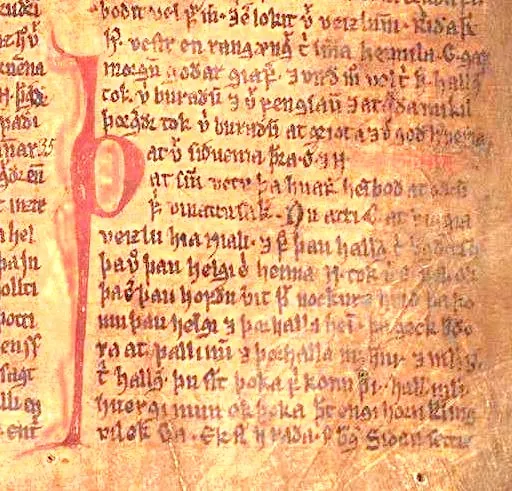 A page of Njáls saga in Möðruvallabók, an Icelandic manuscript written about 1350Wikimedia Commons, GDK, Public domain (Möðruvallabók f13r.jpg)
By the Cogad, Murchad kills Sigurd, earl of Orkney, and is killed soon after. In Njáls saga, written in Iceland about 1270–1290, one man after another dies carrying Sigurd’s raven banner, until the earl takes it himself and falls. Brodir comes on Brian praying in his tent and kills him, and is then killed himself. The last men of Dublin fall at Dubgall’s Bridge, which Seán Duffy places on the Tolka on the road back to the town.
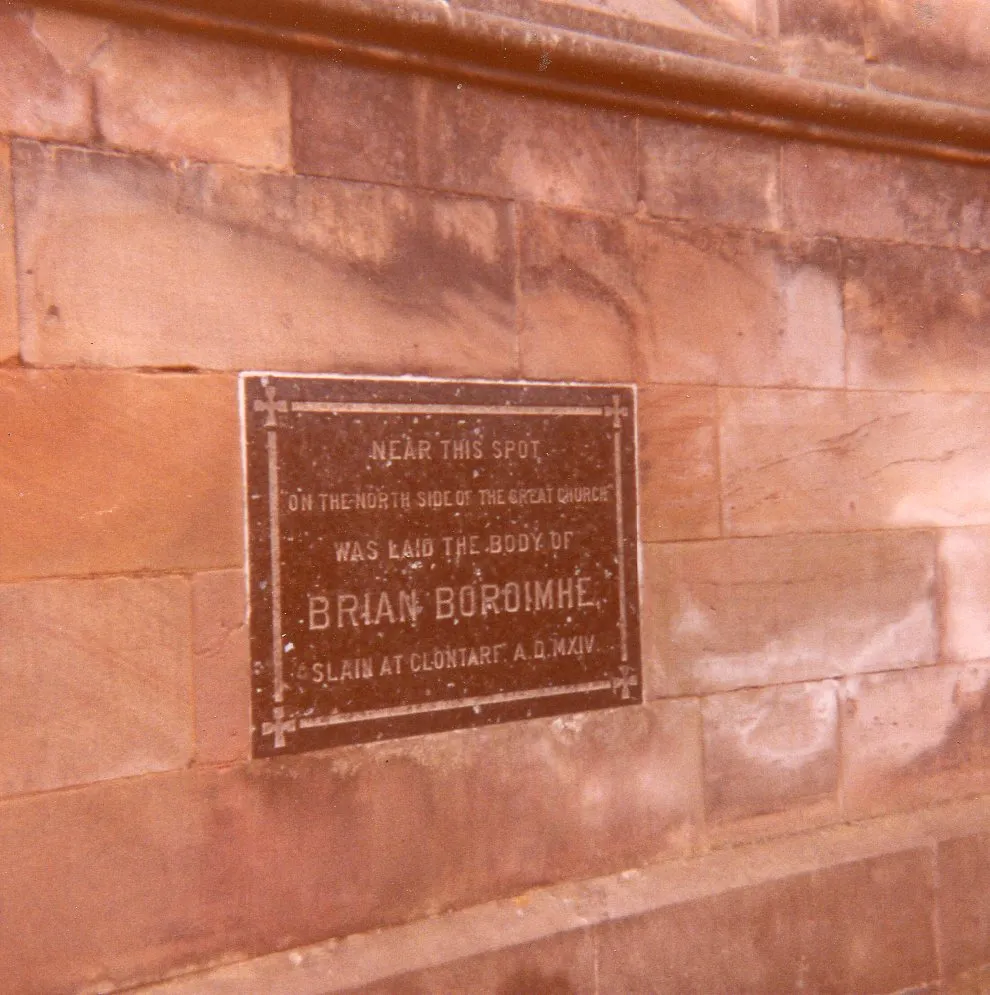 The plaque on St Patrick’s Cathedral in Armagh marking the place where Brian Boru was buriedWikimedia Commons, Stephen B Calvert Clariosophic, CC BY-SA 3.0 (St Patrick's (COI) Cathedral, Armagh 087.jpg)
The Annals of Ulster name among the dead Brian, Murchad, Toirdelbach, Máel Mórda and Sigurd, and modern estimates of the dead run from 7,000 to 10,000. Brian is buried at Armagh. Máel Sechnaill is high king again until his death in 1022, and Sigtrygg remains king of Dublin until 1036.
Sources
- Annals of Ulster, entry for 1014.
- Seán Duffy, Brian Boru and the Battle of Clontarf (2013), pp. 209 to 220.
- Njáls saga, chapter 157.
Prev: The lines at ClontarfNext: Staraya Ladoga and the Rhos, c. 750–839