149 BC
Rome lands at Utica
In 149 BC Utica, the largest port near Carthage, goes over to Rome, and Rome declares war. Both consuls cross from Sicily and land at Utica with an army that Appian puts at 84,000 men and modern historians at 40,000 to 50,000. Manius Manilius commands the army and Lucius Marcius Censorinus the fleet.
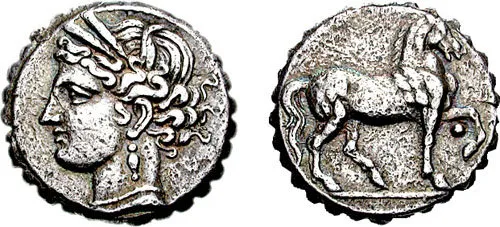 Carthaginian double shekel of about 160 to 149 BC, with the head of Tanit and a horseWikimedia Commons, Classical Numismatic Group, Public domain (Carthage - Double Shekel - c.160-149 BC.jpg)
Carthage tries to avoid war. It sends 300 children of leading families as hostages, as Polybius reports, and then hands over its weapons, by surviving accounts 200,000 sets of armour and 2,000 catapults. Convoys carry them to Utica, and the Carthaginian warships sail there and are burnt in the harbour.
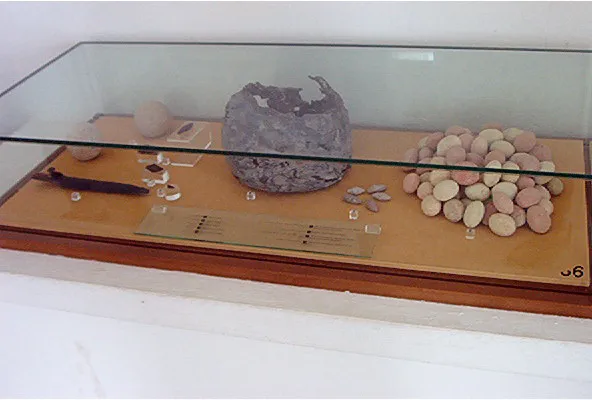 Stone catapult balls and other finds from the siege of 149 to 146 BC, National Museum of CarthageWikimedia Commons, Pascal Radigue, CC BY-SA 3.0 (Vitrine 3e guerre punique.jpg)
The consuls then order the Carthaginians to leave their city and settle 16 km from the sea, so that Carthage can be destroyed. The Carthaginians refuse. They arm the citizens, free the slaves willing to fight, and give a field army of 30,000 men to Hasdrubal at Nepheris, 25 km south of the city.
Sources
- Appian, The Punic Wars.
- Polybius, Histories, book 36.
- Adrian Goldsworthy, The Fall of Carthage (2006).
Prev: Masinissa and CatoNext: The first assaults