241 – 238 BC
The Mercenary War
At the end of the war Carthage owes several years’ pay to the 20,000 soldiers it brings back from Sicily, and it waits for all of them to arrive before offering less. The army, sent to wait at Sicca, refuses anything short of the full amount and seizes Tunis. Talks break down, the troops take the envoy Gisco and his treasury, and they choose Spendius, an escaped Roman slave, and Matho, a Libyan, as their generals.
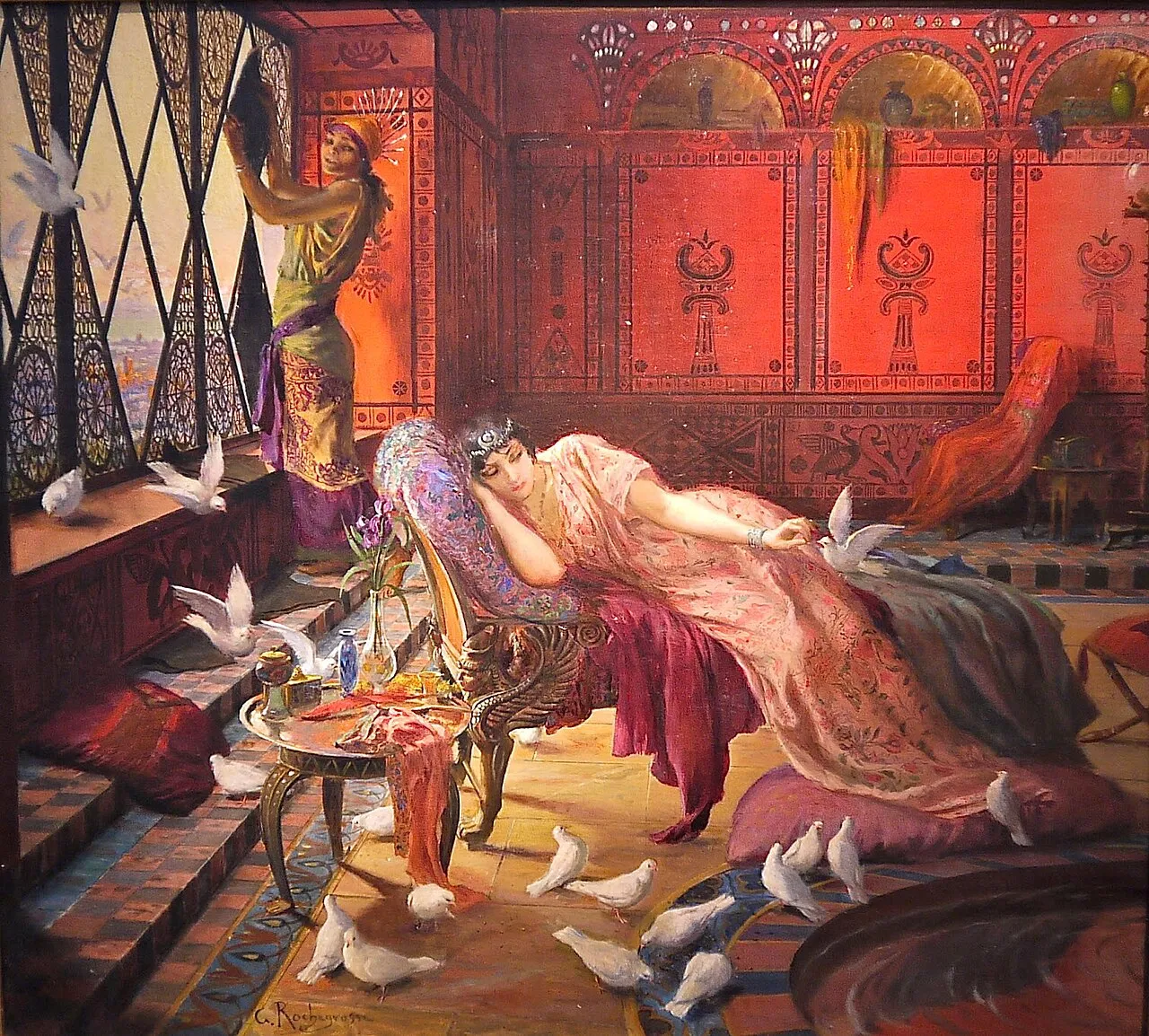 Salammbô, painting by Georges-Antoine Rochegrosse, 1895, for Gustave Flaubert’s novel set in the Mercenary WarWikimedia Commons, Georges Rochegrosse, Public domain (Rochegrosse Salambo.jpg)
Libyan towns crushed by the war taxes of Hanno the Great join the revolt, with 70,000 more men by Polybius’s account, and strike coins of their own. The rebels blockade Carthage from Tunis and besiege Utica and Hippo, the two great ports still loyal. Hanno is beaten at Utica in 240 BC, and Carthage raises a second army of about 10,000 men with 70 elephants under Hamilcar Barca.
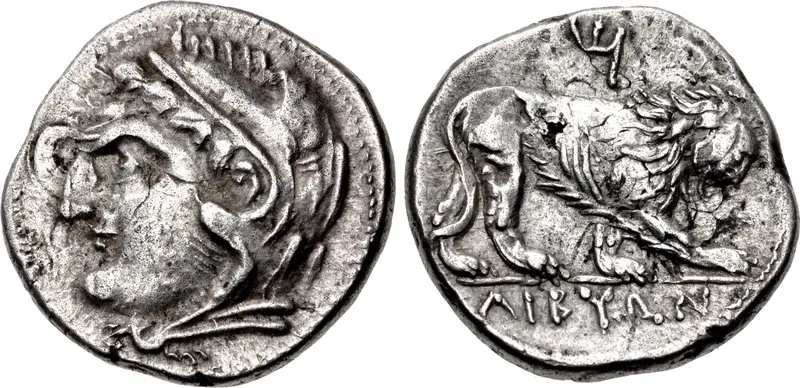 A shekel struck by the rebels, 241 to 238 BC, with Herakles, a lion and the Greek legend ΛΙΒΥΩΝ, of the LibyansWikimedia Commons, Classical Numismatic Group, CC BY-SA 2.5 (Libyan Revolt, shekel, 241-238 BC.jpg)
Hamilcar forces a crossing of the Bagradas by a stratagem and routs 25,000 rebels. Later, surrounded in the hills, he is saved when the Numidian leader Naravas comes over to him with 2,000 horsemen. The rebels then torture 700 Carthaginian prisoners to death, Gisco among them, and from then on both sides kill their captives, the Truceless War of Polybius. In 239 BC Utica and Hippo kill their garrisons and join the rebels, and Hamilcar, now in sole command, cuts the rebels’ supplies around Carthage.
Sources
- Polybius, Histories, book 1, 65 to 88.
- Dexter Hoyos, Truceless War: Carthage’s Fight for Survival, 241 to 237 BC (2007).
- Adrian Goldsworthy, The Fall of Carthage (2006).
Prev: The Treaty of LutatiusNext: Trapped at the Saw