1371–1376
Vassals, 1371–1376
After the battle on the Maritsa, Ottoman troops occupy Uglješa’s lands in eastern Macedonia, and the Byzantines take Serres. Emperor John V becomes Murad’s vassal, in 1371 or 1373 by different accounts: he pays tribute and joins the sultan’s campaigns with his troops. Evrenos Bey holds the western march of Ottoman Thrace from Komotini.
Murad’s armies take northern Thrace, the Rhodopes, Ihtiman and Samokov, and Tsar Ivan Shishman of Tarnovo withdraws north of the Balkan mountains. In 1373 Shishman becomes an Ottoman vassal and agrees to send his sister Kera Tamara to Murad, and he gets Ihtiman and Samokov back. She enters the sultan’s household in 1376 or 1378. Shishman’s elder half-brother Ivan Sratsimir rules Vidin as a separate tsar.
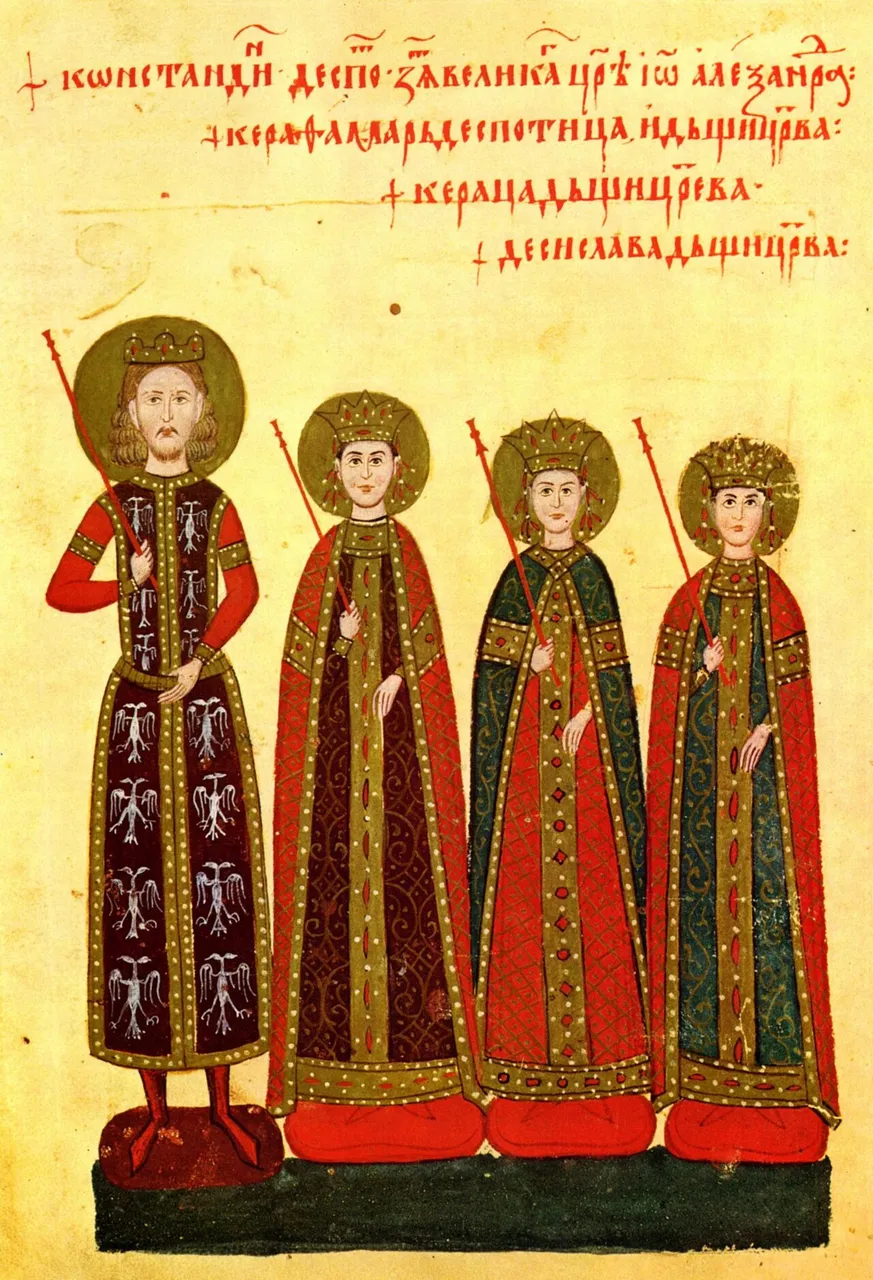 Kera Tamara with her husband, the despot Constantine, and her sisters Kerica and Desislava, in the Gospels of Tsar Ivan AlexanderWikimedia Commons, unknown illuminator, Public domain (Konstantin Dejanović, Kera-Tamara, Kerica, Desislava.jpg)
King Marko of Prilep and the brothers Jovan and Konstantin Dragaš, who hold Štip, Velbužd and the Struma valley, also become Ottoman vassals. Their neighbours take most of Marko’s lands: the Balšići of Zeta take Prizren and Peć, Prince Lazar takes Priština, and Vuk Branković holds Skopje by 1377. In 1373 Lazar and Ban Tvrtko of Bosnia defeat Nikola Altomanović, and Lazar builds the largest of the Serbian principalities, centred on Kruševac in the Morava valley.
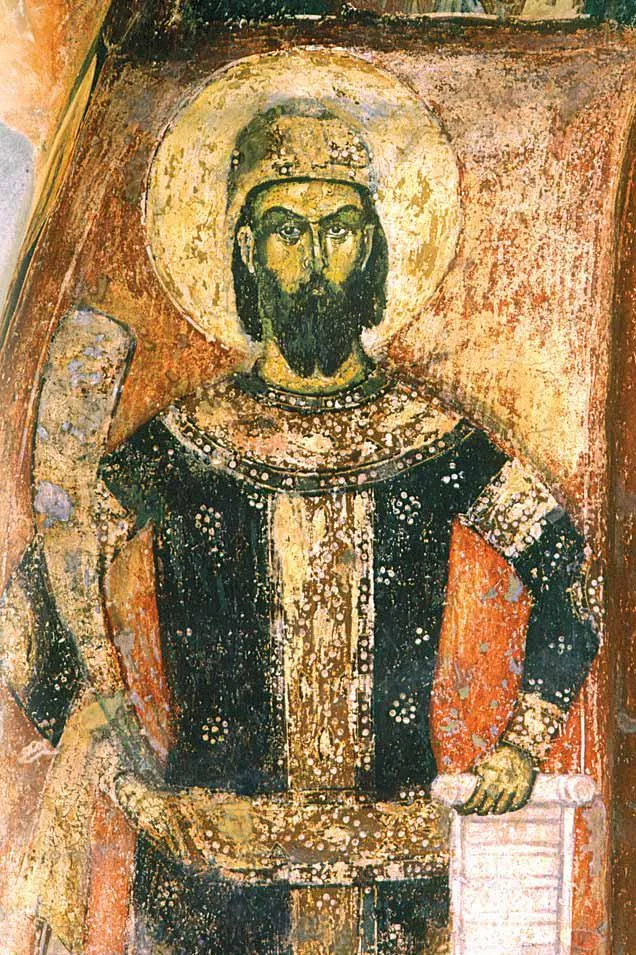 King Marko in a fresco of 1376 above the south entrance of Marko’s Monastery near SkopjeWikimedia Commons, unknown painter, Public domain (Marko Mrnjavcevic.JPG)
Sources
- John V. A. Fine, The Late Medieval Balkans (1987).
- Ivan Božilov and Vasil Gjuzelev, Istorija na srednovekovna Bălgarija VII–XIV vek (1999).
- Donald M. Nicol, The Last Centuries of Byzantium, 1261–1453 (2nd ed., 1993).
- Colin Imber, The Ottoman Empire, 1300–1481 (1990).
Prev: Maritsa, 1371Next: Savcı, Andronikos IV and Gallipoli, 1373–1379