January – spring 1422
Mustafa at Ulubad, 1422
In January 1422 Mustafa crosses the Dardanelles from Gallipoli to Lapseki on Genoese ships from Galata. By Ottoman accounts he has 12,000 horsemen and 5,000 foot soldiers, and he marches on Bursa. Murad comes out to meet him at the Ulubad river near Lake Uluabat and holds the bridge, so that the two armies face each other across the water.
Mihaloğlu Mehmed Bey, the leader of the akıncı raiders of Rumelia, and Hacı İvaz Pasha send word to the Rumelian beys in Mustafa’s camp, and many of them go over to Murad without a fight. Cüneyd, who has been promised the governorship of Aydın, leaves the camp at night with about seventy men and rides home. Mustafa retreats with the rest of his army, and Hacı İvaz Pasha’s men cut down most of his foot soldiers at a bridge. Mustafa escapes to Gallipoli and tries to stop the traffic through the straits.
Murad hires ships and 2,000 armoured men at a high price from Giovanni Adorno, the Genoese podestà of New Phocaea, whose secretary at this time is the historian Doukas. Murad crosses to Gallipoli and takes it, and Mustafa flees to Edirne. When the people of Edirne come out to greet Murad, Mustafa leaves with the treasury for Wallachia, but he is caught in the Tundzha valley at Elhovo, then called Yenice-i Kızılağaç. He is brought back to Edirne and hanged from a tower of the citadel, a death not given to members of the dynasty, and modern historians see in it Murad’s way of marking Mustafa as an impostor.
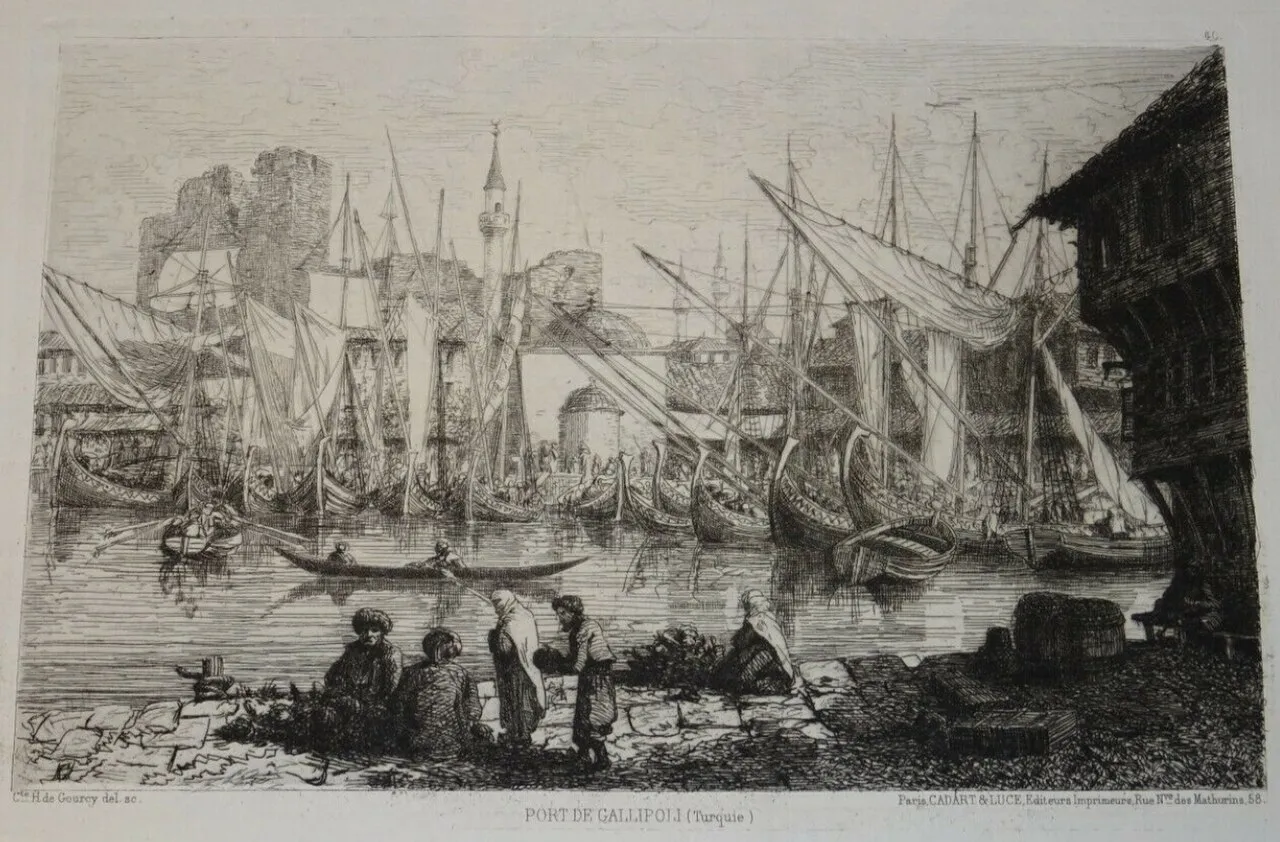 The port of Gallipoli, etching by Henri de Gourcy, about 1880Wikimedia Commons, Henri de Gourcy, Public domain (Port de Gallipoli.JPG)
Sources
- Doukas, Historia Turco-Byzantina (about 1462).
- Aşıkpaşazade, Tevârîh-i Âl-i Osmân (late 15th century).
- Mehmed Neşri, Kitâb-ı Cihan-nümâ (late 15th century).
- Colin Imber, The Ottoman Empire, 1300–1481 (1990).
- Halil İnalcık, “Murād II”, in Encyclopaedia of Islam, 2nd ed., vol. 7 (1993), 594–595.
- Fahameddin Başar, “Mustafa Çelebi, Düzme”, in TDV İslâm Ansiklopedisi.
Prev: Mustafa takes Rumelia, 1421Next: The siege of Constantinople, 1422