3 – 18 February 1451
Murad’s death, 1451
In the winter of 1450–1451 Murad withdraws to an island in the Tunca at Edirne to rest, and there he suffers a stroke and dies on 3 February 1451. His son Mehmed, who had married Sitti Hatun of the Dulkadir house, is governor at Manisa. Mehmed rides to Gallipoli, crosses the Dardanelles and takes the throne at Edirne on 18 February 1451. Murad’s infant son Ahmed, born to Hatice Hatun of the Candar house in 1450, is put to death on Mehmed’s orders, and Murad’s widow Mara Branković goes back to Serbia.
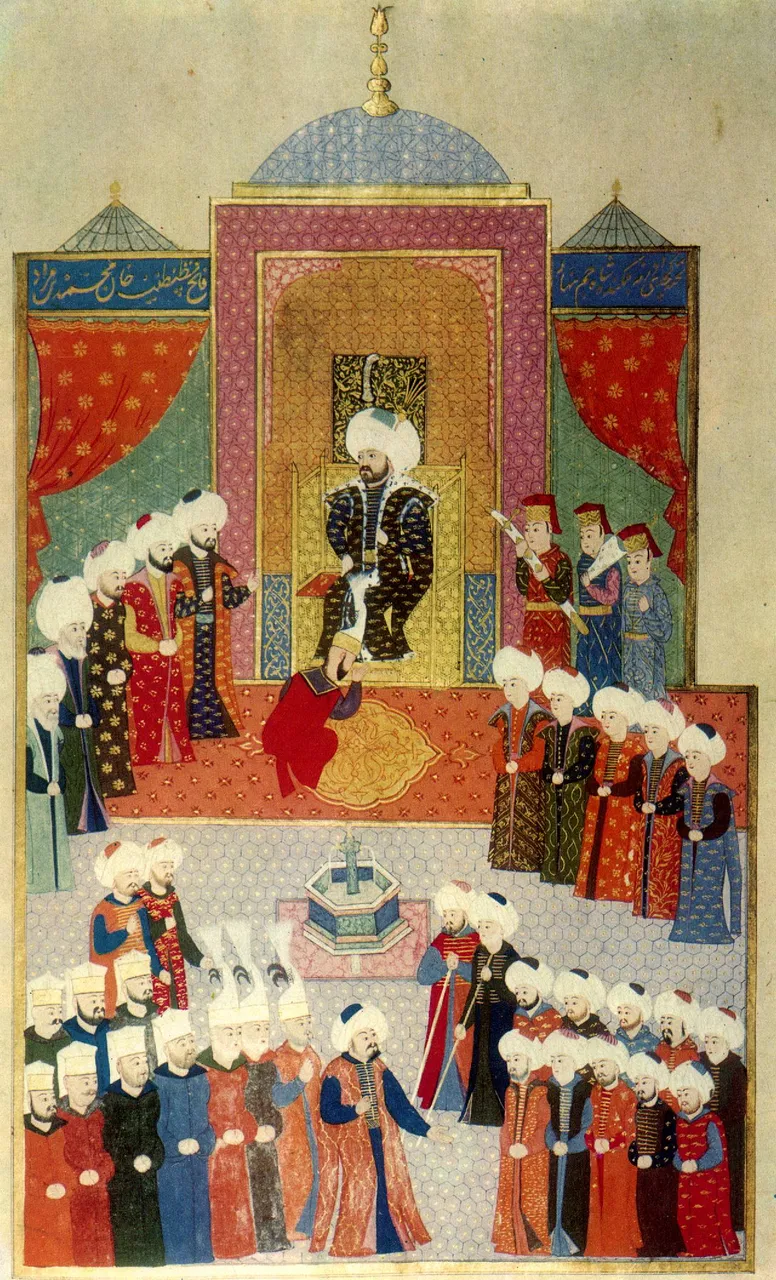 The accession of Mehmed II at Edirne in 1451, in the Hünername of Seyyid Lokman, 1584, Topkapı Palace MuseumWikimedia Commons, unknown Ottoman painter, Public domain (Hunername accession Mehmed II.jpg)
Murad’s body is carried to Bursa and buried, as his will asks, near his son Alaeddin in the Muradiye, in the earth and without a sarcophagus. His tomb is left open at the top of the dome so that the rain falls on the grave, and a gallery runs round it for the readers of the Quran. Mehmed has the tomb built after his father’s death.
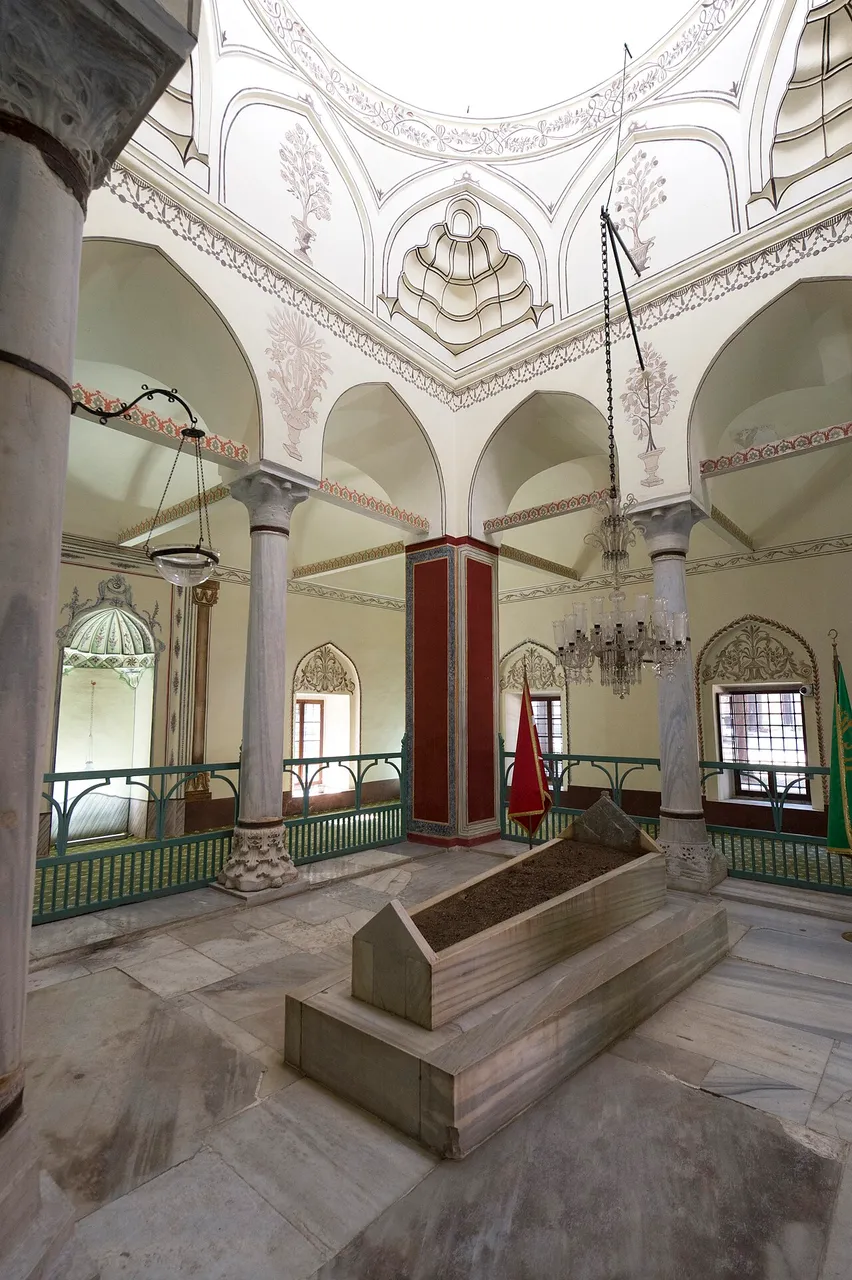 The grave of Murad II in the earth, in his tomb at the Muradiye of BursaWikimedia Commons, Dosseman, CC BY-SA 4.0 (Murat II tomb 7948.jpg)
At Murad’s death the Ottoman lands reach in Europe from the Danube to Thessaly and Epirus, with Thessalonica, Ioannina and Arta, which was taken in 1449. In Anatolia they reach from the Aegean coast to Antalya, Ankara, Amasya and Samsun. Serbia under Đurađ Branković and the despots of the Morea pay tribute, and Byzantium holds Constantinople with a few towns in Thrace. Skanderbeg keeps Krujë, and the beys of Karaman and Candar rule their own lands.
Sources
- Doukas, Historia Turco-Byzantina (about 1462).
- George Sphrantzes, Chronicon minus (about 1477).
- Aşıkpaşazade, Tevârîh-i Âl-i Osmân (late 15th century).
- Mehmed Neşri, Kitâb-ı Cihan-nümâ (late 15th century).
- Franz Babinger, Mehmed the Conqueror and His Time (1978).
- Colin Imber, The Ottoman Empire, 1300–1481 (1990).
- Halil İnalcık, “Murād II”, in Encyclopaedia of Islam, 2nd ed., vol. 7 (1993), 594–595.
Prev: Krujë, 1450