October 1445 – September 1446
Mokra and Otonetë, 1445–1446
After Varna Murad sends Skanderbeg a letter that recalls how he raised him at his court and warns him of the size of the Ottoman army, and by Barleti’s account Skanderbeg answers with a reminder of Torvioll. In October 1445 Firuz Pasha leaves Skopje with 9,000 to 15,000 men to keep Skanderbeg out of Macedonia and to surprise Krujë, because he has heard that the Albanian army has dispersed. Skanderbeg’s scouts report the march, and he goes to meet Firuz with his guard of 3,500 men, 2,000 horsemen and 1,500 foot.
On 10 October 1445 the Albanians draw the Ottomans into a narrow wooded valley near the mountain of Mokra (Jakupica), south-west of Skopje, where they have blocked the paths. Albanian historians place it instead in the Mokra region west of Lake Ohrid, near Pogradec. The Ottoman horsemen cannot move among the trees and are attacked by the Albanian foot, and the Ottomans flee, leaving 1,500 dead and 1,000 prisoners. Firuz Pasha is killed, and Pope Eugene IV and Alfonso V of Aragon, king of Naples, send Skanderbeg their praise.
In 1446 Murad sends Mustafa Pasha into Albania with 15,000 horsemen to plunder the country and wear it down while avoiding a pitched battle. Mustafa splits his force and keeps one part in a fortified camp at Otonetë in Upper Dibra. On 27 September 1446 Skanderbeg attacks the camp with 5,000 men and takes it with its supplies, and by the Albanian accounts 5,000 Ottomans are killed and 300 captured. The Ottoman chroniclers do not mention either battle, and the accounts of both go back to Barleti and later Albanian histories.
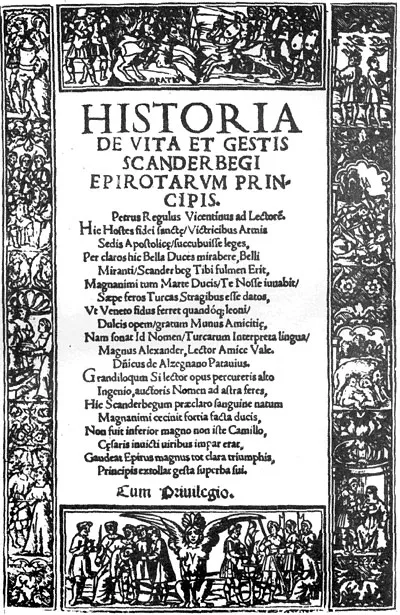 The title page of Marin Barleti’s life of Skanderbeg, printed at Rome about 1508Wikimedia Commons, Marin Barleti, Public domain (Historia de vita et gestis Scanderbegi, Epirotarum principis.jpg)
Sources
- Marin Barleti, Historia de vita et gestis Scanderbegi Epirotarum principis (about 1508).
- Fan S. Noli, George Castrioti Scanderbeg (1405–1468) (1947).
- Kristo Frashëri, The History of Albania: A Brief Survey (1964).
- Harry Hodgkinson, Scanderbeg: From Ottoman Captive to Albanian Hero (1999).
- Kristo Frashëri, Gjergj Kastrioti Skënderbeu: jeta dhe vepra, 1405–1468 (2002).
- Gennaro Francione, Skënderbeu, një hero modern (2003).
Prev: Mehmed’s first reign, 1444–1446Next: The Hexamilion, 1446