December 1443 – June 1444
Skanderbeg and the League of Lezhë, 1444
From Krujë Skanderbeg takes the smaller castles around it, Petrela, Prezë and Guri i Bardhë among them, and comes to hold more than the lands of his father Gjon Kastrioti. He gives up Islam for Christianity and, according to the historian Kristo Frashëri, raises a red flag with a black double-headed eagle over Krujë. Gjergj Arianiti has been in revolt against the Ottomans in central Albania again since August 1443.
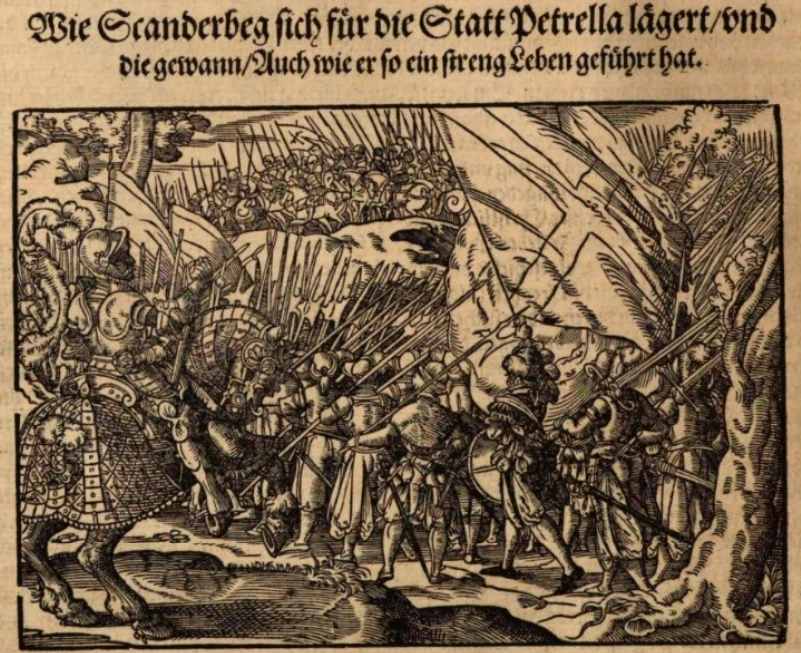 Skanderbeg takes the castle of Petrela, a woodcut in an edition of Marin Barleti’s life of Skanderbeg, 1577Wikimedia Commons, unknown engraver, Public domain (PetrelaCapture.png)
On 2 March 1444 Skanderbeg calls the Albanian lords to Lezhë, a town held by Venice. Gjergj Arianiti, Pal Dukagjini, Andrea Thopia, Lekë Dushmani, Theodor Corona Musachi, Peter Spani, Lekë Zaharia, Pal Strez Balsha and Stefan Crnojević of Zeta form an alliance against the Ottomans there and choose Skanderbeg as its captain. The meeting is known from Marin Barleti, Skanderbeg’s biographer, and no Venetian document of the time mentions it. Later historians call the alliance the League of Lezhë.
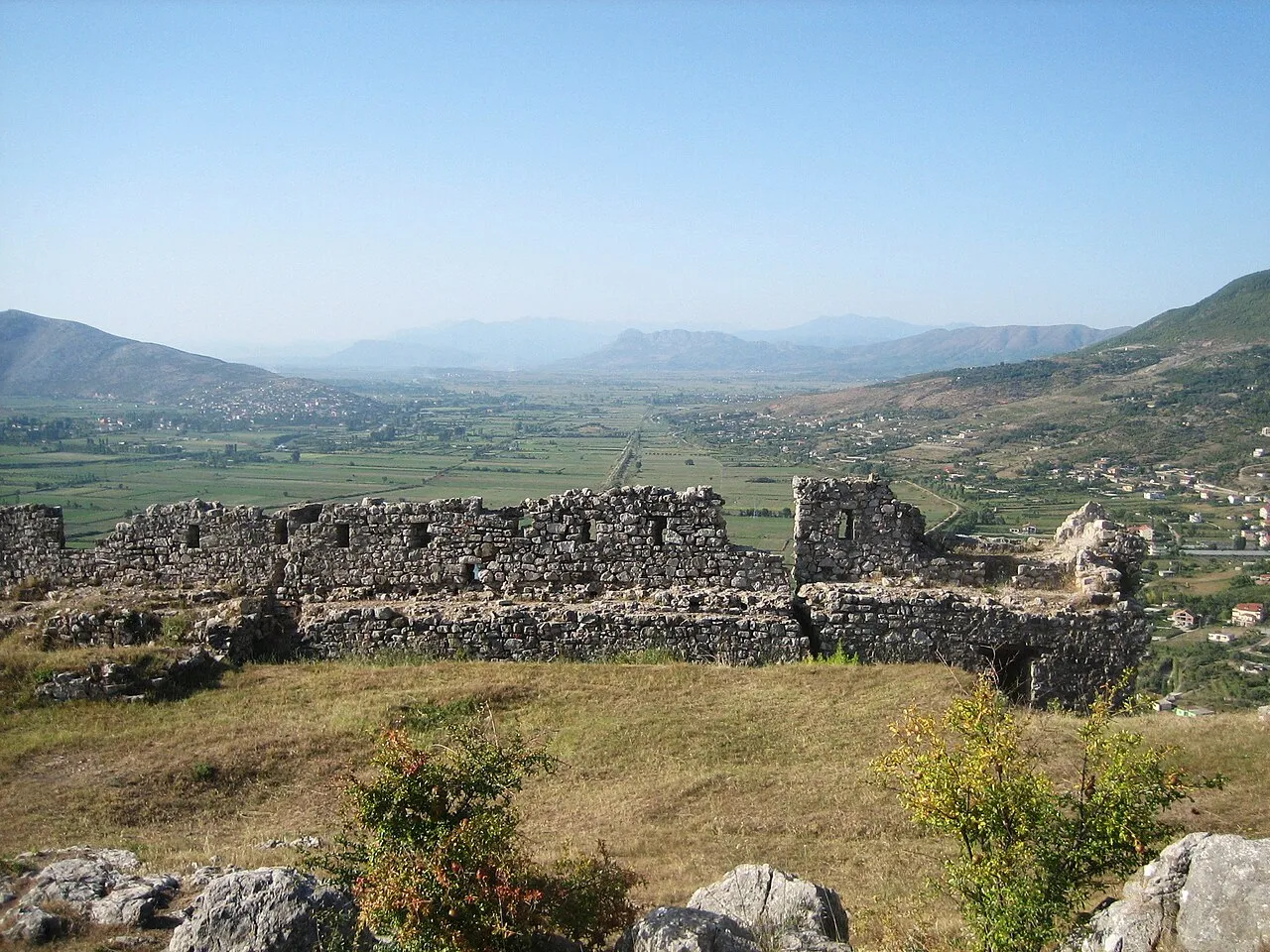 Inside the castle of LezhëWikimedia Commons, Gertjan R., CC BY-SA 3.0 (Lezhë Castle 4.jpg)
In June 1444 Ali Pasha leaves Skopje for Albania with 25,000 men by Barleti’s account, and other figures reach 40,000. Skanderbeg meets him in Lower Dibra with 15,000 men, 8,000 of them horsemen. On 29 June, on the plain of Torvioll, Skanderbeg’s army feigns a retreat and draws the Ottomans into the gorge, and 3,000 horsemen under Hamza Kastrioti come out of the forest at a signal and fall on their rear. By the Albanian accounts the Ottomans lose 7,000 to 10,000 dead. The historian Kenneth Setton writes that most accounts of Skanderbeg in 1443 and 1444 “owe far more to fancy than to fact”.
Sources
- Marin Barleti, Historia de vita et gestis Scanderbegi Epirotarum principis (about 1508).
- Laonikos Chalkokondyles, Histories (c. 1464).
- Fan S. Noli, George Castrioti Scanderbeg (1405–1468) (1947).
- Kristo Frashëri, The History of Albania: A Brief Survey (1964).
- Kenneth M. Setton, The Papacy and the Levant (1204–1571), vol. 2 (1978).
- Oliver Jens Schmitt, Skanderbeg: Der neue Alexander auf dem Balkan (2009).
Prev: Kunovica, 1444Next: Edirne and Szeged, 1444