1 January – summer 1443
The crusade is called, 1443
On 1 January 1443 Pope Eugene IV issues a bull that calls a crusade against the Ottomans. His legate in Hungary is Cardinal Julian Cesarini, who on 13 December 1442 at Győr brought King Władysław and the supporters of the infant Ladislaus to an agreement. At the diet of Buda in April 1443 Władysław and his barons decide on a campaign against the Ottomans, and through Cesarini the king makes a truce of twelve months with Frederick III of Germany, the guardian of Ladislaus. John Hunyadi spends about 32,000 gold florins of his own to hire more than 10,000 mercenaries, and troops come from Poland and Moldavia.
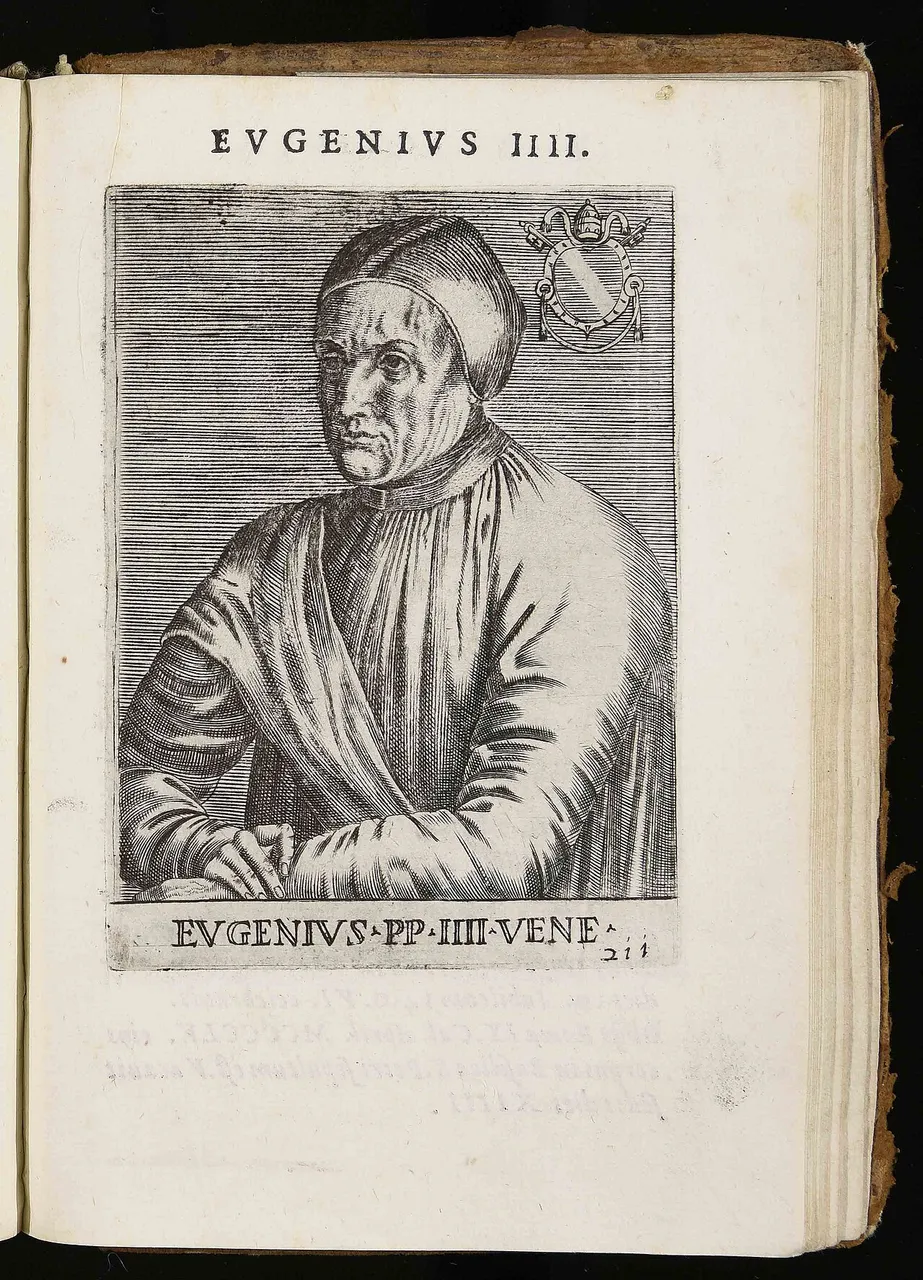 Pope Eugene IV in an engraving by Giovanni Battista de’ Cavalieri, 1580Wikimedia Commons, Giovanni Battista de'Cavalieri, CC0 (Eugenius IV. Eugenio IV.jpg)
Emperor John VIII Palaiologos sailed from Constantinople in November 1437 with Patriarch Joseph II and about 700 Greeks. He reached Venice in February 1438 and joined the council that Eugene had called to Ferrara, where the sessions with the Greeks began on 9 April 1438. The council moved to Florence in January 1439, and there on 6 July 1439 the union of the Greek and Latin churches was proclaimed in the decree Laetentur Caeli, which Eugene and John signed. Mark of Ephesus was the one Greek bishop who refused to sign, and after the Greeks returned most of the clergy and people of Constantinople rejected the union.
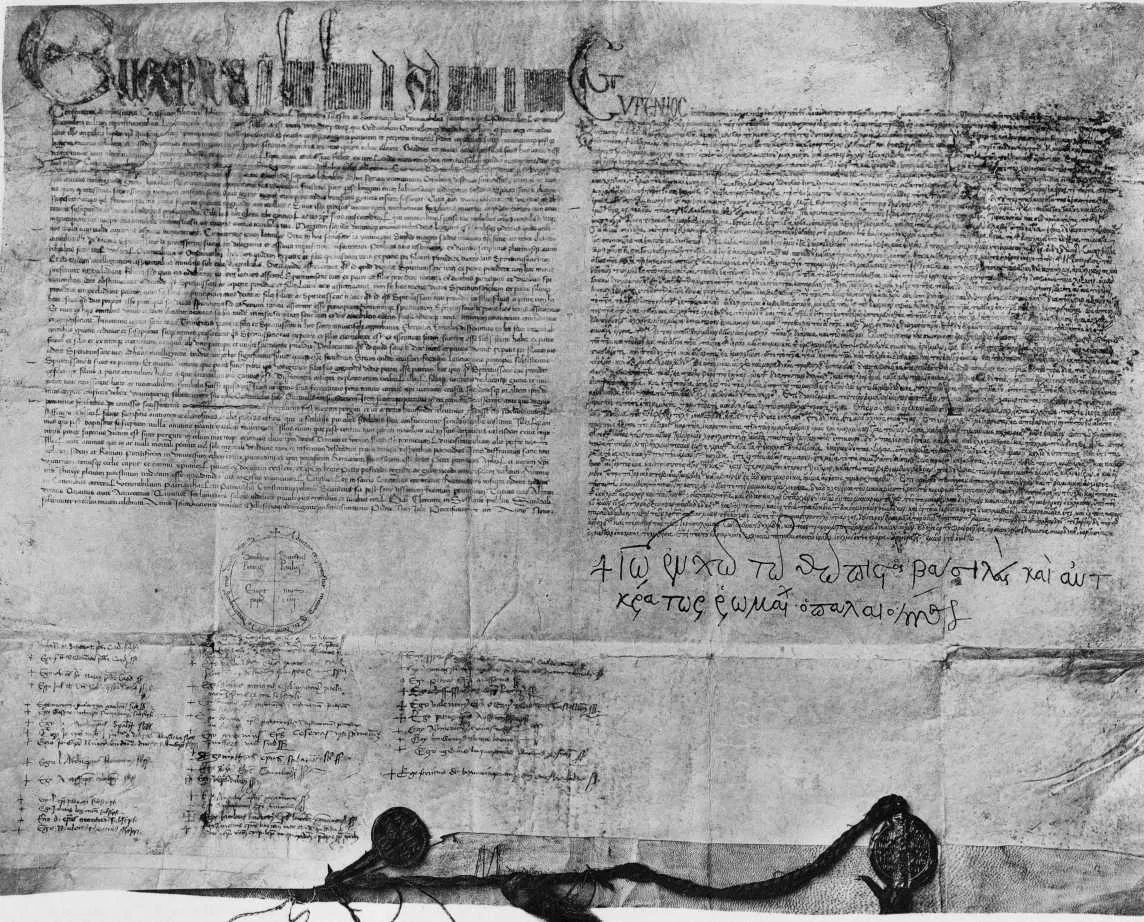 The bull of union of 1439 in Latin and Greek, with the signature of John VIII, the lead seal of the pope and the gold seal of the emperorWikimedia Commons, unknown scribe, Public domain (Union 1439.jpg)
Ibrahim II of Karaman has agreed with the Hungarians to attack the Ottomans at the same time as they do. In the spring of 1443, before the Hungarians are ready, he attacks the Ottoman lands west of his capital Konya, around Akşehir and Beyşehir, and Murad and his son Alaeddin Ali drive him back. Alaeddin dies in June 1443, after a fall from his horse by one account. Murad’s eldest son Ahmed died in 1437, and Mehmed, eleven years old, is now his heir.
Sources
- Sylvester Syropoulos, Memoirs (about 1445).
- Joseph Gill, The Council of Florence (1959).
- Kenneth M. Setton, The Papacy and the Levant (1204–1571), vol. 2 (1978).
- Colin Imber, The Crusade of Varna, 1443–45 (2006).
- Halil İnalcık, “Murād II”, in Encyclopaedia of Islam, 2nd ed., vol. 7 (1993), 594–595.
- Pál Engel, The Realm of St Stephen: A History of Medieval Hungary, 895–1526 (2001).
Prev: The Ialomița, 1442Next: Niš, 1443