1425 – 1450
Bursa and Edirne under Murad II
In 1425 and 1426 Murad builds a complex on the west side of Bursa, with a mosque, a medrese, a bath and a public kitchen. The mosque has the reversed T plan of the early Ottoman mosques, with a domed portico in front, and hexagonal tiles in turquoise and dark blue line its walls. Murad’s eldest son Ahmed, who dies in 1437, and his son Alaeddin, who dies in 1443, are buried beside it.
In Edirne Murad builds the Muradiye in 1435 and 1436 as a lodge of the Mevlevi dervishes with a public kitchen and a school, and its prayer hall is lined with blue and white tiles. Between 1438 and 1447 he builds the Üç Şerefeli Mosque in the centre of the city, first called the New Mosque. Its dome, 24 m across, is wider than any Ottoman dome before it, and the tallest of its four minarets, 67 m high, has the three balconies that give the mosque its name. The bridge at Uzunköprü, built by the architect Müslihiddin between 1426 and 1443, carries the road from Edirne to Gallipoli over the Ergene on 174 arches.
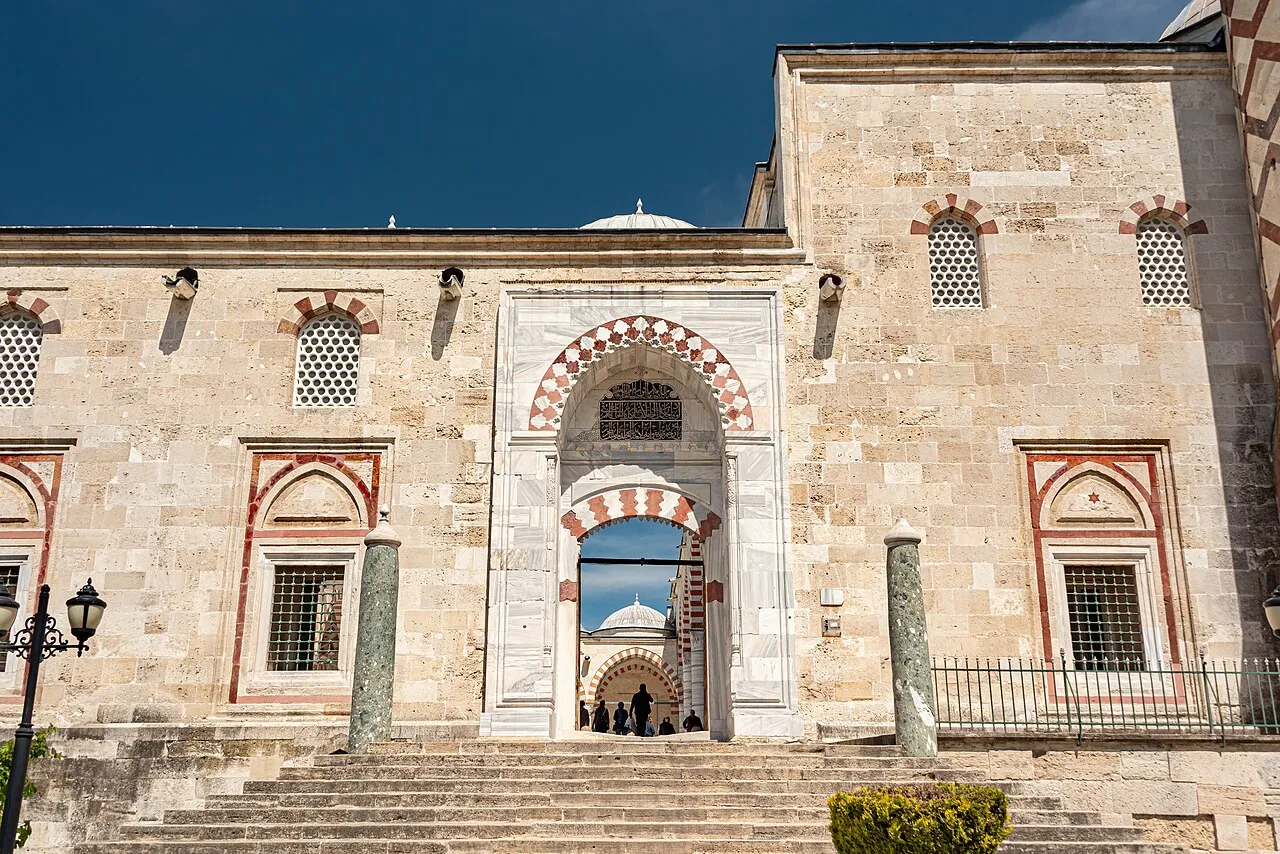 The Üç Şerefeli Mosque of Edirne, built for Murad in 1438–1447Wikimedia Commons, Jorge Franganillo, CC BY 4.0 (Edirne - Üç Şerefeli Camii - 54707214359.jpg)
Murad also begins a new palace by the Tunca north of Edirne. The Burgundian traveller Bertrandon de la Broquière sees him at Edirne in the winter of 1432–1433 and describes a short, stout man with a broad brown face, a round beard and a large hooked nose, and he puts the sultan’s yearly revenue at 2,500,000 ducats. Books in Persian and Arabic are translated into Turkish for Murad, among them the Kabusname, a Persian book of advice for rulers, which Mercimek Ahmed translates in 1432, and Yazıcızade Ali writes a history of the Seljuks for him. Murad writes poems under the name Muradî, and his wars are told in the Gazavât-ı Sultan Murad.
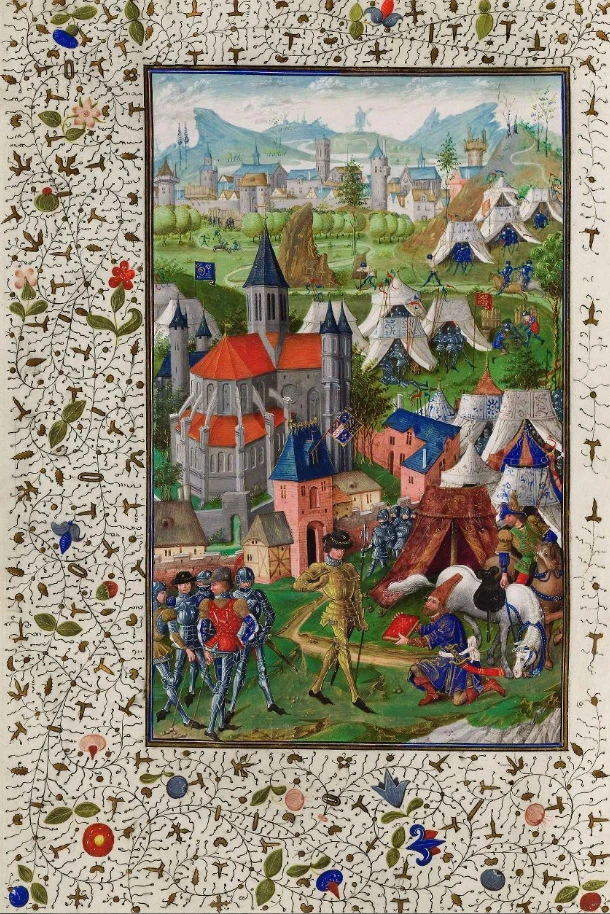 Bertrandon de la Broquière gives Duke Philip the Good a Latin Koran, painted by Jean Le Tavernier for a copy of his Voyage d’Outremer, about 1455, Bibliothèque nationale de FranceWikimedia Commons, Jean Le Tavernier, Public domain (Bertrandon de la Broquière offers a Koran to Duke Philip.png)
Sources
- Bertrandon de la Broquière, Le Voyage d’Outremer (about 1457).
- Aptullah Kuran, The Mosque in Early Ottoman Architecture (1968).
- Godfrey Goodwin, A History of Ottoman Architecture (1971).
- Halil İnalcık, “Murād II”, in Encyclopaedia of Islam, 2nd ed., vol. 7 (1993), 594–595.
- Cemal Kafadar, Between Two Worlds: The Construction of the Ottoman State (1995).
- Doğan Kuban, Ottoman Architecture (2010).
Prev: After Kosovo, 1448–1449Next: Krujë, 1450