4 August – 9 November 1444
The crusade breaks the truce, 1444
On 4 August 1444 at Szeged, before Cardinal Julian Cesarini, the barons and the prelates, Władysław swears to renounce any treaty with the sultan, present or future, and to lead a campaign against the Ottomans before the end of the year. Cesarini holds that an oath sworn to unbelievers does not bind, and his wording lets the king ratify the peace without giving up the crusade. In the week after the treaty is sworn Władysław offers John Hunyadi the crown of Bulgaria, and by mid-September the towns and estates promised in the treaty and in the agreements beside it have changed hands.
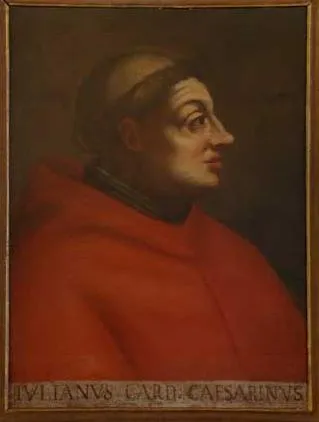 Cardinal Julian Cesarini, the papal legate in Hungary, in a portrait inscribed with his nameWikimedia Commons, unknown painter, CC0 (Giuliano Cesarini.jpg)
The army numbers about 16,000 men by Kenneth Setton’s figure: Hungarians, Poles, Transylvanians, Croats and Bosnians, heavy horsemen from western Europe and mercenaries. It crosses the Danube at Orșova on 20 or 22 September and marches down the right bank by Vidin and Oryahovo, leaving the Ottoman fortresses behind it. Bulgarians from the Danube towns join it, and Fruzhin, a son of Ivan Shishman, the last tsar of Tarnovo, comes with his own guard. Near Nikopol Vlad II’s son Mircea brings the Wallachian horsemen, 4,000 by Setton and 7,000 by John Jefferson, although Vlad has tried to talk the king out of the war.
From Nikopol the army turns east by Shumen and the castle of Petrich towards the Black Sea, where it expects to meet the crusade fleet, and in November it reaches Varna. Đurađ Branković, whose Serbia has been restored with Smederevo, stays out of the war. In Edirne the grand vizier Çandarlı Halil Pasha sends for Murad at Manisa to lead the army. Chronicles of the 17th century have the young Mehmed II himself order his father to come, and Halil İnalcık holds that the recall was Halil’s work.
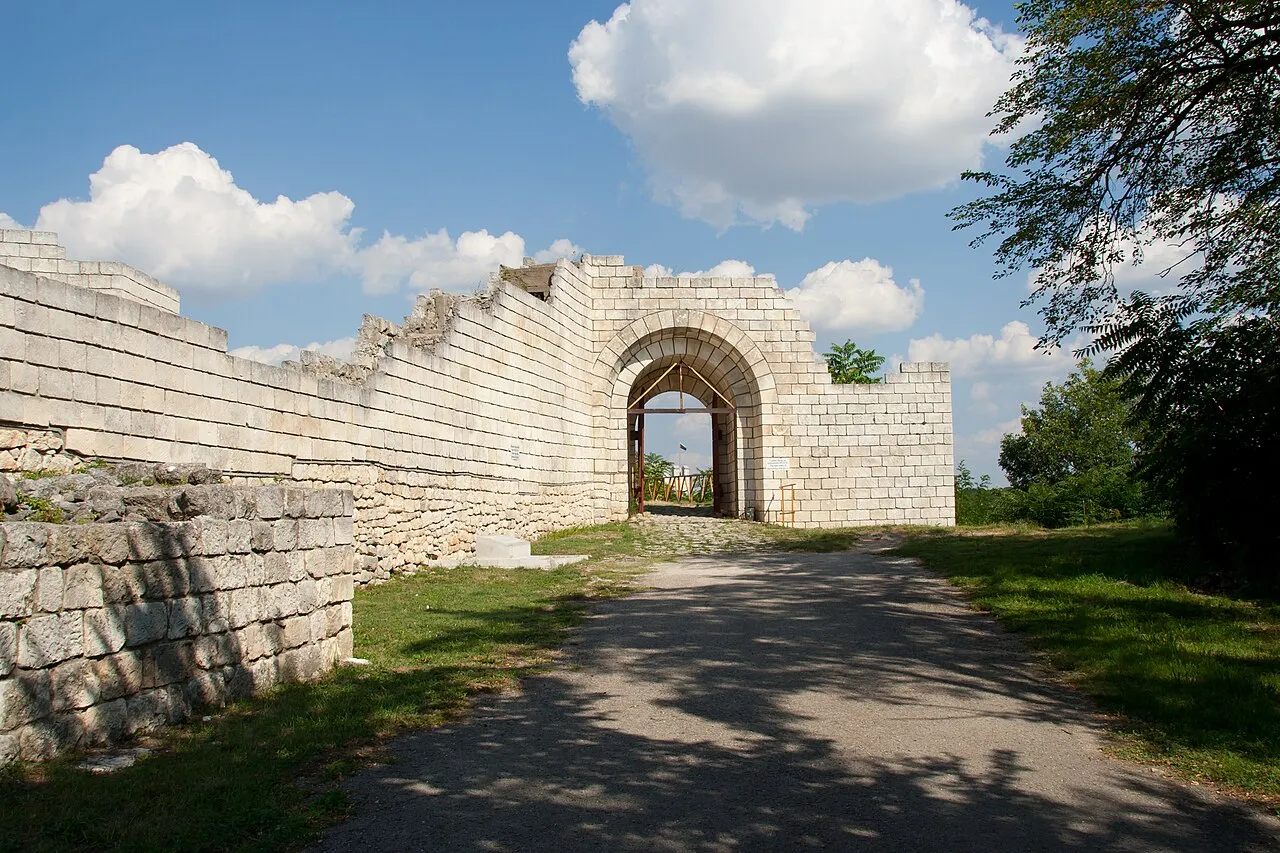 The gate of the medieval fortress of ShumenWikimedia Commons, Feradz, CC BY 3.0 (Shumen Fortress Gate.jpg)
Sources
- Jan Długosz, Annales seu Cronicae incliti Regni Poloniae (late 15th century).
- Laonikos Chalkokondyles, Histories (c. 1464).
- Oskar Halecki, The Crusade of Varna: A Discussion of Controversial Problems (1943).
- Kenneth M. Setton, The Papacy and the Levant (1204–1571), vol. 2 (1978).
- Pál Engel, The Realm of St Stephen: A History of Medieval Hungary, 895–1526 (2001).
- Colin Imber, The Crusade of Varna, 1443–45 (2006).
- John Jefferson, The Holy Wars of King Wladislas and Sultan Murad: The Ottoman-Christian Conflict from 1438–1444 (2012).
- Halil İnalcık, Fatih Devri Üzerinde Tetkikler ve Vesikalar I (1954).
Prev: Edirne and Szeged, 1444Next: The fleet in the straits, 1444