10 June – 6 September 1422
The siege of Constantinople, 1422
After Mustafa’s death, Murad takes the advice of his grand vizier Çandarlı İbrahim Pasha, the vizier Hacı İvaz Pasha and his tutor Yörgüç Pasha and turns on Byzantium, which had freed and backed Mustafa. On 10 June 1422 the vanguard under Mihaloğlu Mehmed Bey attacks Constantinople and lays waste its suburbs. Murad arrives from Edirne on 20 June with the main army and the siege engines, and his men raise an earthen rampart along the land walls, from the Sea of Marmara to the Golden Horn, to shelter from the stones of the Byzantine guns.
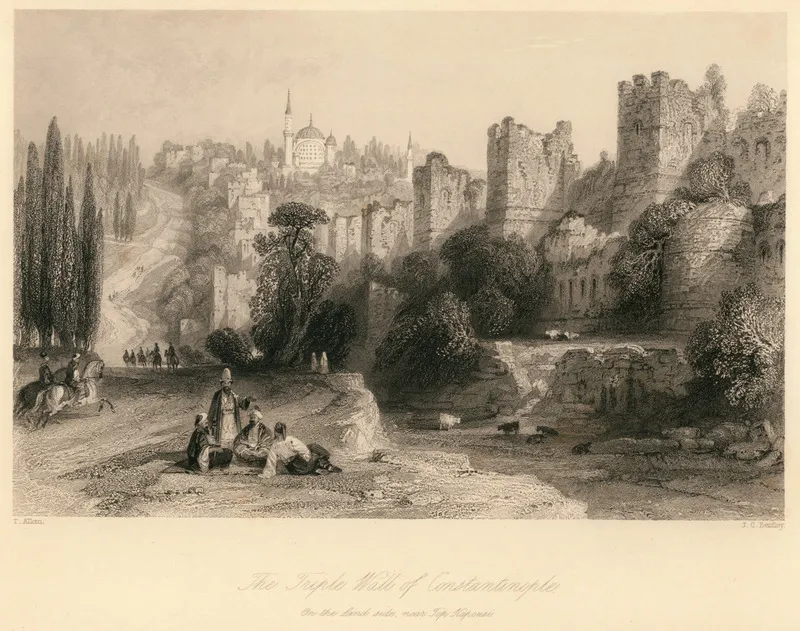 The triple land wall of Constantinople near Topkapı, the old Gate of St Romanos, engraved after Thomas Allom, 1836Wikimedia Commons, Thomas Allom, Public domain (The Triple Wall of Constantinople, on the land side near Top Kapoussi - Walsh Robert & Allom Thomas - 1836.jpg)
The Ottomans have cannon of their own for the first time in this siege. They fire at the wall between the Golden Gate and the Gate of St Romanos but do not breach it, and a general assault on 24 August fails. The eyewitness John Kananos writes that a woman in a purple robe was seen walking on the outer walls, and Byzantine tradition credits the Virgin with saving the city. Byzantium meanwhile backs Murad’s younger brother Mustafa in Anatolia, and on 6 September 1422 Murad lifts the siege to march against him.
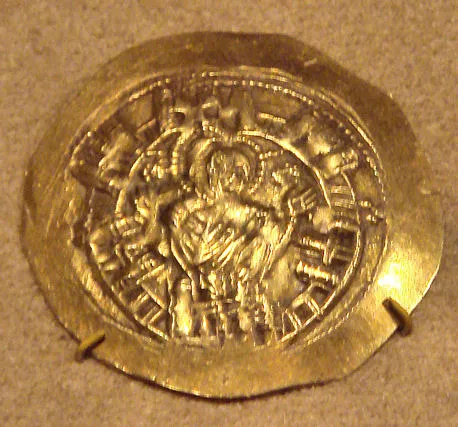 A gold hyperpyron of Michael VIII Palaiologos, 1261–1282, with the Virgin praying within the walls of ConstantinopleWikimedia Commons, PHGCOM, CC BY-SA 3.0 (MichaelVIIIPaleologusVirginMaryOverWallOfConstantinople.jpg)
In June 1422 Burak Bey, a son of Evrenos, whose family holds Giannitsa, lays siege to Thessalonica with the marcher lords of the Balkans. His men lay waste the suburbs and the western part of the Chalcidice. Despot Andronikos, a son of Manuel II, holds the city for Byzantium and sends repeated pleas for help to Constantinople, which has neither men nor money to send.
Sources
- John Kananos, Account of the Siege of Constantinople (1422).
- George Sphrantzes, Chronicon minus (about 1477).
- Doukas, Historia Turco-Byzantina (about 1462).
- Colin Imber, The Ottoman Empire, 1300–1481 (1990).
- Nevra Necipoğlu, Byzantium between the Ottomans and the Latins (2009).
- Donald M. Nicol, The Last Centuries of Byzantium, 1261–1453 (2nd ed., 1993).
Prev: Mustafa at Ulubad, 1422Next: Küçük Mustafa, 1422–1423