1465 – January 1475
Vaslui, 1475
Stephen the Great of Moldavia takes the Danube port of Kiliya (then Kilia) on 25 or 26 January 1465, and on 7 March 1471 he defeats Radu, the Ottoman vassal in Wallachia, at Soci. In 1473 he stops paying his tribute to the sultan. While Mehmed is at war with Uzun Hasan, Stephen marches from Suceava into Wallachia, defeats Radu again in a battle of three days at Râmnicu Sărat from 18 to 20 November 1473, takes Bucharest and makes Basarab Laiotă prince of Wallachia. Radu soon returns with Ottoman help, and by late 1474 Basarab too has gone over to the Ottomans.
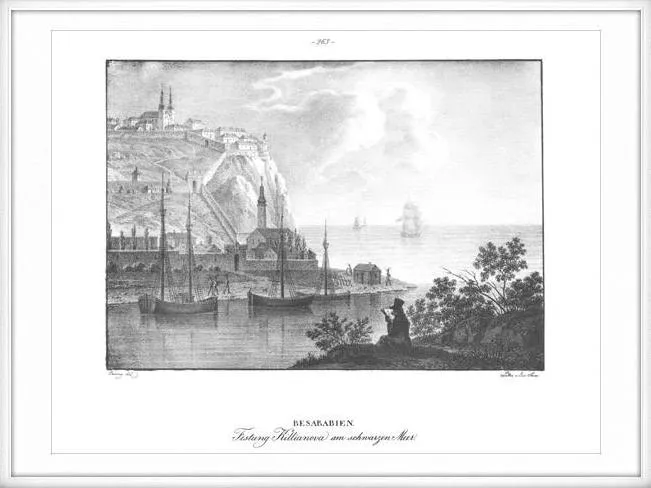 Kiliya on the Danube, a lithograph after Jakob Alt, 1826Wikimedia Commons, Jakob Alt, Public domain (Кілійська фортеця.JPG)
Mehmed orders Hadım Süleyman Pasha, the beylerbey of Rumelia, to take his army from the siege of Shkodër by Sofia into Moldavia. Süleyman crosses the frozen Danube and rests in Wallachia, where Basarab joins him with 17,000 men, and he enters Moldavia in December 1474. Stephen lays waste to the land before him and waits at the high bridge over the Bârlad near Vaslui, in a marshy valley with wooded hills on every side.
In fog on the morning of 10 January 1475 Stephen's guns and archers fire on the Ottomans from three sides, the wooden bridge breaks under their horsemen, and Moldavian buglers hidden behind the Ottoman lines spread confusion. Süleyman's army breaks, and Moldavian and Polish horsemen pursue it for three days as far as Isaccea (then Oblucița) on the Danube. The Wallachians leave the field without fighting, and Pope Sixtus IV calls Stephen a true champion of the Christian faith.
Sources
- Jan Długosz, Annales seu Cronicae incliti Regni Poloniae (about 1480).
- Franz Babinger, Mehmed the Conqueror and His Time (1978).
- Kenneth M. Setton, The Papacy and the Levant (1204–1571), vol. 2 (1978).
- Pál Engel, The Realm of St Stephen: A History of Medieval Hungary, 895–1526 (2001).
- Jonathan Eagles, Stephen the Great and Balkan Nationalism (2014).
Prev: Karaman ends, 1473–1475Next: Caffa and Theodoro, 1475