Summer – 15 August 1461
Trebizond, 1461
The Empire of Trebizond, ruled by the Komnenos dynasty since 1204, holds a strip of the Black Sea coast around Trebizond and pays the sultan 3,000 gold pieces a year from 1458. Emperor John IV gives his daughter Theodora in marriage to Uzun Hasan, ruler of the Aq Qoyunlu, who promises to defend Trebizond, and he wins promises of help from the Georgian kings and princes and from the beys of Sinop and Karaman. His brother David, who succeeds him in 1459 or 1460, asks the West for allies, and Uzun Hasan’s envoys tell Mehmed that the tribute of Trebizond is now to be paid to their master.
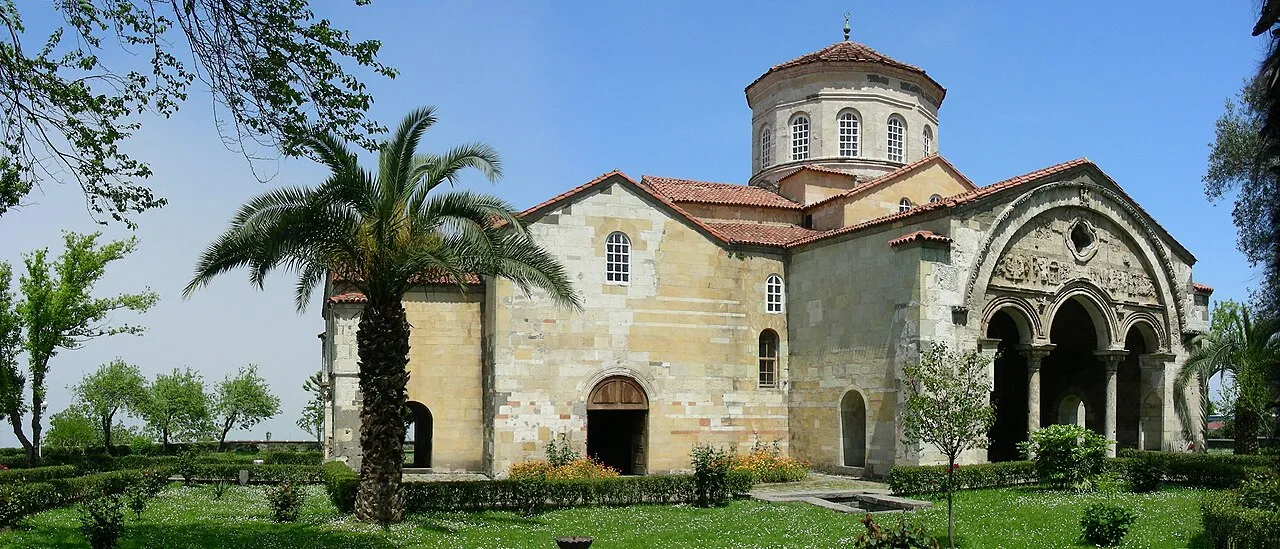 The church of Hagia Sophia at Trebizond, built in the 13th centuryWikimedia Commons, Herbert Frank, CC BY 2.0 (Trabzon, Hagia Sophia Ἁγία Σοφία (39484827385).jpg)
From Sinop Mehmed leads the army inland, and his admiral Kasım Pasha sails with the fleet along the coast to Trebizond. The march takes more than a month through mountains, rain and mud. Past Sivas the army enters the lands of the Aq Qoyunlu, and the Ottomans storm Uzun Hasan’s border fortress of Koyulhisar. Uzun Hasan’s mother Sara Khatun comes to Mehmed’s camp with gifts to ask for peace, and Mehmed makes peace with Uzun Hasan but leaves Trebizond out of it and keeps Sara Khatun with the army until the end of the campaign.
The fleet has besieged Trebizond for 32 days when Mahmud Pasha’s vanguard crosses the Zigana pass. Mahmud offers David terms through the court official George Amiroutzes, his cousin, in the account of Chalkokondyles, or through Thomas Katabolinos in that of Kritovoulos: if David gives up the city, he keeps his life and his wealth and receives estates elsewhere. No help comes from Uzun Hasan or from Georgia, and Mehmed enters Trebizond on 15 August 1461, which ends the last Byzantine state. David and his family are taken to Constantinople, where he and his sons are executed in 1463, and many of the townspeople are moved to Constantinople or enslaved.
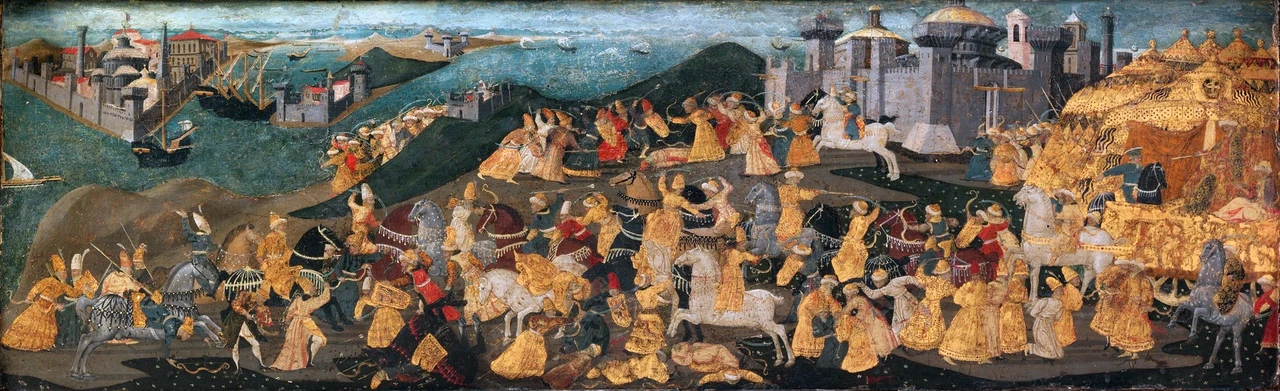 The conquest of Trebizond on the front of a Florentine wedding chest from the workshop of Apollonio di Giovanni, painted soon after 1461, Metropolitan Museum of ArtWikimedia Commons, workshop of Apollonio di Giovanni, Public domain (Cassone Conquest of Trebizond Apollonio di Giovanni di Tomaso.png)
Sources
- Michael Kritovoulos, History of Mehmed the Conqueror (about 1467).
- Doukas, Historia Turco-Byzantina (about 1462).
- Laonikos Chalkokondyles, Histories (c. 1464).
- Tursun Beg, Tarih-i Ebü’l-Feth (about 1490).
- Konstantin Mihailović, Memoirs of a Janissary (about 1500).
- William Miller, Trebizond: The Last Greek Empire (1926).
- Franz Babinger, Mehmed the Conqueror and His Time (1978).
- Donald M. Nicol, The Last Centuries of Byzantium, 1261–1453 (2nd ed., 1993).
- John E. Woods, The Aqquyunlu: Clan, Confederation, Empire (2nd ed., 1999).
Prev: Amasra and Sinop, 1460–1461Next: Vlad’s war on the Danube, 1462