Summer – autumn 1451
Karaman, 1451
In 1451 Ibrahim II of Karaman takes Seydişehir and Akşehir from the Ottomans and stirs up the heirs of the beyliks that the Ottomans had annexed. Mehmed crosses to Anatolia in the summer and marches against him, and Ibrahim, who rules from Konya, submits and makes peace. It is the first campaign of Mehmed’s reign.
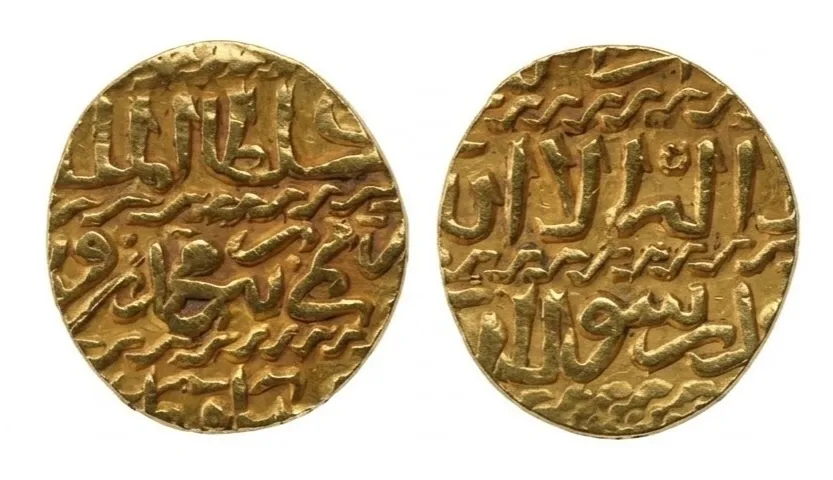 A gold coin of İbrahim II, bey of Karaman from 1424 to 1464Wikimedia Commons, unknown author, CC0 (Gold dirhem Ibrahim II Karamanid.jpg)
On the march home the janissaries demand a gift for the new sultan’s accession, and Mehmed pays it. Every sultan after him pays the janissaries such a gift when he takes the throne.
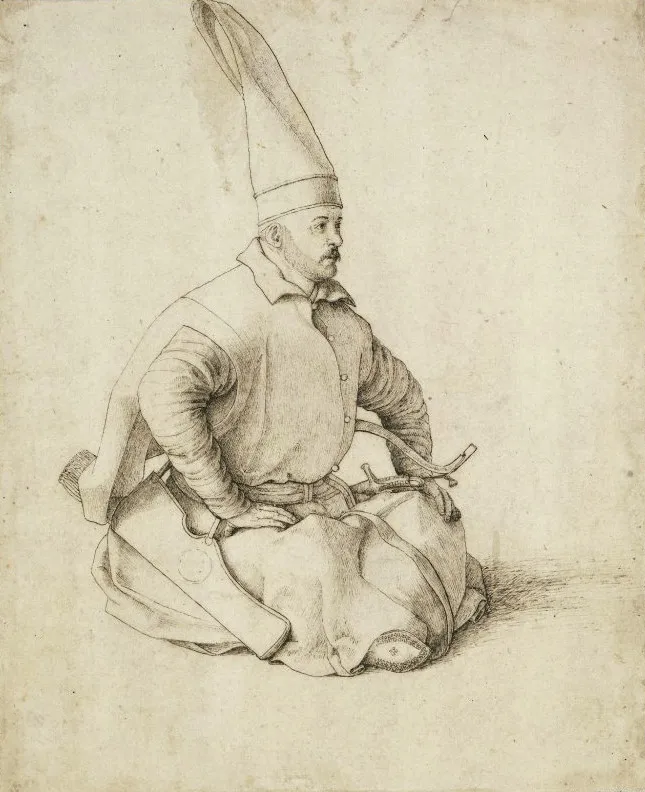 A janissary, drawn by Gentile Bellini in Constantinople in 1479–1481Wikimedia Commons, Gentile Bellini, Public domain (Yenieri-aturkishjanissary-gentilebellini.jpg)
While Mehmed is in Anatolia, Constantine XI sends envoys to ask for more money for the upkeep of Orhan Çelebi, the only other living man of the Ottoman house, who lives as a hostage in Constantinople. The envoys hint that Orhan may be set free to claim the throne. Doukas places the embassy in 1451, during the Karaman campaign, and Caroline Finkel places it in 1452. Halil receives the envoys at Bursa and sends them away with angry words, and back at Edirne Mehmed stops the revenues set aside for Orhan.
Sources
- Doukas, Historia Turco-Byzantina (about 1462).
- Aşıkpaşazade, Tevârîh-i Âl-i Osmân (late 15th century).
- Mehmed Neşri, Kitâb-ı Cihan-nümâ (late 15th century).
- Franz Babinger, Mehmed the Conqueror and His Time (1978).
- Halil İnalcık, “Meḥemmed II”, in Encyclopaedia of Islam, 2nd ed., vol. 6 (1991), 978–981.
- Donald M. Nicol, The Immortal Emperor: The Life and Legend of Constantine Palaiologos (1992).
- Caroline Finkel, Osman’s Dream: The Story of the Ottoman Empire, 1300–1923 (2005).
Prev: Mehmed takes the throne, 1451Next: The castle on the Bosporus, 1452