1453 – 1481
Istanbul rebuilt, 1453–1481
Mehmed makes Constantinople his capital, and the Ottomans call the city Kostantiniyye and Istanbul. At the conquest it has about 30,000 to 40,000 people by modern estimates. Mehmed orders Muslims, Christians and Jews from all his lands to settle there, and after his conquests he moves people to the city by force, from Trebizond in 1461, from Konya, Larende and Aksaray in Karaman after 1468 and from Caffa in 1475. The Greeks and Genoese of Galata get their houses back, Gennadios becomes patriarch of the Orthodox in January 1454 and a few years later moves his seat to the Pammakaristos, and Moses Capsali becomes the chief rabbi.
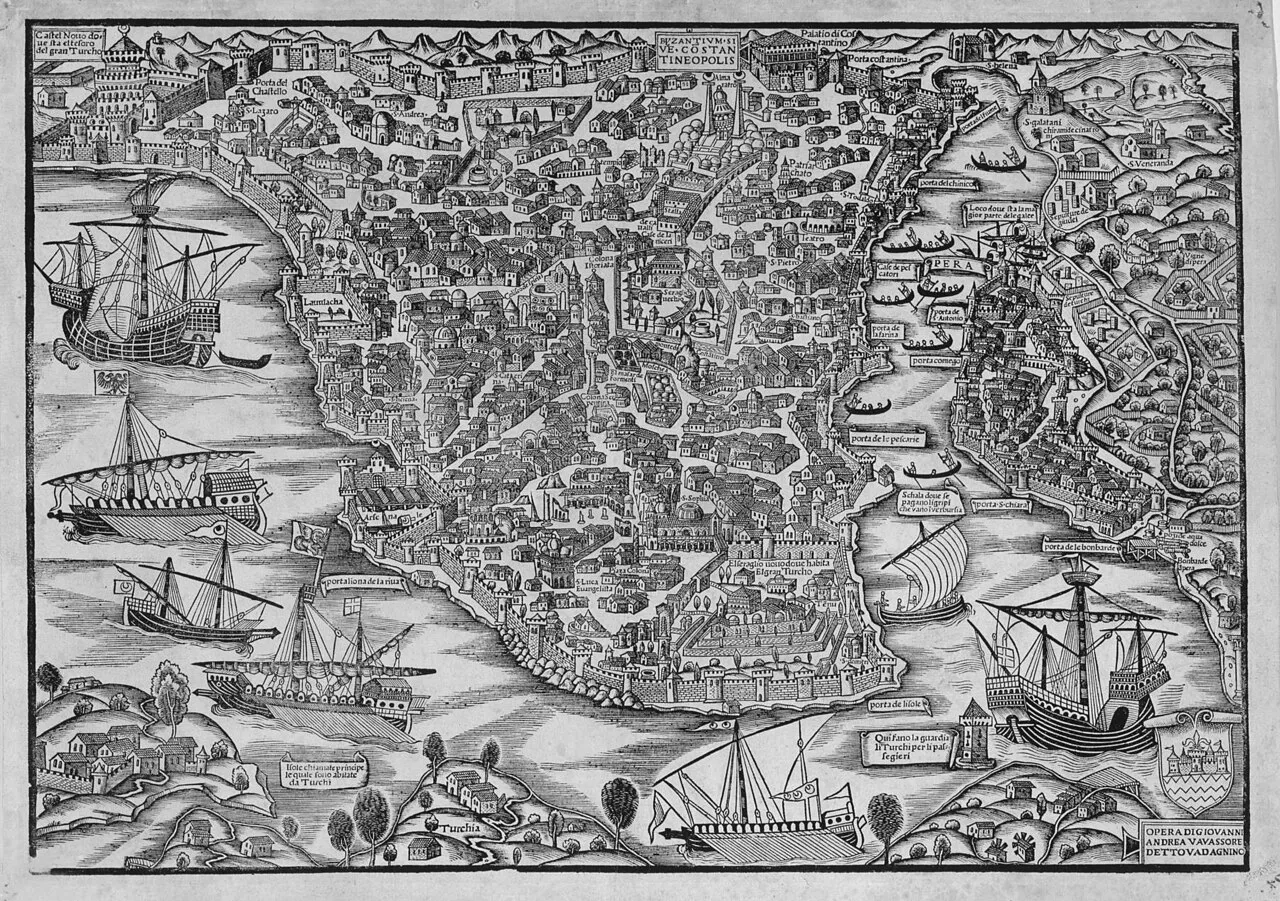 Constantinople in a woodcut by Giovanni Andrea Vavassore, about 1535, after a view of the city in Mehmed’s timeWikimedia Commons, Giovanni Andrea Vavassore, Public domain (Giovanni Andreas Vavassore, Byzantivm sive Costantineopolis.jpg)
Mehmed builds his first palace on the site of the Forum of Theodosius, later called the Old Palace, and makes Hagia Sophia the main mosque of the city. In 1455–1461 he builds a covered market for cloth and jewels, the core of the later Grand Bazaar, and gives its income to Hagia Sophia. In 1458 Yedikule, a fort of seven towers built round the Golden Gate, becomes the treasury, and a mosque is built at Eyüp beside the newly found tomb of Abu Ayyub al-Ansari, a companion of the Prophet Muhammad.
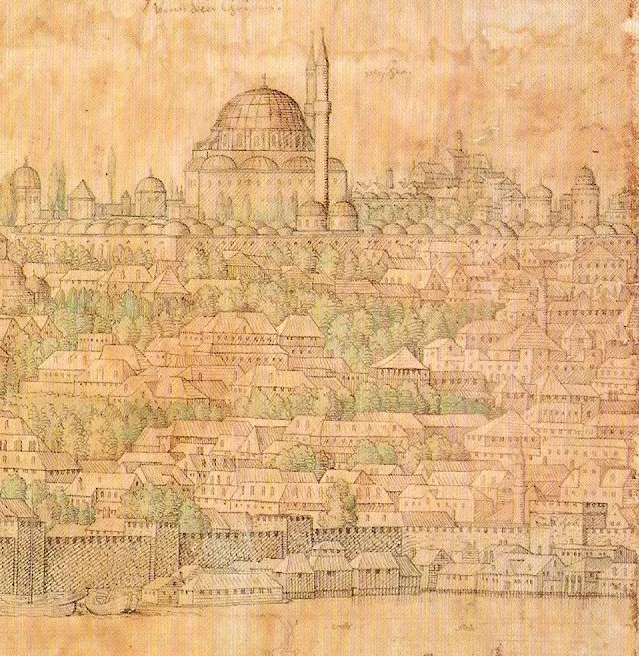 Mehmed’s mosque and its colleges in Melchior Lorck’s panorama of Constantinople, 1559Wikimedia Commons, Melchior Lorck, Public domain (Fatihcomplex.jpg)
From 1459 Mehmed builds the New Palace, today’s Topkapı Palace, on the point where the acropolis of ancient Byzantion stood, with the Tiled Kiosk of 1472 in its outer garden and its main gate of 1478. In 1463–1470 the architect Atik Sinan builds the Fatih Mosque on the site of the Church of the Holy Apostles, with eight medreses, a hospital, a library, a public kitchen, a caravanserai, a bath and 280 shops round it. A count of 1477 finds 14,803 households in the city: 8,951 Muslim, 3,151 Greek Orthodox, 1,647 Jewish and 372 Armenian, 384 Armenian and Greek households from Karaman, 267 from Caffa and 31 Roma. Galata has 1,521 more.
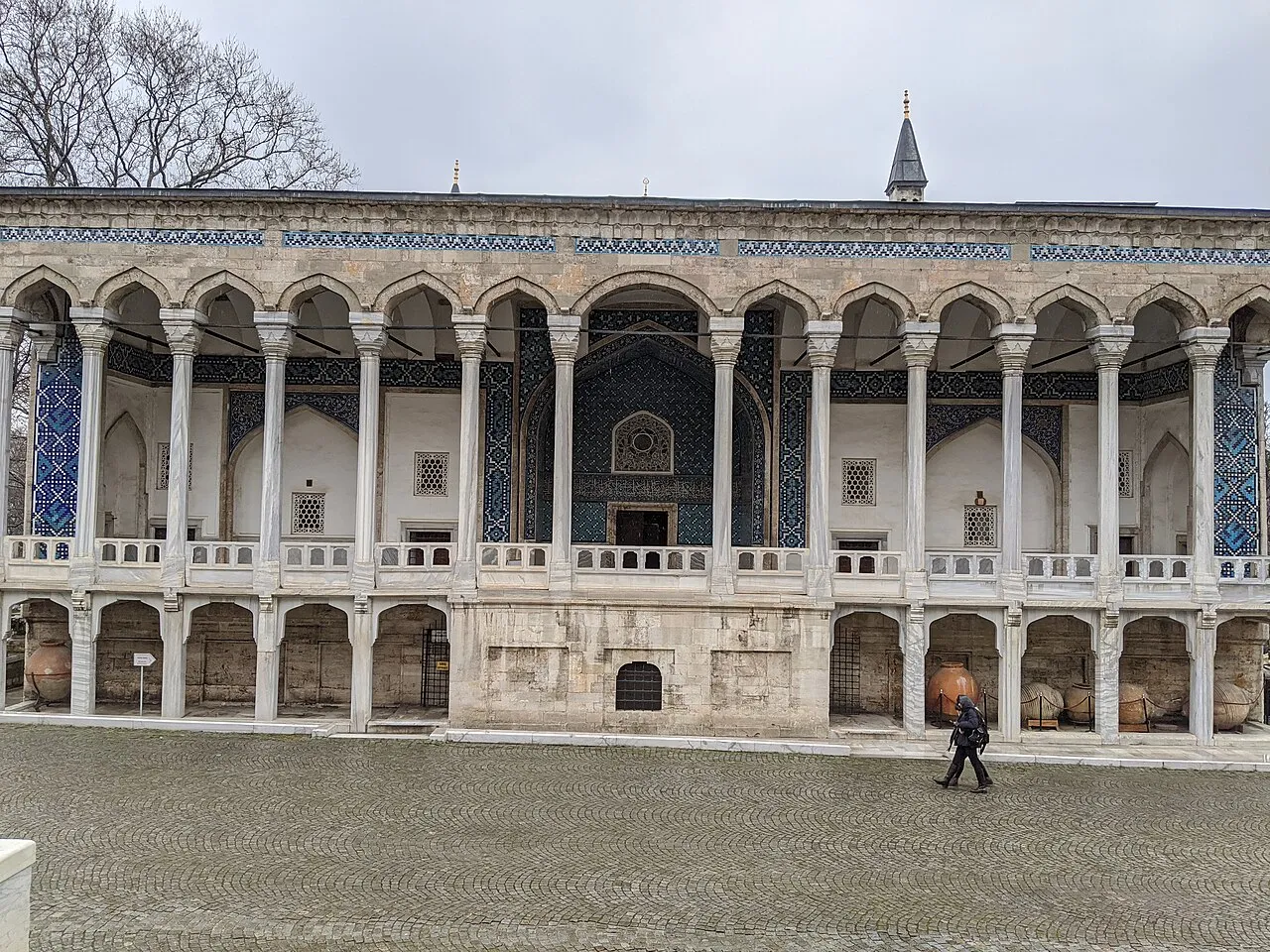 The Tiled Kiosk of 1472 in the outer garden of Topkapı PalaceWikimedia Commons, Mustafa-trit20, CC BY-SA 4.0 (Tiled Kiosk exterior, Istanbul Archaeology Museum.jpg)
Sources
- Michael Kritovoulos, History of Mehmed the Conqueror (about 1467).
- Tursun Beg, Tarih-i Ebü’l-Feth (about 1490).
- Halil İnalcık, “The Policy of Mehmed II toward the Greek Population of Istanbul and the Byzantine Buildings of the City”, Dumbarton Oaks Papers 23/24 (1969–1970).
- Franz Babinger, Mehmed the Conqueror and His Time (1978).
- Gülru Necipoğlu, Architecture, Ceremonial, and Power: The Topkapı Palace in the Fifteenth and Sixteenth Centuries (1991).
- Doğan Kuban, Istanbul: An Urban History (1996).
Prev: The peace with Venice, 1479Next: The sultan’s law