15 May – autumn 1458
Corinth and Athens, 1458
By 1458 the despots Thomas and Demetrios owe the sultan three years of tribute, and each of them is asking the West for help against him. Mehmed leaves Edirne in spring 1458 and waits in Thessaly for the despots’ envoys, but only Thomas sends his, with 4,500 ducats. On 15 May the army enters the Morea, and Mehmed leaves his Anatolian troops to besiege the Acrocorinth, the citadel of Corinth, which Nikephoros Loukanes holds for Demetrios. Mehmed leads the rest of the army through Corinthia, the Argolid and Arcadia: at Phlius the Ottomans cut the water supply, enter the castle during the talks for its surrender and kill the garrison, and Mouchli falls after three days.
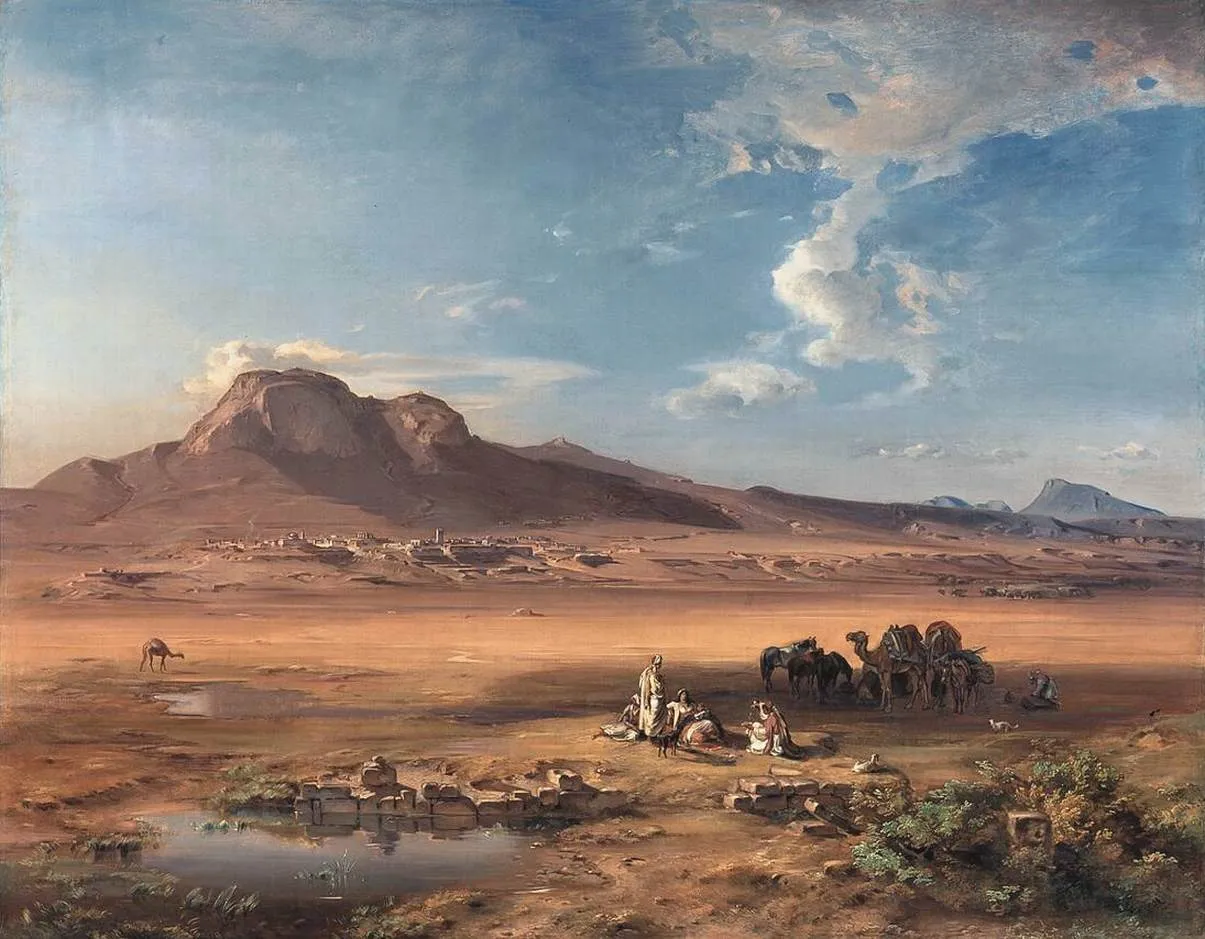 Corinth and the Acrocorinth, painted by Carl Rottmann in 1847Wikimedia Commons, Carl Rottmann, Public domain (Carl Anton Joseph Rottmann - Corinth with Akrocorinth - WGA20150.jpg)
Thomas waits at a small port, ready to sail for Italy, and Demetrios leaves Mistra for Monemvasia. The army turns north-west to Patras, Thomas’s capital, whose people have fled, and its citadel surrenders after a short siege, or only under the treaty of August by Sphrantzes’s account. Mehmed comes back along the coast to Corinth, where Matthew Palaiologos Asen has slipped into the citadel by night with 70 men and supplies, and when the food runs out Asen surrenders the Acrocorinth on 6 August 1458: the garrison may leave, and the townspeople keep their homes. Acting for the despots, Asen agrees a new treaty: the north-eastern third of the Morea, with Corinth, Patras and Kalavryta, becomes Ottoman, and the despots keep the rest for a tribute of 3,000 gold pieces a year.
Mehmed makes Turahan’s son Ömer Bey governor of the new province. Ömer’s troops have held the town of Athens since 1456, and in June 1458 its duke, Francesco II Acciaioli, and the townspeople who have held out with him on the Acropolis surrender, which ends the Duchy of Athens. In August Mehmed visits Athens, and Ömer takes up residence in the ducal palace in the Propylaea. In early autumn Mehmed returns to Edirne with thousands of prisoners from the Morea, whom he settles in Constantinople.
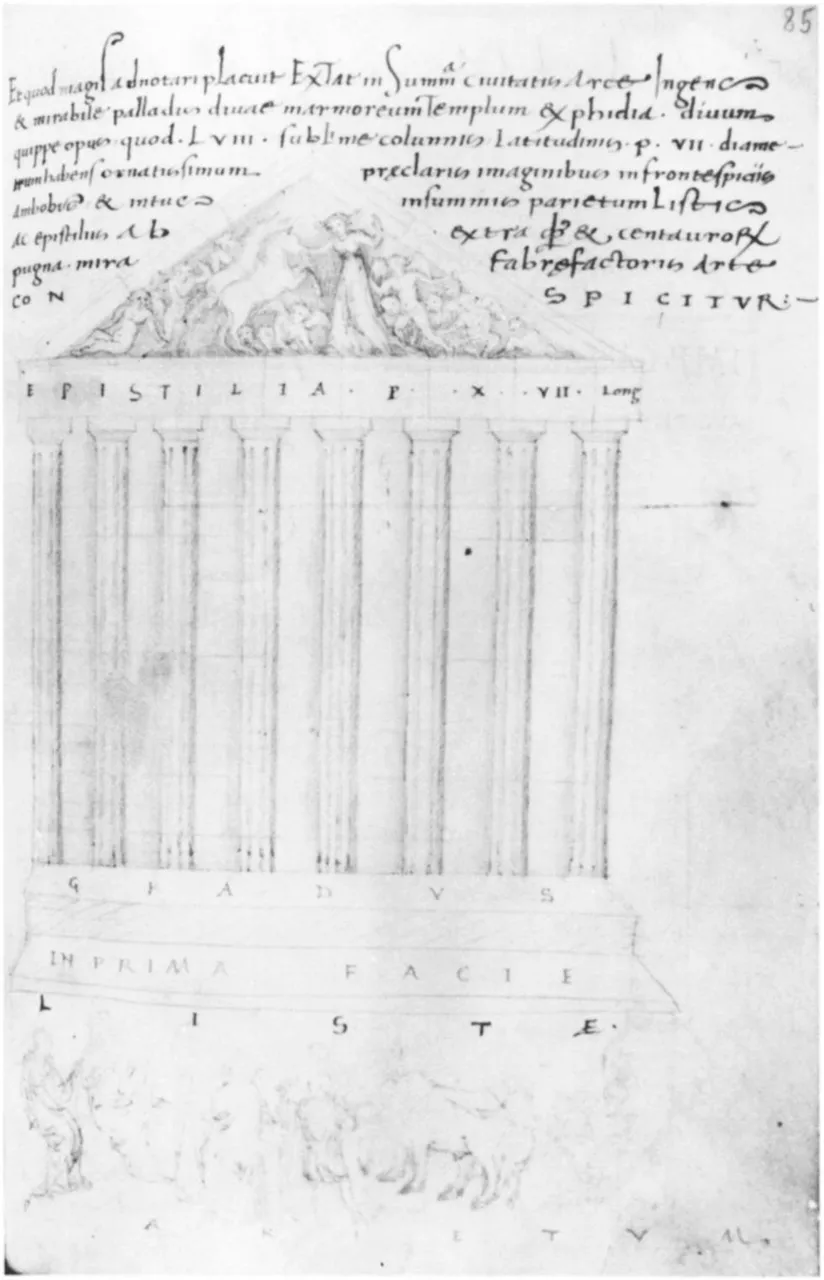 The Parthenon in a 15th-century copy of a drawing by Cyriac of Ancona, who saw Athens in 1436 and 1444Wikimedia Commons, after Cyriac of Ancona, Public domain (CiriacoParthenon.JPG)
Sources
- Laonikos Chalkokondyles, Histories (c. 1464).
- Michael Kritovoulos, History of Mehmed the Conqueror (about 1467).
- George Sphrantzes, Chronicon minus (about 1477).
- Dionysios Zakythinos, Le Despotat grec de Morée, vol. 1 (1932).
- Franz Babinger, Mehmed the Conqueror and His Time (1978).
- Kenneth M. Setton, The Papacy and the Levant (1204–1571), vol. 2 (1978).
- Steven Runciman, Lost Capital of Byzantium: The History of Mistra and the Peloponnese (1980).
- Donald M. Nicol, The Last Centuries of Byzantium, 1261–1453 (2nd ed., 1993).
Prev: Albulena, 1457Next: Smederevo, 1458–1460