2 – 6 April 1453
The walls and the armies
On 2 April 1453 the first Ottoman troops reach the walls of Constantinople, and on 5 April Mehmed arrives with the rest of the army and pitches his tent on the hill of Maltepe, facing the gate of St Romanos. The land walls run about 5.7 km from the Sea of Marmara to Blachernae: a moat about 18 m wide, then an outer and an inner wall with towers every 45 to 55 m. At the north end, round the palace of Blachernae, the city has a single wall and no moat. Karaca Pasha’s Rumelian troops hold the line from the Horn to the Charisian gate, Mehmed with the janissaries and the guns the middle, İshak Pasha’s Anatolian troops the line from the Lycus stream to the Marmara, and Zaganos Pasha’s troops the hills north of the Horn behind Galata.
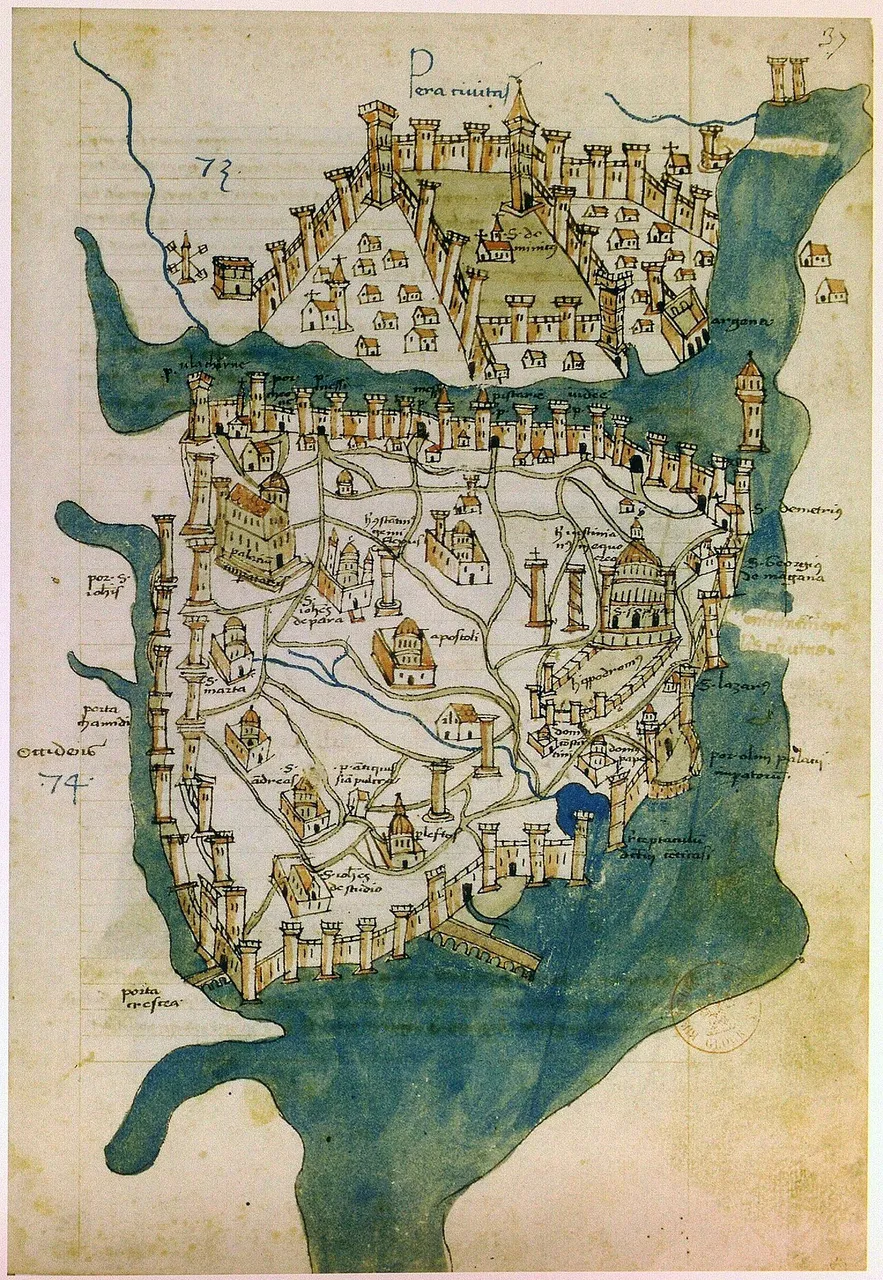 Constantinople in a copy of Cristoforo Buondelmonti’s Book of the Islands made before 1430, Bibliothèque nationale de FranceWikimedia Commons, Cristoforo Buondelmonti, Public domain (Map of Constantinople, Buondelmonti.jpg)
The defenders number about 7,000, 2,000 of them foreigners, and they man only the outer wall. Constantine XI holds the Mesoteichion, the middle of the land walls where the Lycus passes under them, and Giustiniani with his Genoese the Charisian gate. North of them stand the Bocchiardi brothers, the engineer Johannes Grant at the Kaligaria gate and the Venetian bailo Girolamo Minotto at the palace. To the south Maurizio Cataneo holds the gate of Pege, Filippo Contarini the walls down to the Golden Gate, Manuel the Genoese the gate itself and Demetrios Kantakouzenos the south end. Theophilos Palaiologos, a kinsman of the emperor, stands with Grant at the Kaligaria gate in the account of Kaldellis, and with Cataneo at the gate of Pege in that of Runciman.
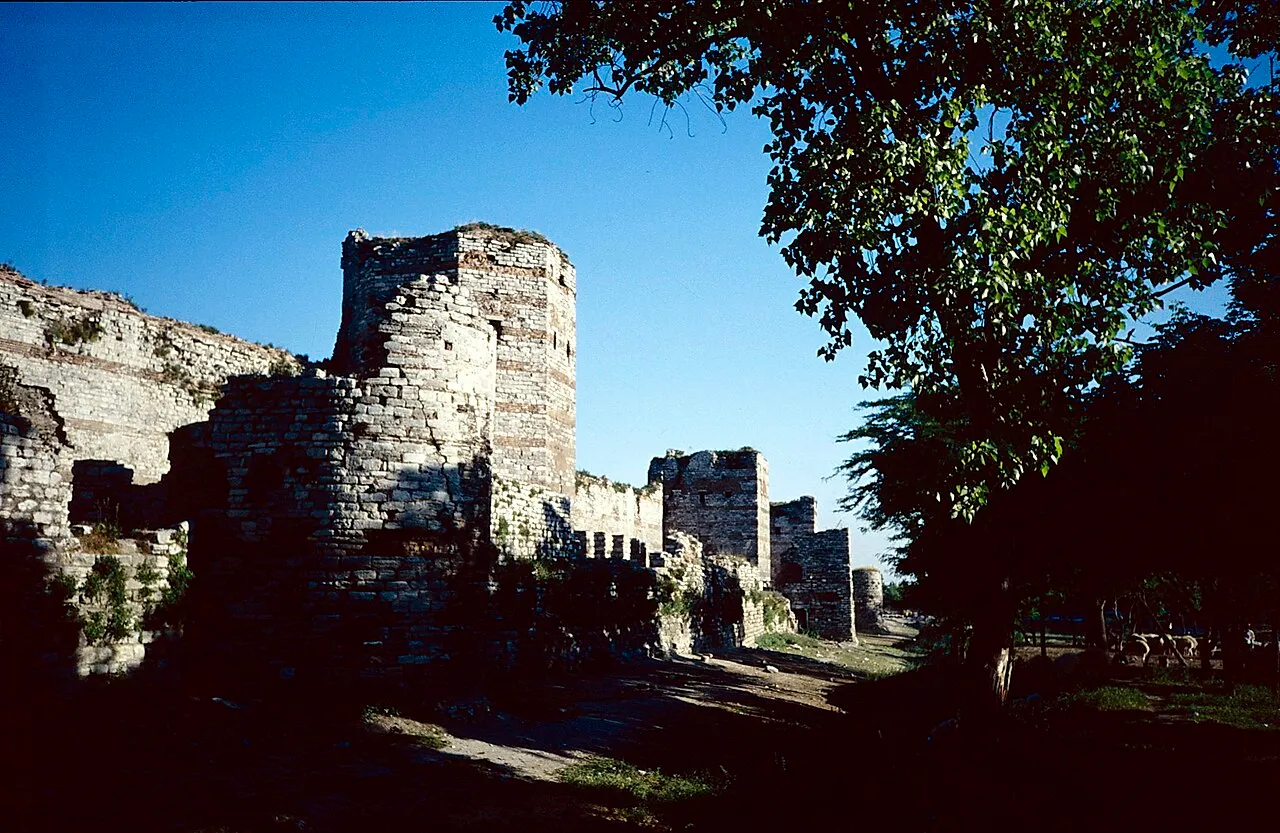 Towers of the Theodosian land walls of ConstantinopleWikimedia Commons, Peter Christian Riemann, CC BY-SA 4.0 (Theodosian Walls of Constantinople, Istanbul (1991).jpg)
On the Marmara walls Jacopo Contarini holds Studios, Prince Orhan, a claimant to the Ottoman throne, holds the harbour of Eleutherios with his Turks, Genoese and Catalan troops hold the old Great Palace, and Cardinal Isidore holds the Acropolis point. Gabriele Trevisano’s Venetian and Genoese sailors hold the walls along the Horn, where Loukas Notaras holds the Petrion, although some accounts put him with a reserve in the Petra quarter behind the land walls. Nikephoros Palaiologos keeps the other reserve at the church of the Holy Apostles, and 26 ships under the Venetian Alviso Diedo lie in the Horn.
Sources
- Nicolò Barbaro, Giornale dell’assedio di Costantinopoli (1453).
- Leonard of Chios, Historia Constantinopolitanae urbis a Mahumete captae (1453).
- Doukas, Historia Turco-Byzantina (about 1462).
- Michael Kritovoulos, History of Mehmed the Conqueror (about 1467).
- George Sphrantzes, Chronicon minus (about 1477).
- Tursun Beg, Tarih-i Ebü’l-Feth (about 1490).
- Steven Runciman, The Fall of Constantinople 1453 (1965).
- Franz Babinger, Mehmed the Conqueror and His Time (1978).
- Donald M. Nicol, The Immortal Emperor: The Life and Legend of Constantine Palaiologos (1992).
- David Nicolle, Constantinople 1453: The End of Byzantium (2000).
- Anthony Kaldellis, 1453: The Conquest and Tragedy of Constantinople (2026).
Prev: Before the siege, 1452–1453Next: The chain across the Horn