22 – 23 July 1456
The sortie of 22 July
By some accounts the fighting of 22 July starts without orders. Crusaders climb out over the broken walls against Hunyadi’s orders, take up positions across from the Ottoman line and harass its soldiers. Sipahis try to drive them off and fail, more defenders join them, and the skirmish turns into a battle. John of Capistrano first tries to call his men back, then leads about 2,000 of them across the Sava against the Ottoman flank and rear. At the same time Hunyadi charges out of the fortress and takes the Ottoman guns.
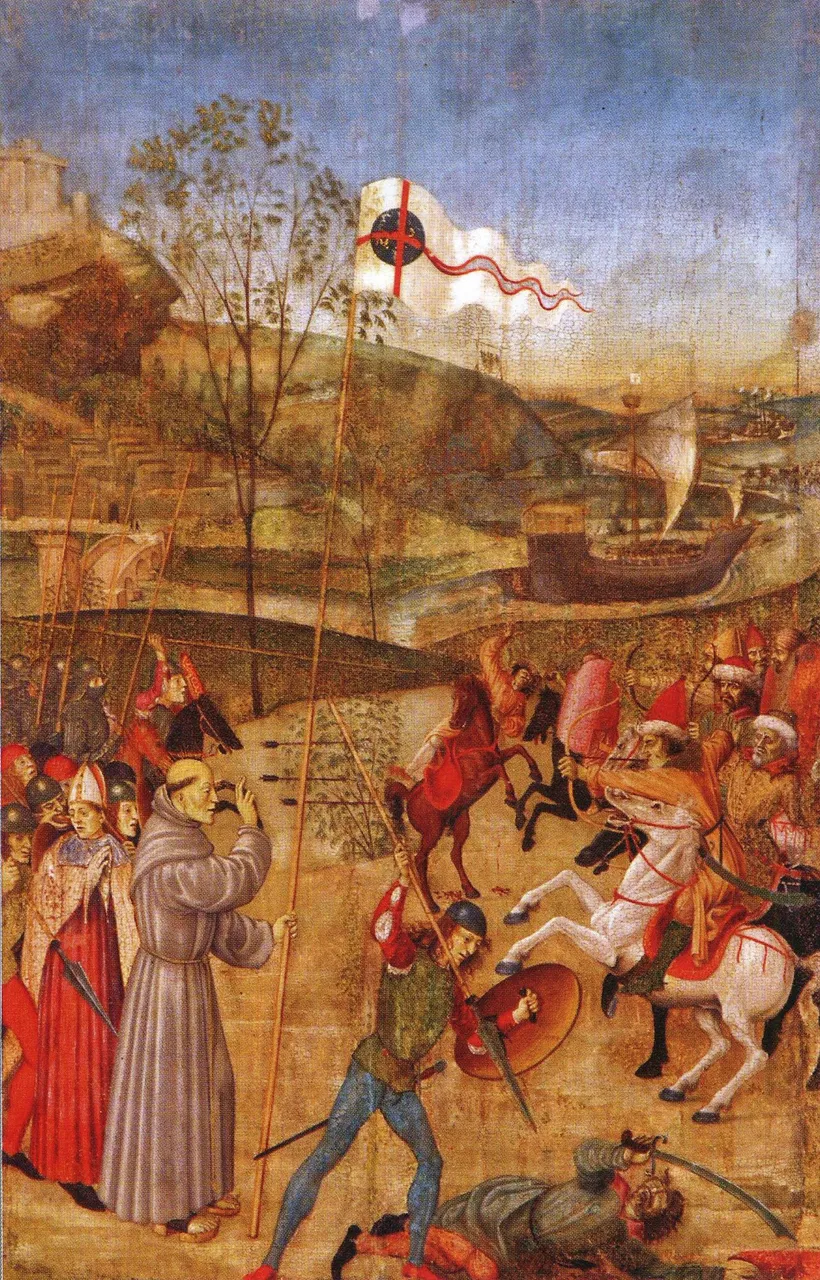 Capistrano with the crusaders at Belgrade, painted by Giovanni di Bartolomeo dell’Aquila, 15th centuryWikimedia Commons, Giovanni di Bartolomeo dell’Aquila, Public domain (Giovanni di Bartolomeo d’Aquila - Kapisztrán Szent János a nándorfehérvári csatában.jpg)
The Christians reach the Ottoman camp. One of the viziers advises Mehmed to leave it, but he refuses, because flight would be a sign of cowardice, and he joins the fighting with two of his beys. He kills three men by Tursun Beg’s account and one by Chalkokondyles’s, and he is wounded. The Turkish accounts also tell that Hasan, the agha of the janissaries, is killed. The sultan’s example and fresh troops rally his army, and it drives the Christians out of the camp, but it fails to take back the guns.
The Ottoman council decides to end the siege. In the night of 22 to 23 July the army buries its dead, loads its wounded on a long column of wagons and marches away to the south-east, and the Christians do not pursue. The next day the crusaders enter the empty camp and find great plunder. The Ottomans lose about 13,000 men, or 4,000 to 5,000 by Babinger’s estimate, and all their guns.
Sources
- Laonikos Chalkokondyles, Histories (c. 1464).
- Michael Kritovoulos, History of Mehmed the Conqueror (about 1467).
- Tursun Beg, Tarih-i Ebü’l-Feth (about 1490).
- Aşıkpaşazade, Tevârîh-i Âl-i Osmân (late 15th century).
- Konstantin Mihailović, Memoirs of a Janissary (about 1500).
- János Thuróczy, Chronica Hungarorum (1488).
- Antonio Bonfini, Rerum Ungaricarum decades (about 1497).
- Franz Babinger, Mehmed the Conqueror and His Time (1978).
- Kenneth M. Setton, The Papacy and the Levant (1204–1571), vol. 2 (1978).
- Pál Engel, The Realm of St Stephen: A History of Medieval Hungary, 895–1526 (2001).
- Tamás Pálosfalvi, From Nicopolis to Mohács: A History of Ottoman-Hungarian Warfare, 1389–1526 (2018).
Prev: The assault of 21 JulyNext: After Belgrade, 1456–1458