18 February – November 1451
Mehmed takes the throne, 1451
At the news of his father’s death Mehmed rides from Manisa to Edirne and takes the throne on 18 February 1451, and his infant half-brother Ahmed is put to death on his orders. Mehmed keeps Çandarlı Halil Pasha, grand vizier since 1439, in office and makes İshak Pasha beylerbey of Anatolia. Zaganos Pasha, whom Halil had sent into exile, comes back to court.
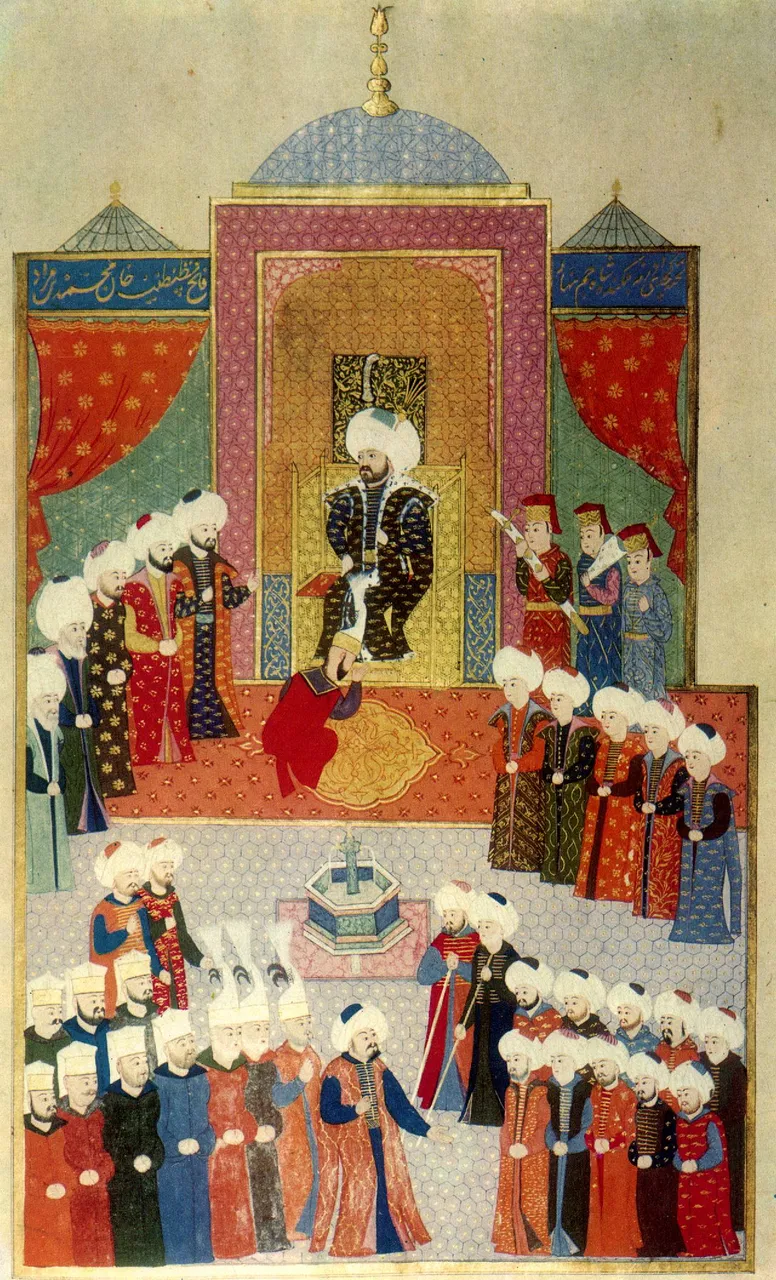 The accession of Mehmed II at Edirne in 1451, in the Hünername of Seyyid Lokman, 1584, Topkapı Palace MuseumWikimedia Commons, unknown Ottoman painter, Public domain (Hunername accession Mehmed II.jpg)
Mehmed had reigned once before. In August 1444 Murad II gave him the throne at the age of twelve, and in the autumn Halil called Murad back to lead the army against the crusaders, whom Murad beat at Varna on 10 November 1444. In 1446 a janissary revolt at Edirne brought Murad back to the throne, and Mehmed spent most of the next five years at Manisa as governor of Saruhan.
In 1451 Mehmed renews his father’s treaties with Venice and Genoa, makes a truce with Hungary in November and extends the peace with Serbia. Murad’s widow Mara goes home to her father, Despot Đurađ Branković, who rules Serbia from Smederevo, and Mehmed gives back to Serbia the districts of Toplica and Dubočica, which had been her dowry. Byzantium holds Constantinople, a few towns in Thrace and the Morea, where Constantine XI’s brothers Thomas and Demetrios rule as despots. In Anatolia the beys of Karaman and Candar and the emperor of Trebizond hold lands of their own.
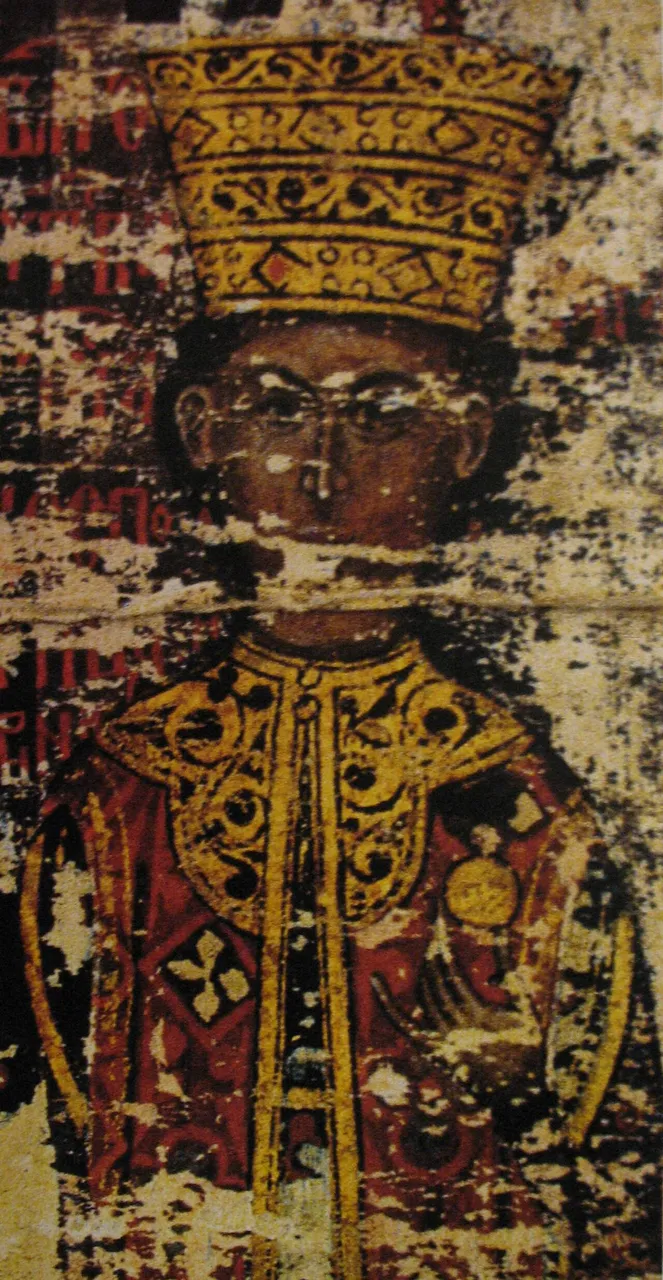 Mara Branković in her father’s charter for the monastery of Esphigmenou, 1429Wikimedia Commons, unknown painter, Public domain (Mara Branković, Esphigmenou charter (1429).jpg)
Sources
- Doukas, Historia Turco-Byzantina (about 1462).
- Michael Kritovoulos, History of Mehmed the Conqueror (about 1467).
- Aşıkpaşazade, Tevârîh-i Âl-i Osmân (late 15th century).
- Franz Babinger, Mehmed the Conqueror and His Time (1978).
- Colin Imber, The Ottoman Empire, 1300–1481 (1990).
- Halil İnalcık, “Meḥemmed II”, in Encyclopaedia of Islam, 2nd ed., vol. 6 (1991), 978–981.
- John V. A. Fine, The Late Medieval Balkans (1994).
Next: Karaman, 1451