24–25 September 1396
The armies at Nicopolis
Nicopolis stands on the right bank of the Danube, about 4 km downstream from the mouth of the Osam. South of the town the ground rises to a plateau cut by ravines, and the road from Tarnovo comes in from the south. The crusaders camp around the town, the Venetian ships close the river, and a Hungarian garrison holds Little Nicopolis (Turnu) on the far bank. Bayezid’s army takes up its position on the heights a few kilometres south of the town. The accounts do not fix the site of the battle more closely than the slope and the heights south of the town.
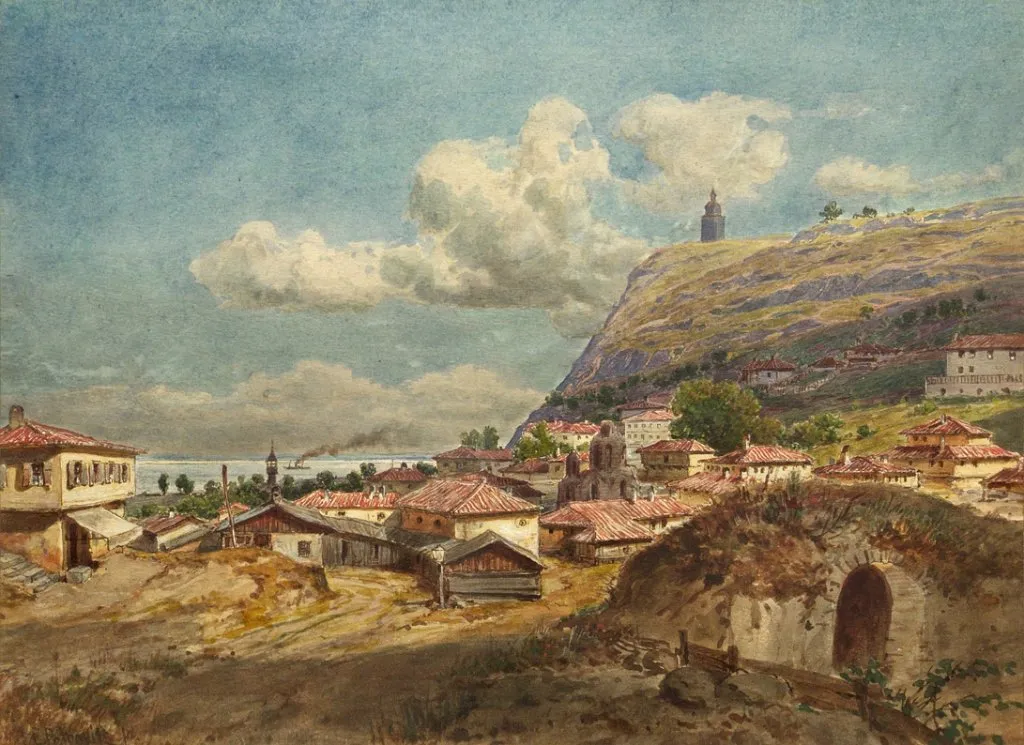 Nikopol on its heights above the Danube, painted by Felix Kanitz, 1885Wikimedia Commons, Felix Kanitz, Public domain (Nikopol by Felix Kanitz.jpg)
Johann Schiltberger, who fights in Sigismund’s army at the age of 16, gives the crusaders about 16,000 men and the Ottomans 200,000. The Ottoman historian Şükrullah, writing in the 1460s, gives 130,000 crusaders and 60,000 Ottomans. Modern estimates put each army at 15,000 to 20,000 men, and David Nicolle gives 16,000 crusaders and 15,000 Ottomans. Bayezid has with him about 1,500 Serbian heavy horsemen under Stefan Lazarević, his brother-in-law and vassal.
At a war council on 24 September Sigismund and Mircea propose to send the Wallachian foot first against the Ottoman light troops, with the French behind them and the Hungarians and the other allies following. The Count of Eu claims the front place as Constable of France, Boucicaut backs him, and Nevers agrees. That evening Sigismund sends word that Bayezid is six hours away, and the hostages taken at Rahova are killed.
Sources
- Johann Schiltberger, Reisebuch (about 1427).
- Şükrullah, Behcetü’t-Tevârih (1460s).
- Aziz S. Atiya, The Crusade of Nicopolis (1934).
- Barbara W. Tuchman, A Distant Mirror: The Calamitous 14th Century (1978).
- David Nicolle, Nicopolis 1396: The Last Crusade (1999).
Prev: Vidin and Rahova, 1396Next: The French charge