1400
Bayezid’s empire, 1400
By 1400 Bayezid rules from the Danube to the Euphrates at Malatya. He removes the dynasties he has defeated in Anatolia and sets out to build a centralised state run by his own men. Stefan Lazarević of Serbia and the other Christian vassals in the Balkans owe him tribute and troops, and his reliance on them angers the Anatolian beys and the Muslim scholars. Bayezid takes the title Sultan of Rûm, after the Arabic name for the lands of the Eastern Roman Empire, and has the Abbasid caliph in Cairo confirm it.
The state rests on the sultan’s household of slaves, the kul: men taken in war or bought, and since the 1380s boys levied from the Christian villages of the Balkans, raised as Muslims and trained for the palace or for the janissaries, the sultan’s infantry. An early account of the boy levy is a sermon that Isidore Glabas, the metropolitan of Thessalonica, gives on 28 February 1395 on the children taken at the sultan’s order. The grand vizier Çandarlı Ali Pasha, in office since 1387, founds the corps of palace pages and sets the fees of the kadıs.
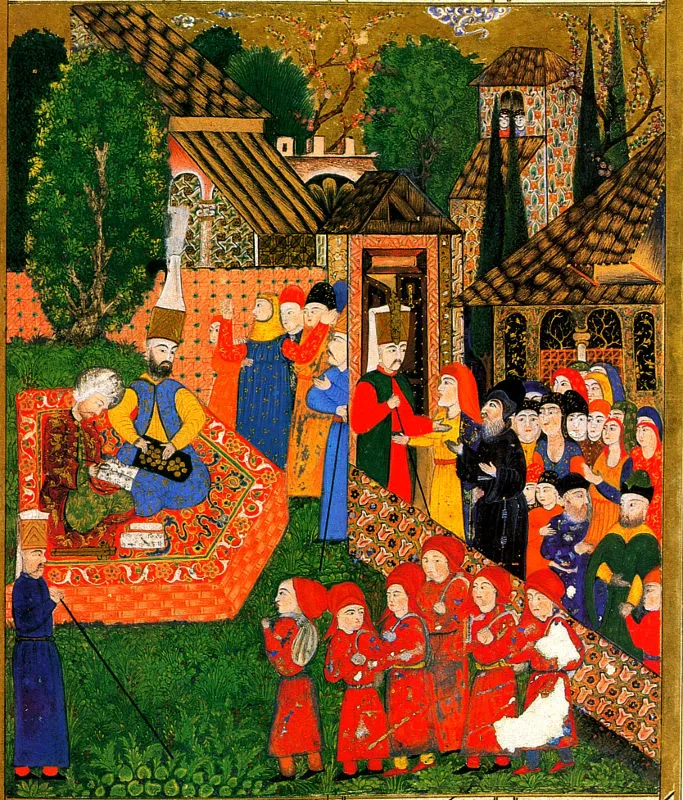 Christian boys registered for the devşirme, in the Süleymanname of Arifi, 1558, Topkapı Palace MuseumWikimedia Commons, unknown Ottoman painter, Public domain (Janissary Recruitment in the Balkans-Suleymanname.jpg)
In Bursa Bayezid spends the spoils of Nicopolis on the Ulu Cami, built by the architect Ali Neccar between 1396 and 1399, a hall of twenty domes in four rows of five on twelve pillars. By tradition he had vowed twenty mosques for the victory and built one mosque with twenty domes instead. On the east side of the town stands his own complex, the Yıldırım complex, with a mosque, a medrese and a hospital. His castle of Güzelcehisar guards the Bosporus.
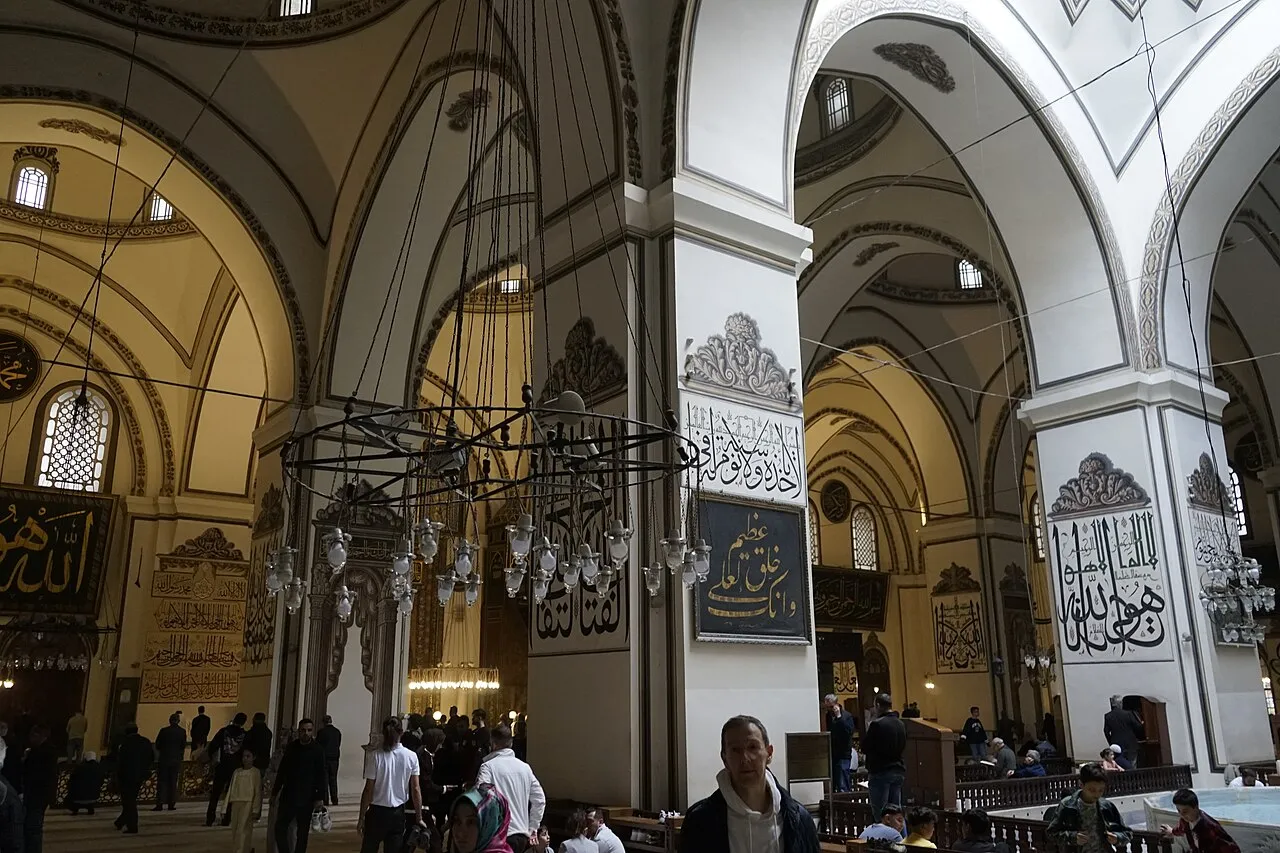 The Ulu Cami of Bursa, built for Bayezid in 1396–1399, with calligraphy on its pillarsWikimedia Commons, Carl Ha, CC BY-SA 4.0 (Bursa, Ulu Cami, interior, view from north eastern corner towards south-southwest.jpg)
Sources
- Isidore Glabas, Homily on the Seizure of the Children (1395).
- Speros Vryonis, “Isidore Glabas and the Turkish Devshirme”, Speculum 31 (1956), 433–443.
- Robert Mantran, “ʿAlī Pas̲h̲a Čandarli̊-zāde”, in Encyclopaedia of Islam, 2nd ed., vol. 1 (1960), 394.
- Halil İnalcık, The Ottoman Empire: The Classical Age 1300–1600 (1973).
- Aptullah Kuran, The Mosque in Early Ottoman Architecture (1968).
- Godfrey Goodwin, A History of Ottoman Architecture (1971).
- Colin Imber, The Ottoman Empire, 1300–1481 (1990).
Prev: Boucicaut and Manuel’s journey, 1399–1402Next: Timur takes Sivas, 1400