1399 – 1402
Boucicaut and Manuel’s journey, 1399–1402
In 1399 Charles VI of France sends Marshal Boucicaut to help Manuel II, and Boucicaut sails from Aigues-Mortes with six ships and 1,200 men. From Constantinople he raids the Ottoman shore of Asia, but his small force achieves little. He persuades Manuel and John VII to end their quarrel. Manuel adopts John VII and leaves the city in his charge, so that he can go to the West himself to ask for help.
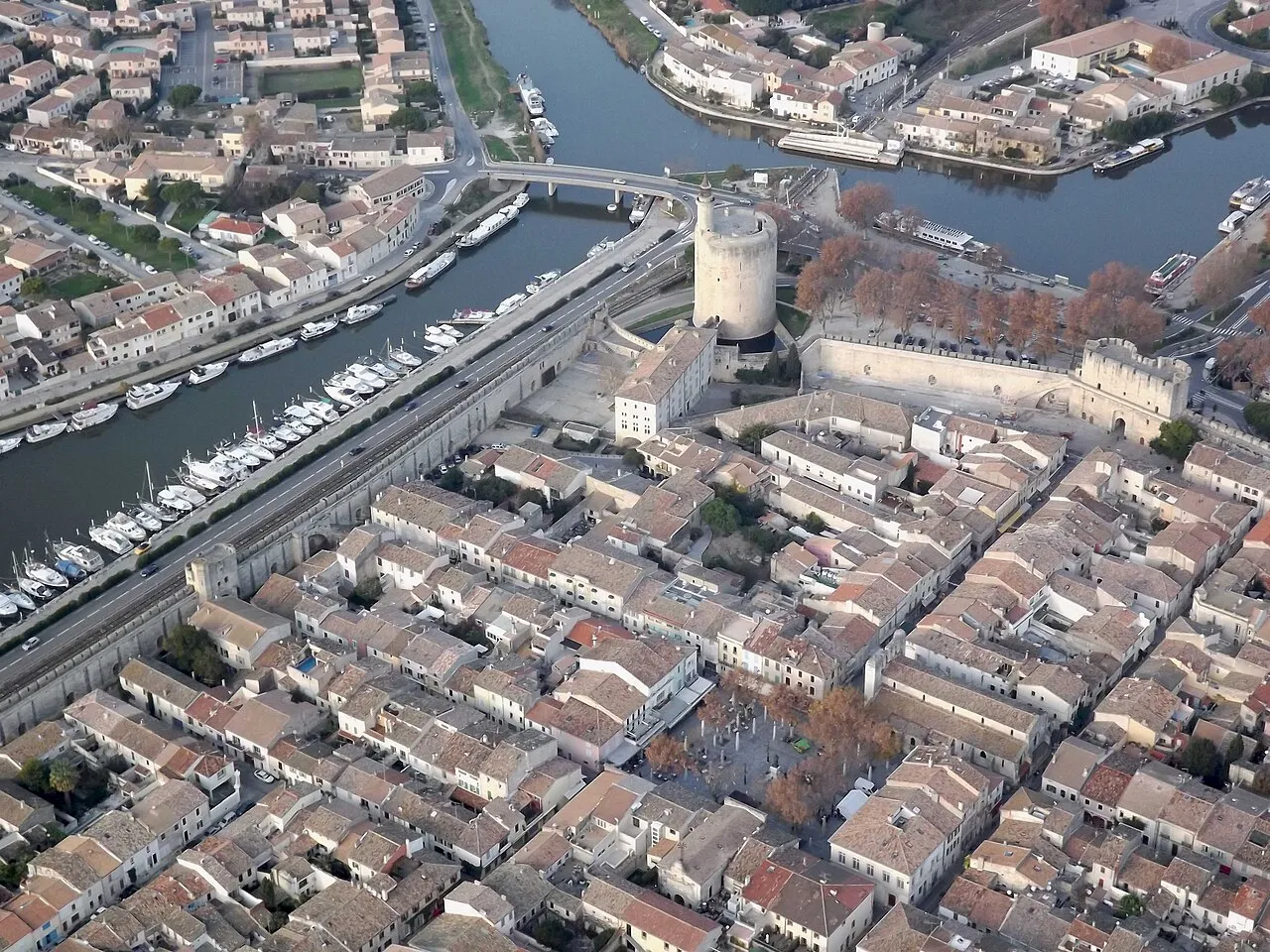 The walled town of Aigues-Mortes, from where Boucicaut sailed in 1399Wikimedia Commons, Eddy Circhirello, CC BY-SA 3.0 (Aigues mortes vu du ciel 2.jpg)
Manuel sets out with Boucicaut on 10 December 1399, with a suite of about 40, and leaves 300 French soldiers under Jean de Châteaumorand in the city. He leaves his wife and children with his brother Theodore in the Morea and reaches Venice in April 1400. He travels on by Padua, Vicenza and Pavia to Milan, where he meets Duke Gian Galeazzo Visconti, and Charles VI receives him at Charenton outside Paris on 3 June 1400. Henry IV of England meets him at Blackheath on 21 December and takes him to London. Manuel stays at Eltham until the middle of February 1401 and receives £2,000. He then returns to Paris and stays in France until November 1402.
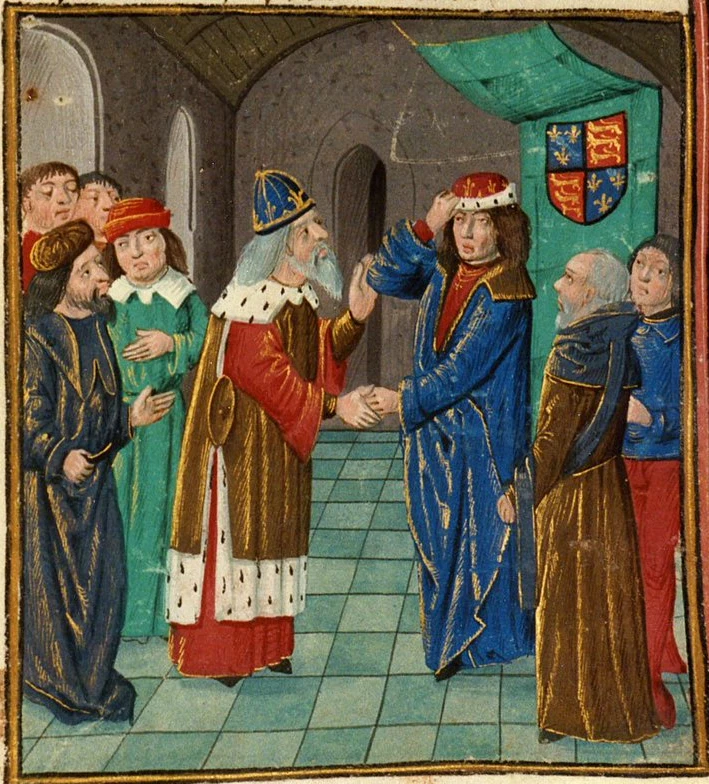 Manuel II with Henry IV of England, in a manuscript of the St Albans Chronicle, 15th centuryWikimedia Commons, unknown illuminator, Public domain (Manuel II Palaiologos with Henry IV of England.png)
In Constantinople John VII refuses Bayezid’s demand to surrender the city. Bayezid keeps up the blockade, and many of the people slip out of the walls to give themselves up to the Ottomans. The Castilian traveller Clavijo writes a few years later that John had agreed to hand over the city if Bayezid defeated Timur, an agreement historians doubt.
Sources
- Le Livre des fais du bon messire Jehan le Maingre, dit Bouciquaut (1409).
- Michel Pintoin, Chronicle of the Monk of Saint-Denis (early 15th century).
- Adam of Usk, Chronicle (early 15th century).
- Ruy González de Clavijo, Embajada a Tamorlán (about 1406).
- John W. Barker, Manuel II Palaeologus (1391–1425) (1969).
- Donald M. Nicol, “Byzantium and England”, Balkan Studies 15 (1974).
- Nevra Necipoğlu, Byzantium between the Ottomans and the Latins (2009), 149–183.
Prev: Argos and the Morea, 1395–1400Next: Bayezid’s empire, 1400