1389 – 1392
Bayezid becomes sultan, 1389–1390
Under the terms of Serbia’s vassalage, Lazar’s son Stefan Lazarević pays Bayezid a yearly tribute and sends troops to his campaigns. His mother Milica rules for him from Kruševac. Stefan and his brother Vuk are to come to the sultan’s court each year, and they bring their sister Olivera to Bayezid at Bursa. In the summer of 1390 Serbian troops, joined by Ottoman detachments, retake Borač and Čestin, which a Hungarian army took in November 1389.
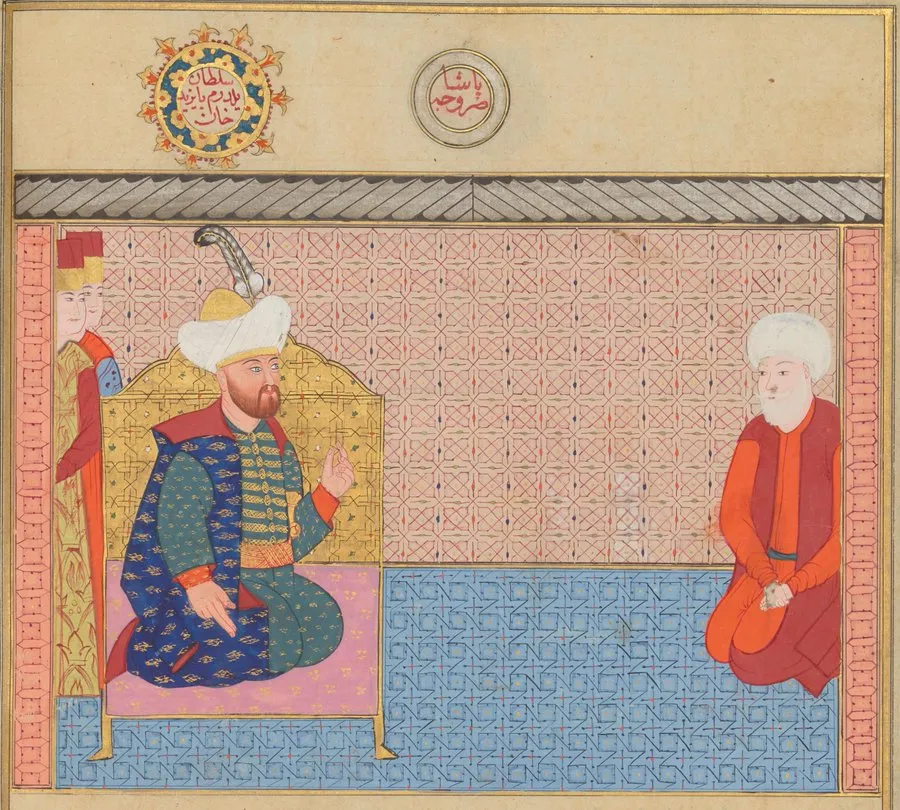 Bayezid I with Saruca Pasha in a copy of the Zübdetü’t-Tevârîh of Seyyid Lokman, 1585–1590, Chester Beatty LibraryWikimedia Commons, unknown Ottoman painter, Public domain (Yıldırım Bayezid (Bayezid I) and Saruca Pasha, Zübdetü't Tevarih, Chester Beatty Library copy, folio 150b.jpg)
Vuk Branković, Lazar’s son-in-law, rules Priština, Vučitrn and Skopje. King Sigismund of Hungary sends his palatine Nicholas Garay to him in July 1389, and in May 1390 Vuk asks Ragusa for refuge in case of war with Stefan. He holds out until early 1392, when the Ottomans take Skopje and settle Turkmen around it. Vuk becomes Bayezid’s vassal before the end of that year.
From 1390 akıncı raiders cross the Danube into Wallachia and the southern counties of Hungary. Sigismund leads an army against the Ottomans in the summer of 1392. He crosses the Danube near Kovin and marches up the Mlava valley to Ždrelo, then turns back and tries to take Golubac.
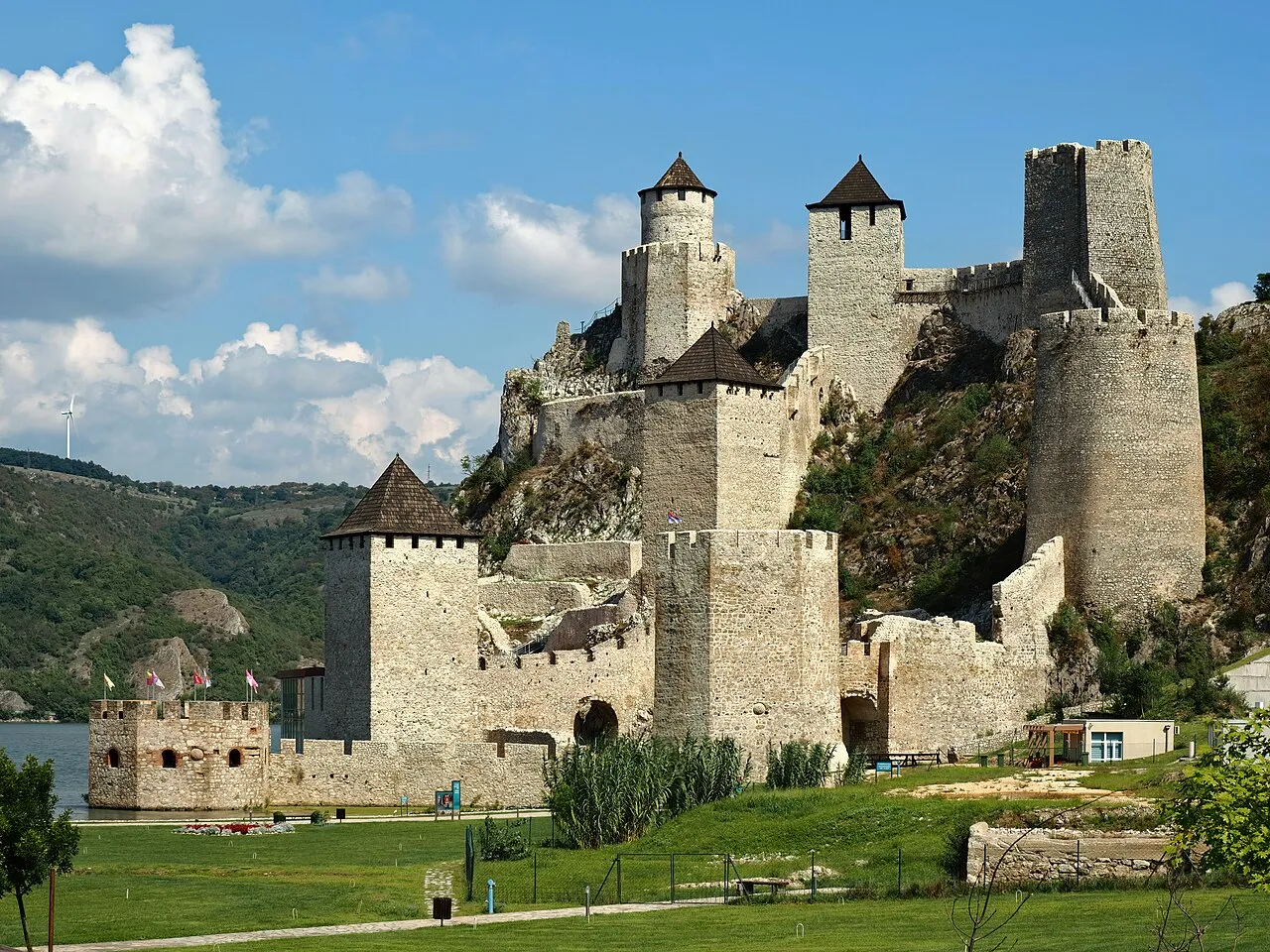 The fortress of Golubac on the DanubeWikimedia Commons, Petar Milošević, CC BY-SA 4.0 (Golubac Fortress (град Голубац).jpg)
Sources
- Konstantin the Philosopher, Life of Despot Stefan Lazarević (1431).
- John V. A. Fine, The Late Medieval Balkans (1987), 412–424.
- Sima Ćirković, The Serbs (2004).
- Pál Engel, The Realm of St Stephen: A History of Medieval Hungary, 895–1526 (2001).
- Colin Imber, The Ottoman Empire, 1300–1481 (1990).
Next: The beyliks and Philadelphia, 1390