July 1402
The armies at Ankara
Timur learns that Bayezid is about 16 km away and lifts the siege of Ankara. He crosses the Çubuk stream, draws up his army on the plain north-east of the town and fortifies his camp by the water. Bayezid leaves his first camp on the wet ground near Ravlı (Akyurt) and moves to the low hills near Melikşah on the west side of the plain, and the outposts skirmish through the night.
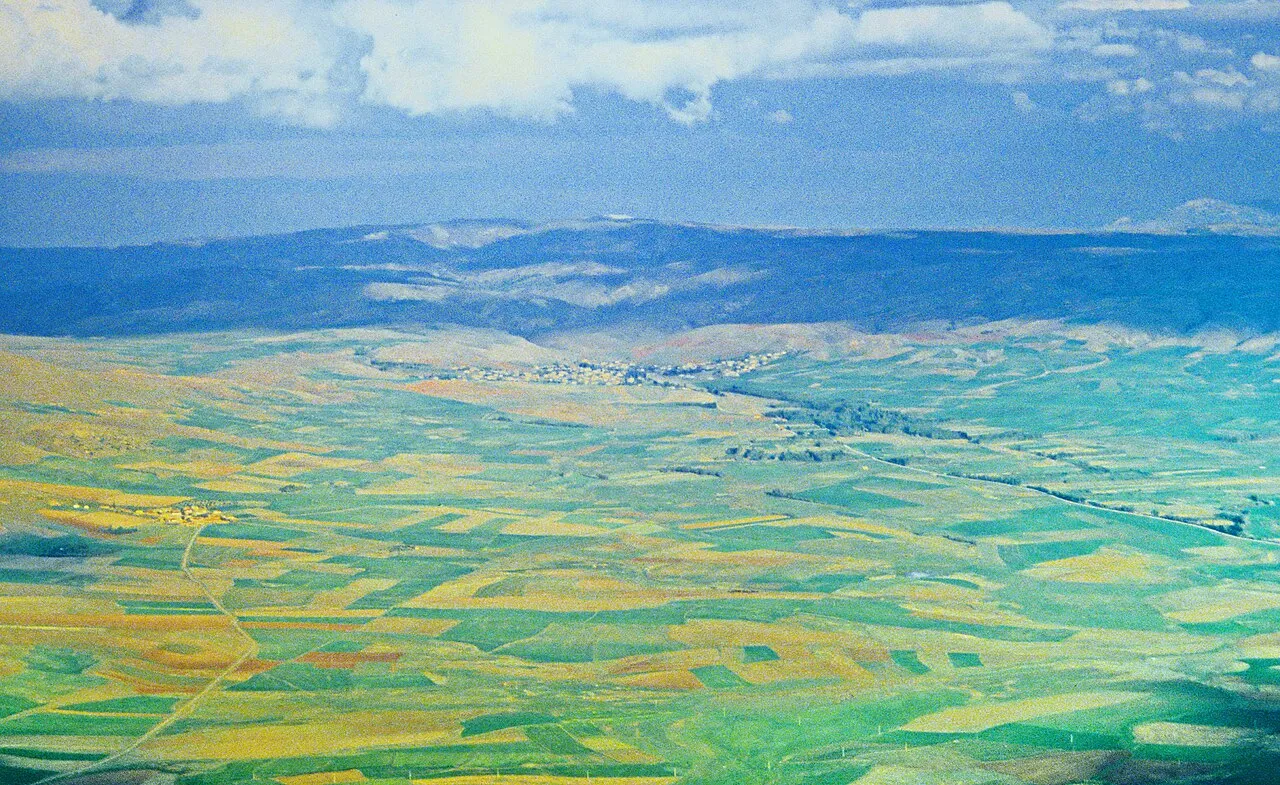 The Çubuk plain north-east of Ankara in 1989Wikimedia Commons, Volker Höhfeld, CC BY-SA 4.0 (Ankara 12 05 1989 Çubuk Ovası.jpg)
The early Ottoman chroniclers place the battle only at Ankara, Doukas in a plain at Ankara, and Timur’s letter of victory east of Ankara, half a fersah away. Kemalpaşazade, early in the 16th century, is the first to name the Çubuk plain. Ömer Halis Bıyıktay in 1934 placed the fighting along the Kızılcaköy stream, which joins the Çubuk from the west, and the last stand on a hill he calls Çataltepe, and most later historians follow him. Halil Çetin argues instead for Culuk near Haymana, south-west of Ankara.
David Nicolle puts Timur’s army at about 140,000 men, most of them horsemen, with 32 war elephants, and Bayezid’s at no more than 85,000. Ibn Arabshah gives Timur 800,000 men, and Timur’s letter of victory gives the Ottomans 70,000 horse and foot. Sharaf ad-Din Ali Yazdi dates the battle to Thursday 20 July 1402, Ibn Arabshah to 28 July.
Sources
- Nizam ad-Din Shami, Zafarnama (1404).
- Sharaf ad-Din Ali Yazdi, Zafarnama (1425).
- Ibn Arabshah, ʿAjāʾib al-maqdūr fī nawāʾib Tīmūr (1435).
- Doukas, Historia Turco-Byzantina (about 1462).
- Ömer Halis Bıyıktay, Yedi Yıl Harbi İçinde Timur’un Anadolu Seferi ve Ankara Savaşı (1934).
- Marie-Mathilde Alexandrescu-Dersca, La campagne de Timur en Anatolie (1402) (1942).
- David Nicolle, Armies of the Ottoman Turks 1300–1774 (1983).
- Halil Çetin, Ankara Savaşı ve Timur’un Anadolu Seferi (2012).
Prev: The march to Ankara, 1402Next: The battle lines