17 June 1815
The retreat to Waterloo and Wavre
After Ligny the Prussians do not fall back east along their own lines of communication. They retreat north by Tilly and Gembloux to Wavre, where Bülow's IV Corps joins them, and stay within reach of Wellington. About 8,000 men, mostly new recruits from the Rhine provinces and Westphalia, flee towards Liège and Aachen. Blücher, injured in his fall, refuses to give up the command.
On the morning of 17 June Wellington learns of the Prussian defeat and withdraws from Quatre Bras up the Brussels road to the ridge of Mont-Saint-Jean, south of Waterloo, a position he had reconnoitred the year before. Napoleon makes a late start, joins Ney at Quatre Bras at 13:00 and finds it empty. The French follow in thunderstorms and heavy rain, and apart from a cavalry action at Genappe there is no serious fighting before Wellington's army reaches its bivouacs.
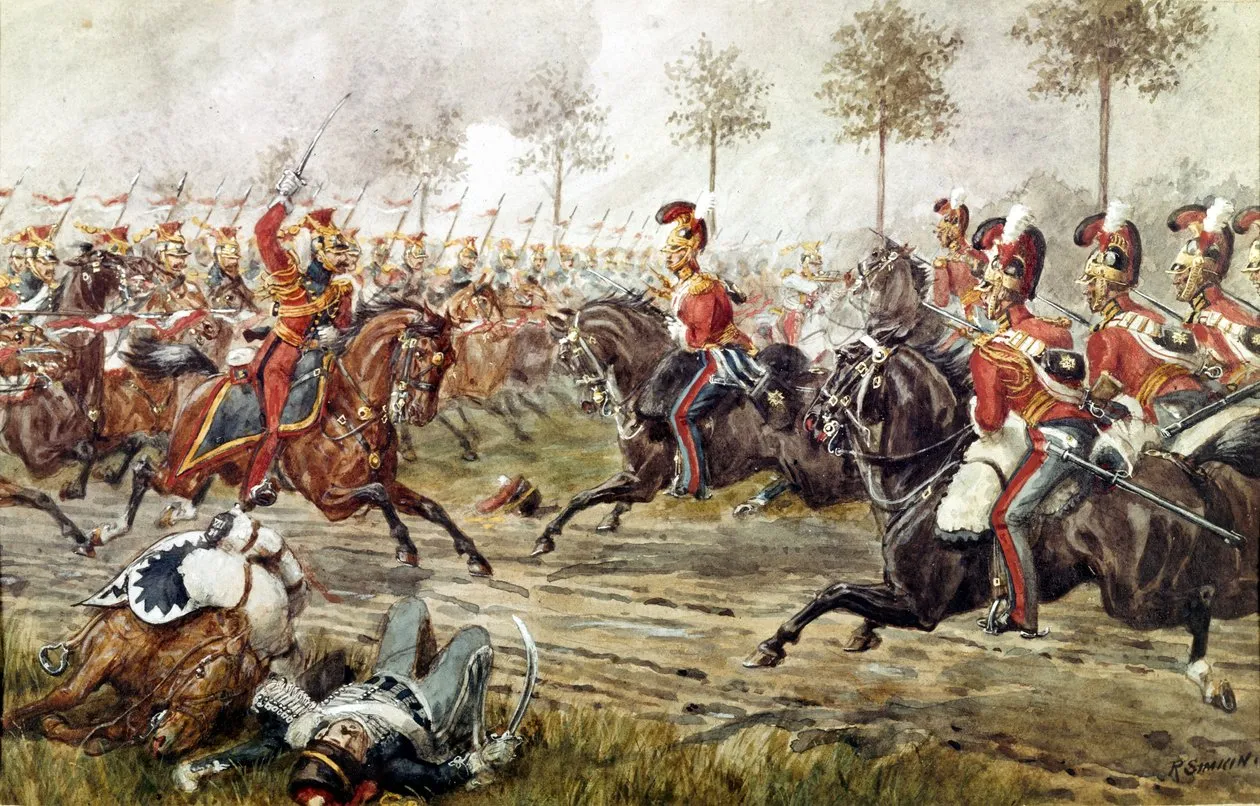 The charge of the 1st Life Guards at Genappe, 17 June 1815, by Richard Simkin, 1890Wikimedia Commons, Richard Simkin, Public domain (Charge of the 1st Life Guards at Genappe, 17 June 1815.jpg)
Napoleon sends Grouchy with the right wing, about 33,000 men, after the Prussians. Grouchy assumes they are retreating towards Namur and Liège and sends his cavalry east as far as Perwez, and by evening his troops are behind the Prussians, on the far side of the Dyle. In the night Blücher promises Wellington the support of three corps, and Wellington decides to give battle.
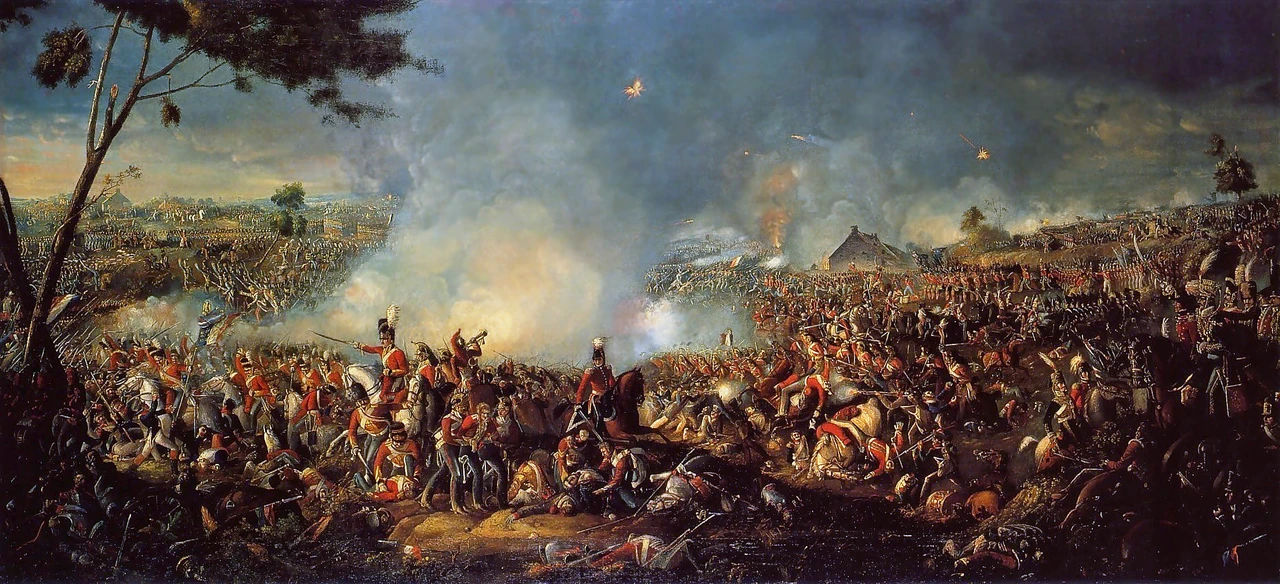 The battle of Waterloo, painting by William SadlerWikimedia Commons, William Sadler, Public domain (Battle of Waterloo 1815.PNG)
On 18 June Wellington has about 68,000 men and 156 guns: 31,000 British, 17,000 Dutch-Belgians, 11,000 Hanoverians, 6,000 Brunswickers and 3,000 Nassauers. A further 17,000, mostly Dutch, stand at Halle, 13 km to the west, against a wide flanking march. Napoleon has 72,000 to 73,000 men and about 250 guns, most of them veterans, and the three Prussian corps on the march to join Wellington bring about 50,000.
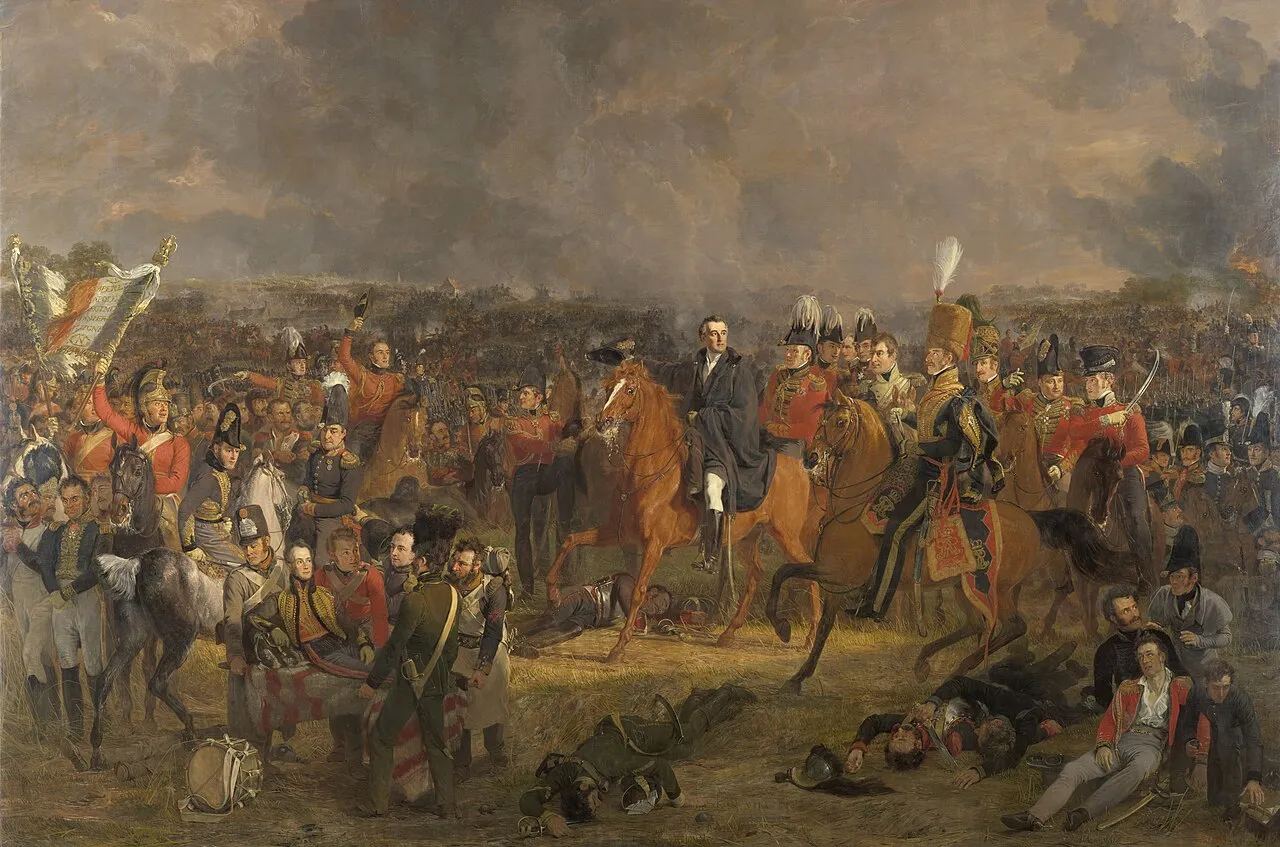 The battle of Waterloo, Wellington and his staff, painting by Jan Willem Pieneman, 1824Wikimedia Commons, Jan Willem Pieneman, Public domain (De Slag bij Waterloo Rijksmuseum SK-A-1115.jpeg)
Sources
- Alessandro Barbero, The Battle: A New History of Waterloo (2003).
- William Siborne, The Waterloo Campaign, 1815 (1848).
- Tim Clayton, Waterloo: Four Days that Changed Europe’s Destiny (2014).
Prev: Quatre Bras: Wellington holds the crossroadsNext: The attack on Hougoumont