18 June 1815, morning to 13:00
The attack on Hougoumont
Wellington's line runs about 4 km along the ridge of Mont-Saint-Jean behind the sunken Ohain road, with most of his infantry on the reverse slope out of the enemy's sight. In front of it he garrisons three farms: the château of Hougoumont on his right, La Haye Sainte beside the Brussels road in the centre, held by 400 light infantry of the King's German Legion, and Papelotte on his left. Napoleon draws up on the opposite ridge on both sides of the road, with d'Erlon's I Corps on the right, Reille's II Corps on the left, and Lobau's VI Corps and the Imperial Guard in reserve by the inn of La Belle Alliance.
Napoleon delays the start to let the ground dry after the night's rain. At about 11:30, or 10:00 by Wellington's dispatch, Jérôme's division attacks Hougoumont, held by four light companies of the Guards in the house and by Hanoverian Jäger and Nassauers in the wood. Bauduin's brigade clears the wood but is driven back by artillery, and Bauduin is killed. A second attack reaches the north gate, where Sous-Lieutenant Legros breaks it open with an axe, but the Coldstream and Scots Guards close the gate on the men inside, who are all killed.
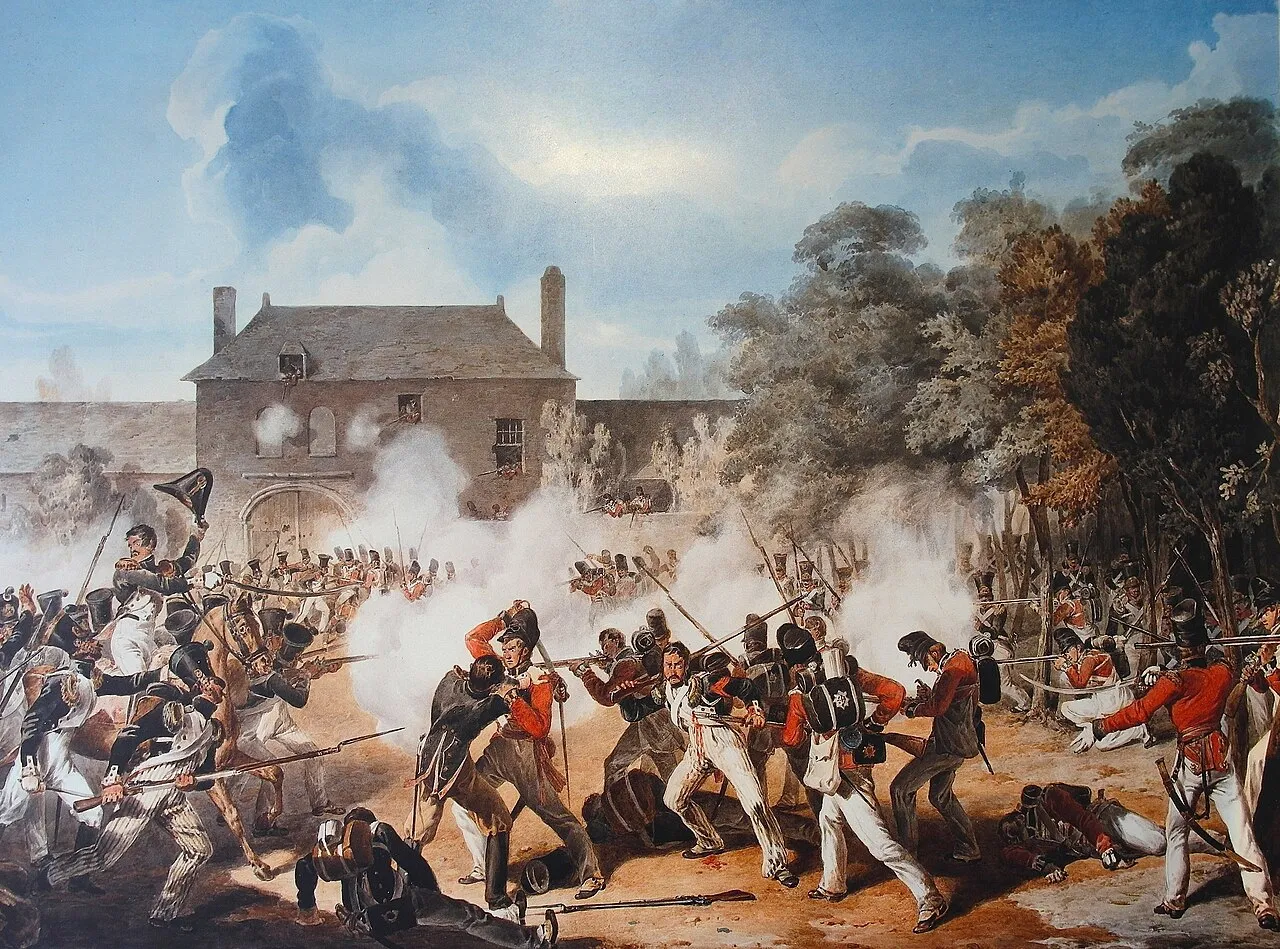 The château of Hougoumont during the battle, painting by Denis Dighton, 1815Wikimedia Commons, Denis Dighton, Public domain (Castle of Hougoumont during the Battle of Waterloo.jpg)
The fighting goes on around Hougoumont all afternoon, and Napoleon has the house shelled until all but the chapel burns. He sends 33 battalions, about 14,000 men, against it, and Wellington uses 21 battalions, about 12,000, to hold it and the lane behind it. Hougoumont holds out to the end of the battle.
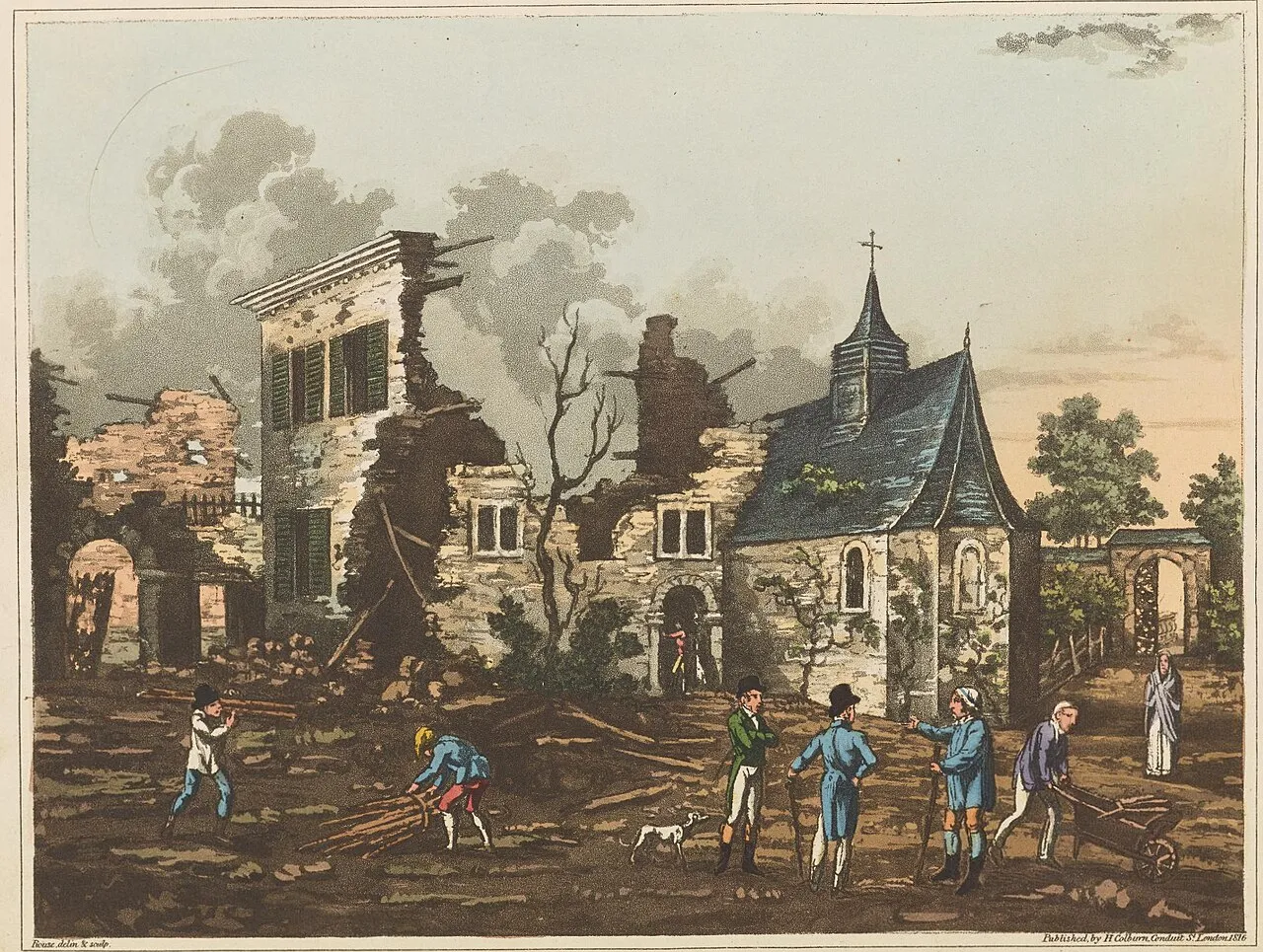 The interior of Hougoumont after the battle, plate from William Mudford’s account of the campaign, 1817Wikimedia Commons, William Mudford, Public domain (Plate R from 'An Historical Account of the Campaign in the Netherlands' by William Mudford (1817).jpg)
Sources
- Alessandro Barbero, The Battle: A New History of Waterloo (2003).
- William Siborne, The Waterloo Campaign, 1815 (1848).
- Tim Clayton, Waterloo: Four Days that Changed Europe’s Destiny (2014).
Prev: The retreat to Waterloo and WavreNext: D’Erlon’s attack and the heavy cavalry