18 June 1815, 18:00 to 21:00
Plancenoit and the Imperial Guard
Napoleon sends all eight battalions of the Young Guard to help Lobau. They take Plancenoit and lose it again, and two battalions of the Old Guard retake it with the bayonet. On the allied left Zieten's Prussian I Corps arrives towards 18:00, and the Prussian liaison officer Müffling persuades him to march straight to Wellington's support. Its troops retake Papelotte and La Haie and drive back Durutte's division, and Wellington can move cavalry from his left to his weakened centre.
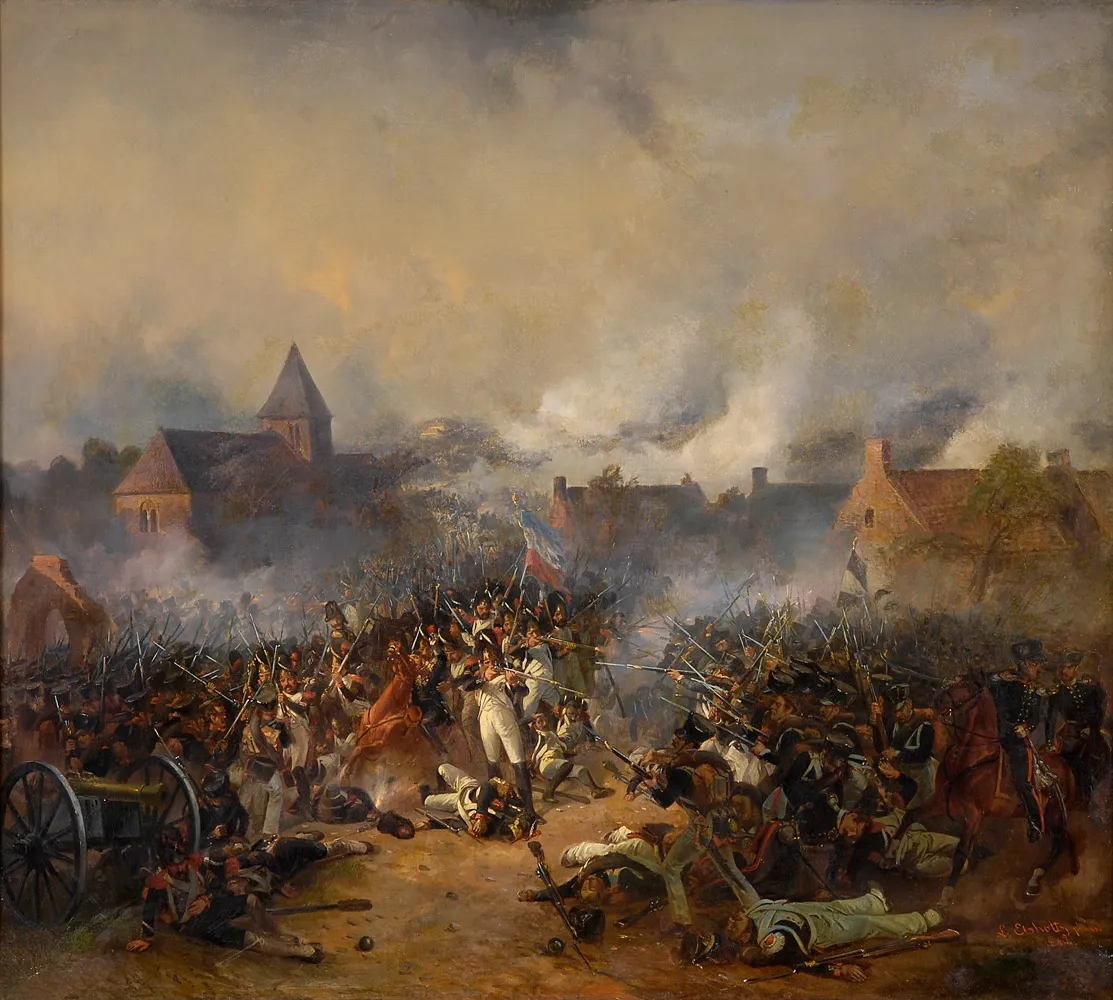 The storming of Plancenoit, painting by Ludwig Elsholtz, 1843Wikimedia Commons, Ludwig Elsholtz, Public domain (Ludwig Elsholtz Erstürmung von Planchenois.jpg)
At about 19:30 Napoleon sends in his last reserve, five battalions of the Middle Guard led by Ney, with three battalions of the Old Guard behind them. The grenadiers break Halkett's brigade but are stopped by Dutch horse artillery and a bayonet charge of Chassé's Dutch division. Further west the chasseurs come over the crest into volleys at point-blank range from 1,500 British Foot Guards under Peregrine Maitland, and Colborne's 52nd Light Infantry wheels onto their flank and breaks them. The cry "La Garde recule" spreads, and Wellington signals a general advance.
The brigades of Bülow and Pirch take Plancenoit for the last time, and the French army breaks up. Napoleon leaves the field from a square of the Old Guard by La Belle Alliance, where Wellington and Blücher meet at about 21:00, and Gneisenau pursues the fugitives as far as Genappe. Napoleon's army loses 24,000 to 26,000 killed and wounded, among them 6,000 to 7,000 captured, Wellington's about 17,000 and Blücher's about 7,000.
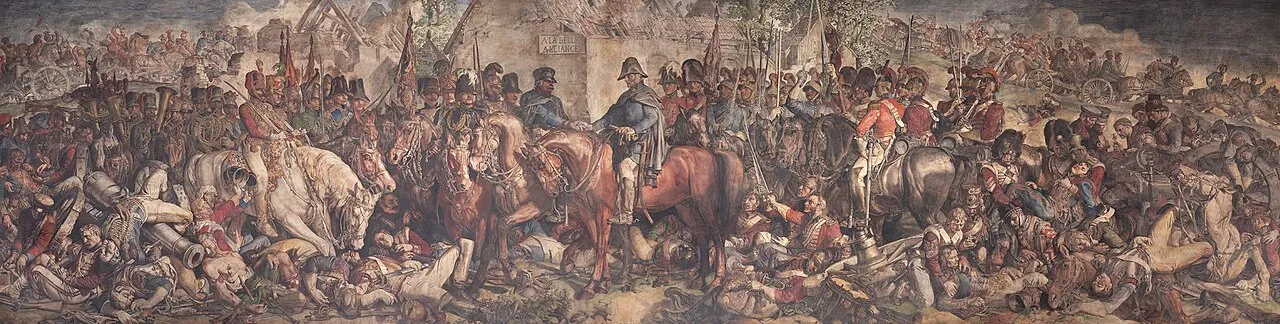 The meeting of Wellington and Blücher after the battle of Waterloo, by Daniel Maclise, 1861Wikimedia Commons, Daniel Maclise, Public domain (The Meeting of Wellington and Blücher after the Battle of Waterloo,1861.jpg)
Sources
- Alessandro Barbero, The Battle: A New History of Waterloo (2003).
- William Siborne, The Waterloo Campaign, 1815 (1848).
- Tim Clayton, Waterloo: Four Days that Changed Europe’s Destiny (2014).
Prev: The cavalry charges and La Haye SainteNext: The second abdication