18 June 1815, 13:00 to 15:00
D’Erlon’s attack and the heavy cavalry
Napoleon's grand battery of 80 guns opens fire around noon. At about 13:15 he sees the first Prussian columns near Chapelle-Saint-Lambert, about three hours' march away, and sends Lobau's VI Corps to his right to hold them. At about 13:30 d'Erlon's I Corps advances, about 14,000 men in four divisions, each in a dense column of battalions one behind another. Quiot's division surrounds La Haye Sainte, while the other three climb towards Wellington's left, held by Bylandt's Dutch-Belgian brigade and the British brigades of Kempt and Pack under Picton.
Bylandt's line gives way, Picton is killed ordering a counter-attack, and the French break through the hedges along the sunken road. Uxbridge then sends in the British heavy cavalry from behind the ridge, about 2,000 men of the Household Brigade under Lord Edward Somerset and the Union Brigade under Sir William Ponsonby. They rout the cuirassiers beside La Haye Sainte and break d'Erlon's columns, taking the eagles of the 105th and 45th Line.
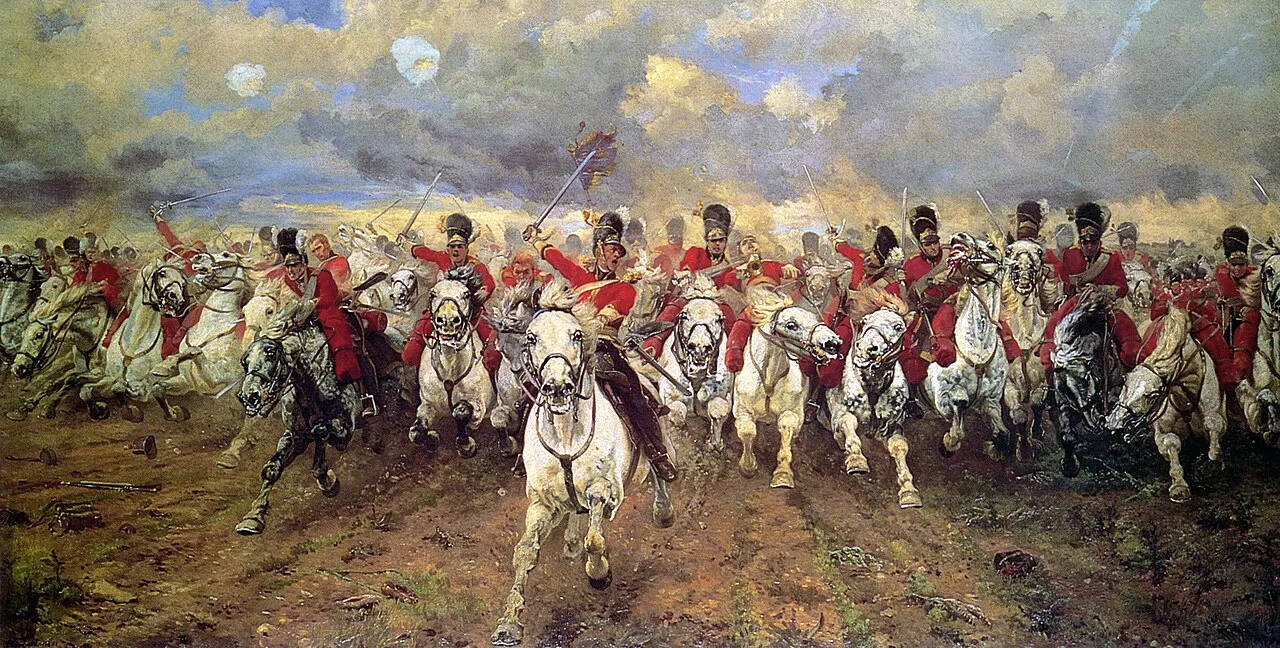 “Scotland Forever!”, the charge of the Scots Greys, painting by Elizabeth Thompson, Lady Butler, 1881Wikimedia Commons, Elizabeth Thompson, Lady Butler, Public domain (Scotland Forever!.jpg)
Out of control, the Union Brigade rides on into the grand battery, where Milhaud's cuirassiers and Jaquinot's lancers counter-charge and Ponsonby is killed. The two brigades lose about 1,200 men over the day, and d'Erlon's corps loses 3,000 in the attack, over 2,000 of them taken prisoner. It needs until 16:00 to re-form.
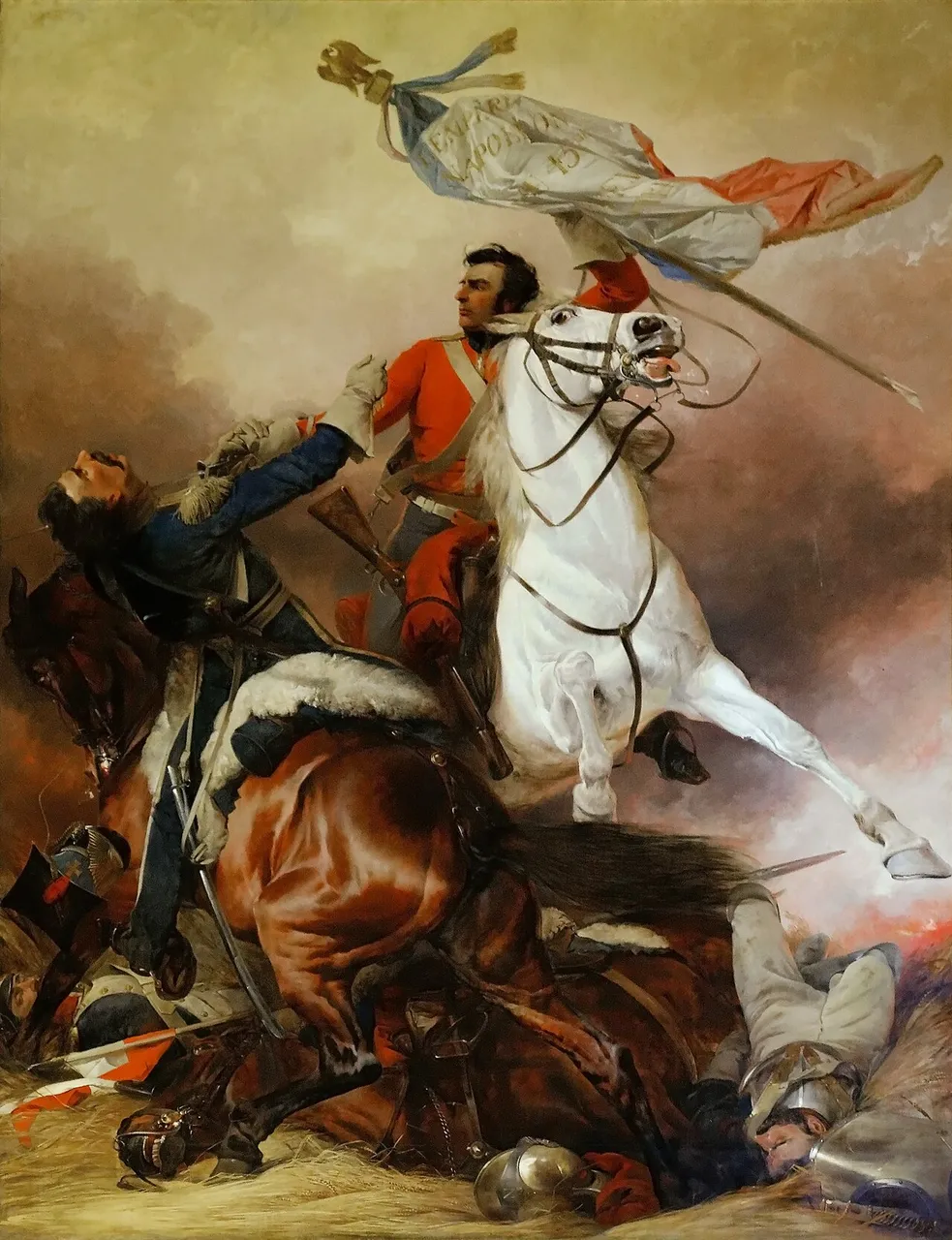 Sergeant Charles Ewart of the Scots Greys takes the eagle of the 45th Line, painting by Richard Ansdell, 1847Wikimedia Commons, Richard Ansdell, CC BY-SA 3.0 (Richard Ansdell — The Fight For The Standard.jpg)
Sources
- Alessandro Barbero, The Battle: A New History of Waterloo (2003).
- William Siborne, The Waterloo Campaign, 1815 (1848).
- Tim Clayton, Waterloo: Four Days that Changed Europe’s Destiny (2014).
Prev: The attack on HougoumontNext: The cavalry charges and La Haye Sainte