23 May to 5 July 1809
Lobau island
After Aspern-Essling Napoleon turns the Lobau into a fortified base, with field hospitals for 20,000 wounded, depots and barracks. From 1 June General Henri-Gatien Bertrand builds two strong bridges from the south bank to the island, protected upstream by palisades, and the artillery sets up a battery of 124 guns on it. By the end of June French boats control the river, and the bulletin of 2 July declares that “the Danube no longer exists for the French army”.
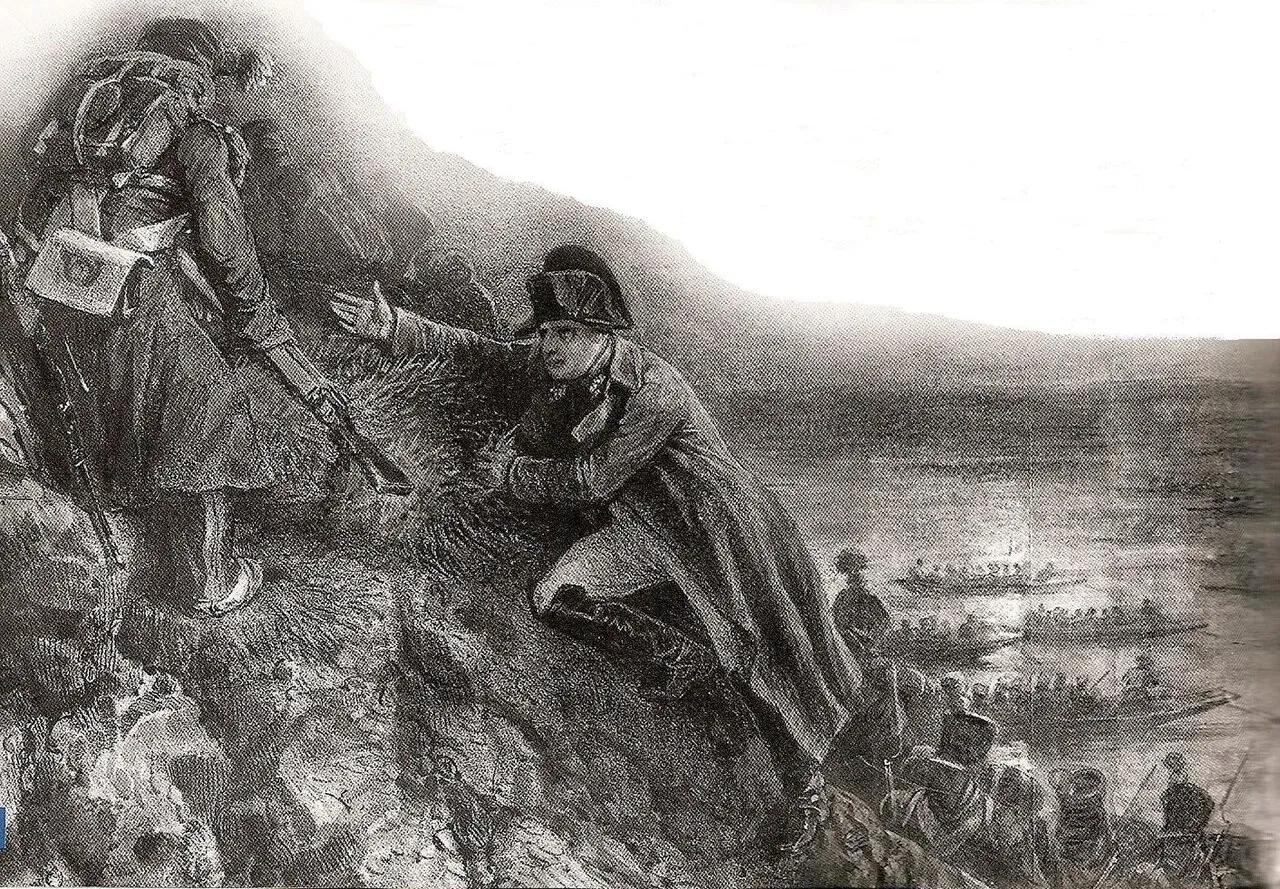 Napoleon arriving on the Lobau, lithograph by Auguste RaffetWikimedia Commons, Auguste Raffet, Public domain (Napoleon at Lobau.jpg)
Napoleon gathers more than 150,000 men around Vienna. Eugène de Beauharnais’s Army of Italy, which defeats Archduke John at Raab on 14 June, and Bernadotte’s Saxon corps join him, and Marmont’s corps from Dalmatia and Wrede’s Bavarian division follow. Charles rebuilds his army to about 136,000 men and builds 16 redoubts between Aspern and Gross-Enzersdorf against a crossing north of the island. On 3 July he leaves them and draws the army back to the Wagram plateau behind the Russbach stream and to the Bisamberg heights, while Archduke John’s 13,000 men stand at Pressburg, about 40 km to the east.
On the night of 4 July, in a violent thunderstorm, the French cross from the east side of the Lobau, beyond the end of the redoubts. Oudinot’s II Corps lands first by boat between 9 and 10 pm, Masséna’s IV Corps follows at 11 pm and Davout’s III Corps after 2 am. About 1,000 shells set Gross-Enzersdorf on fire before the 46th Line storms it, and the castle of Sachsengang surrenders at about 8 am.
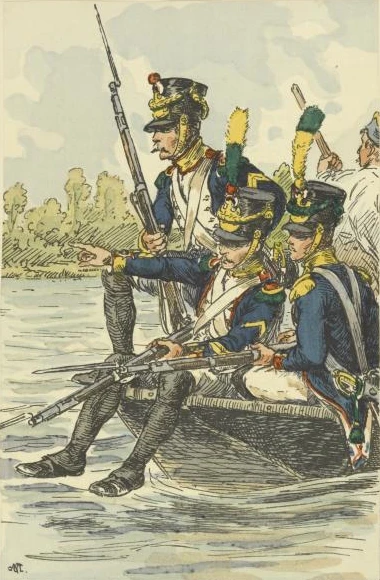 French voltigeurs crossing an arm of the Danube before the battle of Wagram, printWikimedia Commons, unknown author, Public domain (Voltigeurs of a French Line regiment crossing the Danube before the battle of Wagram.png)
By 10 am on 5 July the bridgehead is secure, and the army advances north across the Marchfeld in battalion columns, Masséna on the left, Oudinot in the centre and Davout on the right. Armand von Nordmann’s advance guard and Johann von Klenau’s VI Corps fall back before them, and Nordmann loses half of his 12,000 infantry to the French guns. By 6 pm the French face an Austrian line about 19 km long, from Klenau’s corps near the Danube on the right to Rosenberg’s at Markgrafneusiedl on the left.
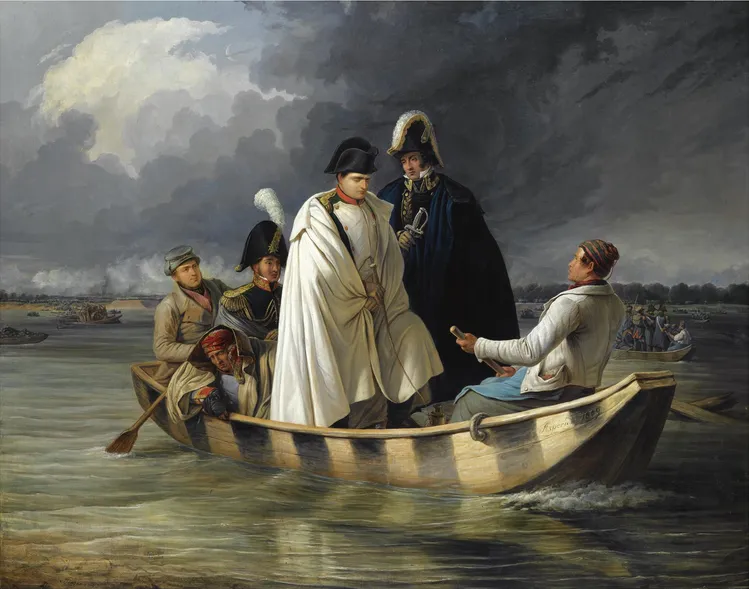 Napoleon crossing from the Lobau, painting by Anton von Perger, 1845Wikimedia Commons, Anton von Perger, Public domain (Anton von Perger - Napoleons Überfahrt aus der Lobau.jpg)
Sources
- David G. Chandler, The Campaigns of Napoleon (1966).
- Gunther E. Rothenberg, The Emperor’s Last Victory: Napoleon and the Battle of Wagram (2004).
- John H. Gill, 1809: Thunder on the Danube, volume III: Wagram and Znaim (2010).
Prev: Essling and the retreatNext: The evening attacks