6 July 1809, 11 am to 1 pm
The grand battery
To meet Klenau, Napoleon sends Masséna’s corps south across the front of the Austrian army and fills the gap it leaves with a grand battery under Jacques Lauriston. Masséna counts 84 guns, 60 of the Guard and 24 of the Army of Italy, while the bulletin speaks of 100. From about 11 am they fire at 350 to 550 m along a front of about 2 km and force Kollowrat back. Masséna’s columns march about 8 km under the Austrian guns and come within sight of Essling at about noon.
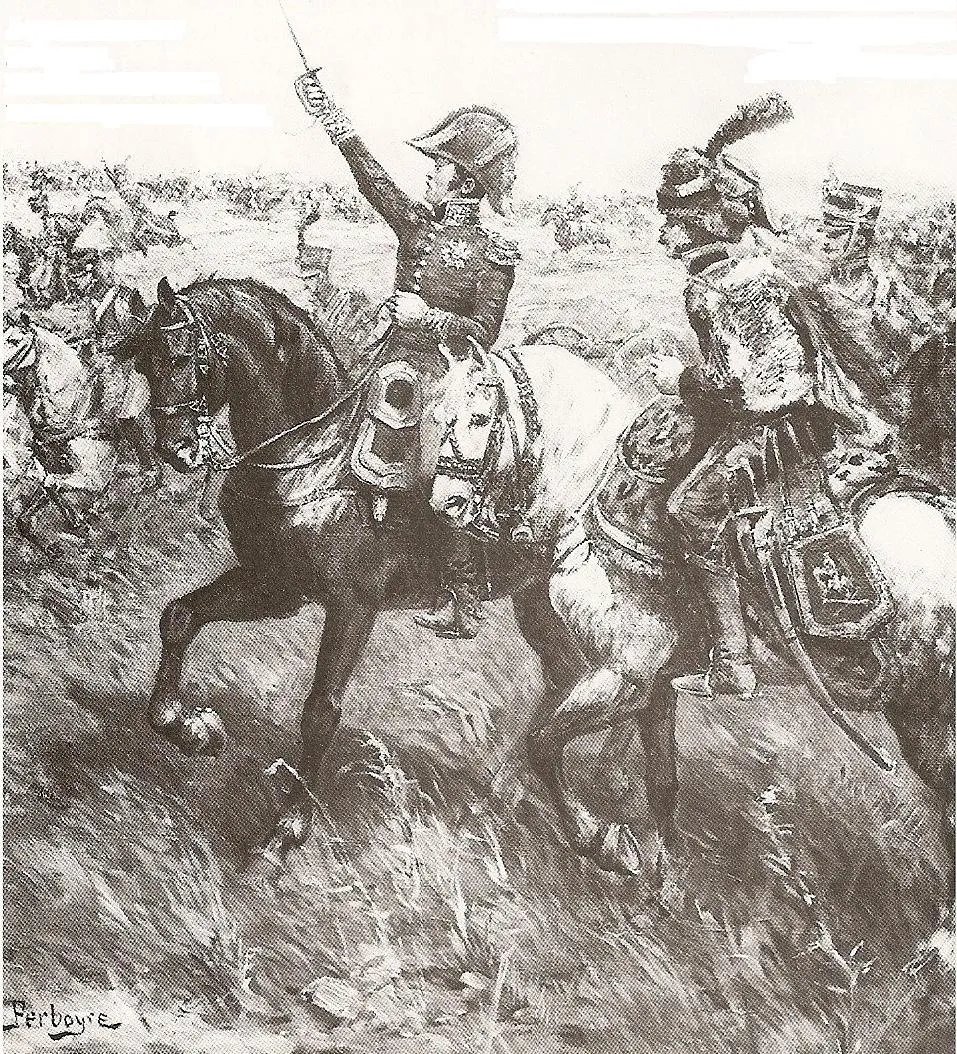 Antoine Drouot with the guns of the Guard at Wagram, by Paul Émile Léon Perboyre, 1913Wikimedia Commons, Paul Émile Léon Perboyre, Public domain (Drouot at Wagram.jpg)
To give the battery time to deploy, Bessières sends Nansouty’s 2,800 cuirassiers and carabiniers against the Austrians near Süssenbrunn. They break a Grenz battalion and capture a battery, but the grenadiers form squares, Austrian cavalry drives them back, and Bessières is unhorsed by a cannonball.
In the east Davout attacks from about 9:30, sending Gudin and Puthod against Markgrafneusiedl while Friant and Morand, with the cavalry of Montbrun and Grouchy, climb the plateau from the east. Nordmann is mortally wounded in a counterattack, and towards noon Friant takes the old church tower of Markgrafneusiedl. Charles brings cavalry and five battalions from the centre, but the French win the cavalry battle on the plateau, and at about 1 pm Rosenberg begins to fall back towards Bockfliess.
Sources
- Gunther E. Rothenberg, The Emperor’s Last Victory: Napoleon and the Battle of Wagram (2004).
- John H. Gill, 1809: Thunder on the Danube, volume III: Wagram and Znaim (2010).
- Ian Castle, Aspern and Wagram 1809 (1990).
Prev: AderklaaNext: MacDonald’s column