1814 – 1821
The Congress of Vienna and Saint Helena
The Congress of Vienna meets from September 1814 to June 1815 under the chairmanship of the Austrian foreign minister Klemens von Metternich, with Castlereagh and then Wellington for Britain, Alexander I and Nesselrode for Russia, Hardenberg for Prussia and Talleyrand for France. Its Final Act is signed on 9 June 1815, nine days before Waterloo. Russia receives most of the Duchy of Warsaw as a Kingdom of Poland under the Tsar, and Prussia three-fifths of Saxony, Swedish Pomerania, Westphalia and the northern Rhineland. Austria regains the Tyrol, Salzburg and the Illyrian provinces and receives Lombardy–Venetia.
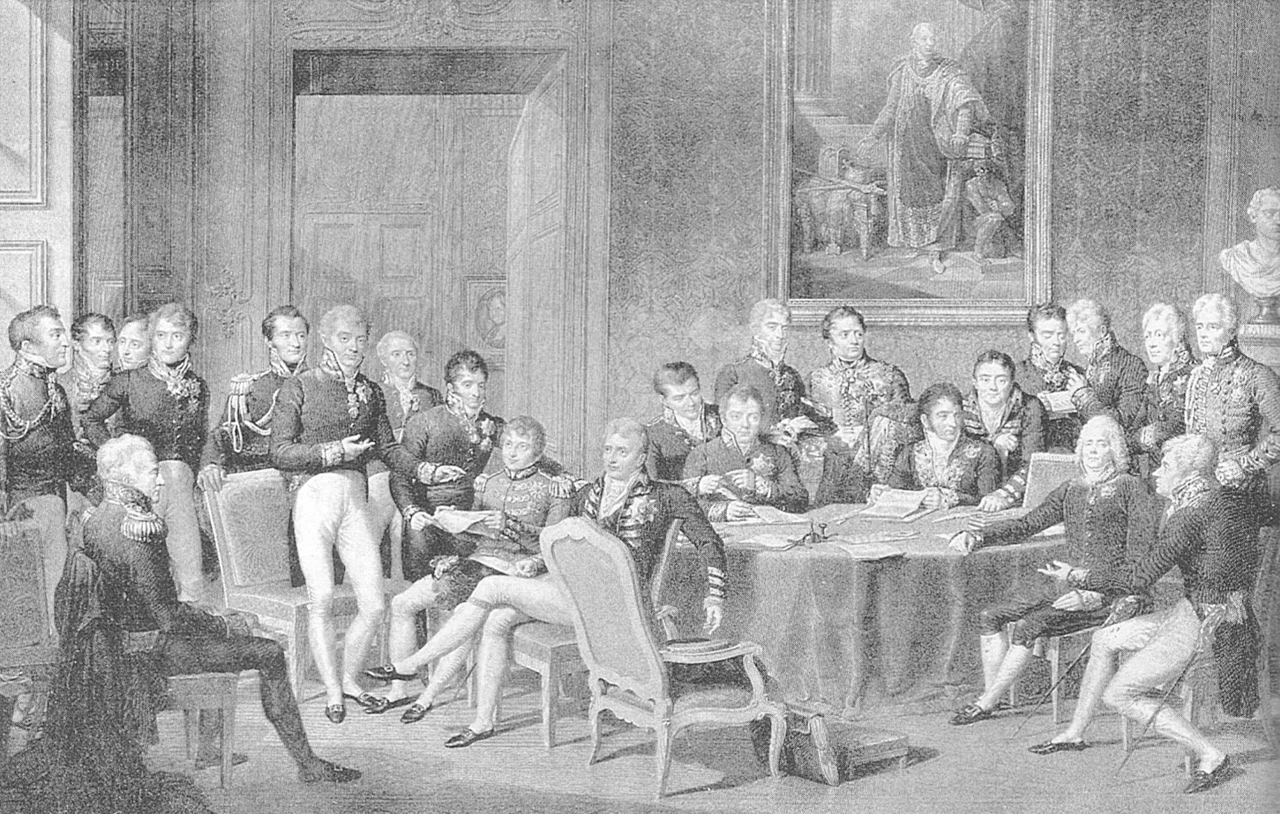 The Congress of Vienna, engraving after Jean-Baptiste IsabeyWikimedia Commons, Jean-Baptiste Isabey, Public domain (Congres de vienne.png)
The Netherlands and the former Austrian Netherlands form the United Kingdom of the Netherlands, and a German Confederation of 39 states under Austrian presidency replaces the Holy Roman Empire and the Confederation of the Rhine. Switzerland's neutrality is guaranteed, Piedmont-Sardinia gains Genoa, the Pope recovers the Papal States, and the Bourbon Ferdinand IV returns to Naples. Norway passes from Denmark to Sweden, and Britain keeps Malta, Heligoland, the Cape Colony and Ceylon.
The Second Treaty of Paris of 20 November 1815 reduces France to its borders of 1790, makes it pay 700 million francs and places up to 150,000 allied soldiers in its eastern departments for up to five years, under the command of Wellington. They leave in 1818. Austria, Britain, Prussia and Russia renew their alliance the same day and agree to meet in peacetime congresses to keep the peace.
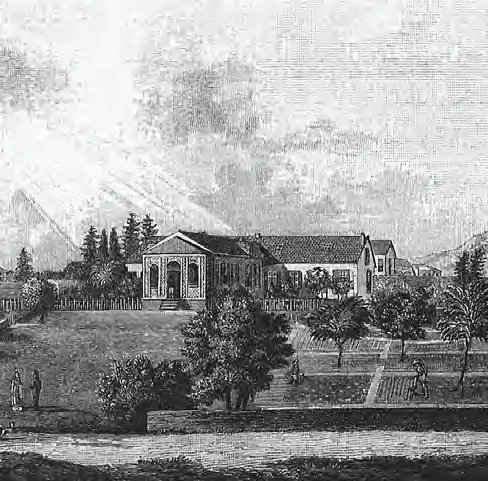 Longwood House on Saint Helena, Napoleon’s residence from 1815 until his death, 19th-century engravingWikimedia Commons, unknown author, Public domain (Longwood House.jpg)
On Saint Helena Napoleon lives at Longwood House from December 1815, guarded by 2,100 soldiers and a squadron of ten ships. He dictates his memoirs and complains of his conditions in letters to the governor, Sir Hudson Lowe. His health declines from 1817, and he dies on 5 May 1821, aged 51, of what the autopsies find to be a stomach cancer. In 1840 his body is brought back to Paris and laid in Les Invalides.
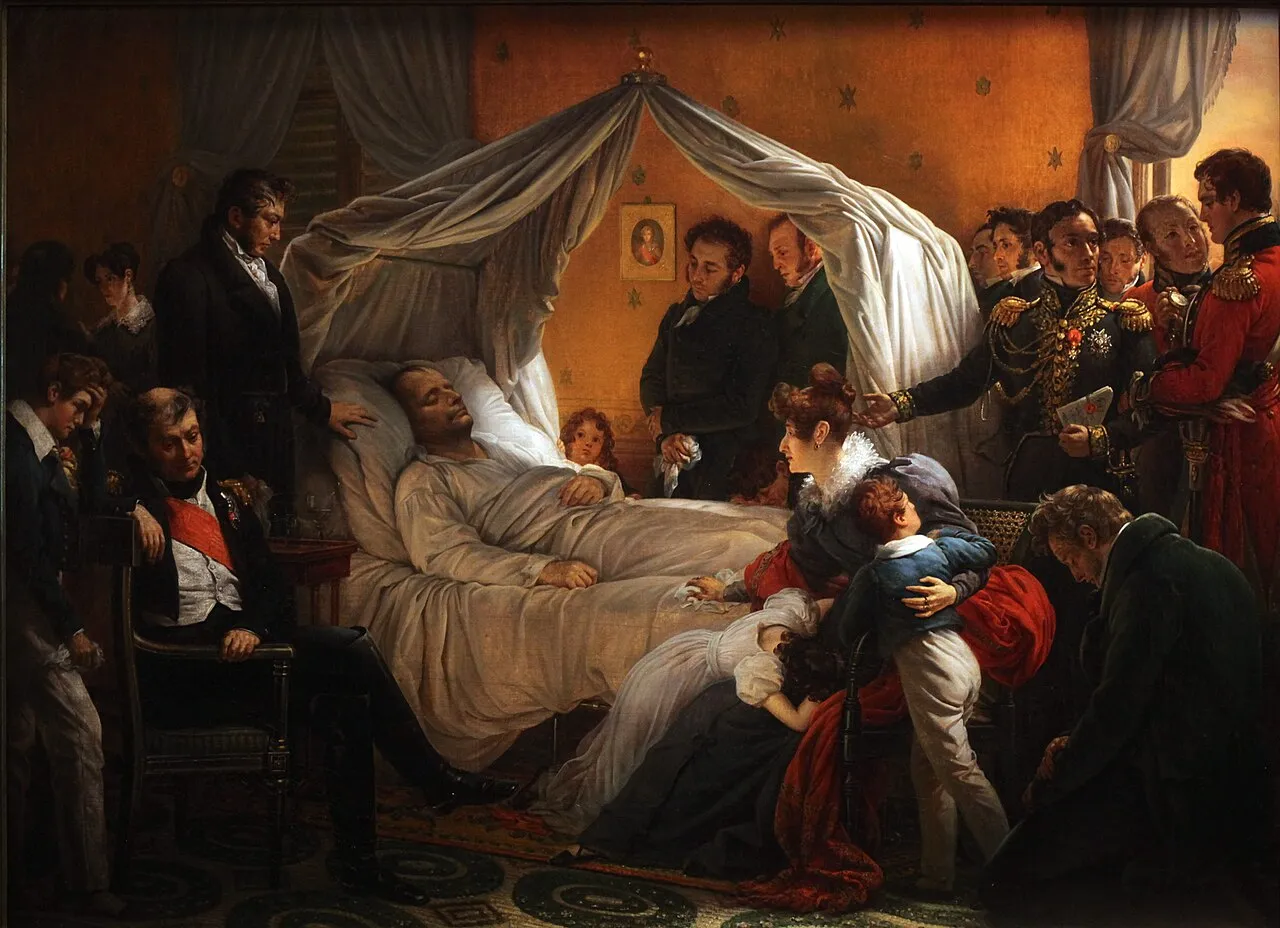 The death of Napoleon on 5 May 1821, painting by Charles de Steuben, exhibited in 1829Wikimedia Commons, Charles de Steuben, Public domain (Napoleon death-Charles von Steuben-IMG 1512.JPG)
Sources
- Harold Nicolson, The Congress of Vienna: A Study in Allied Unity, 1812–1822 (1946).
- Adam Zamoyski, Rites of Peace: The Fall of Napoleon and the Congress of Vienna (2007).
- Mark Jarrett, The Congress of Vienna and Its Legacy (2013).
Prev: The second abdication