15 to 20 October 1805
Mack surrenders at Ulm
On 14 October Murat joins Dupont at Albeck and drives Werneck’s corps north towards Heidenheim, and Archduke Ferdinand leaves Ulm with the cavalry. By night two French corps stand before the Austrian camps on the Michelsberg, the heights north of the city. Marmont and the Imperial Guard are south of the river, and Soult comes up from Memmingen to close the road to the Tyrol.
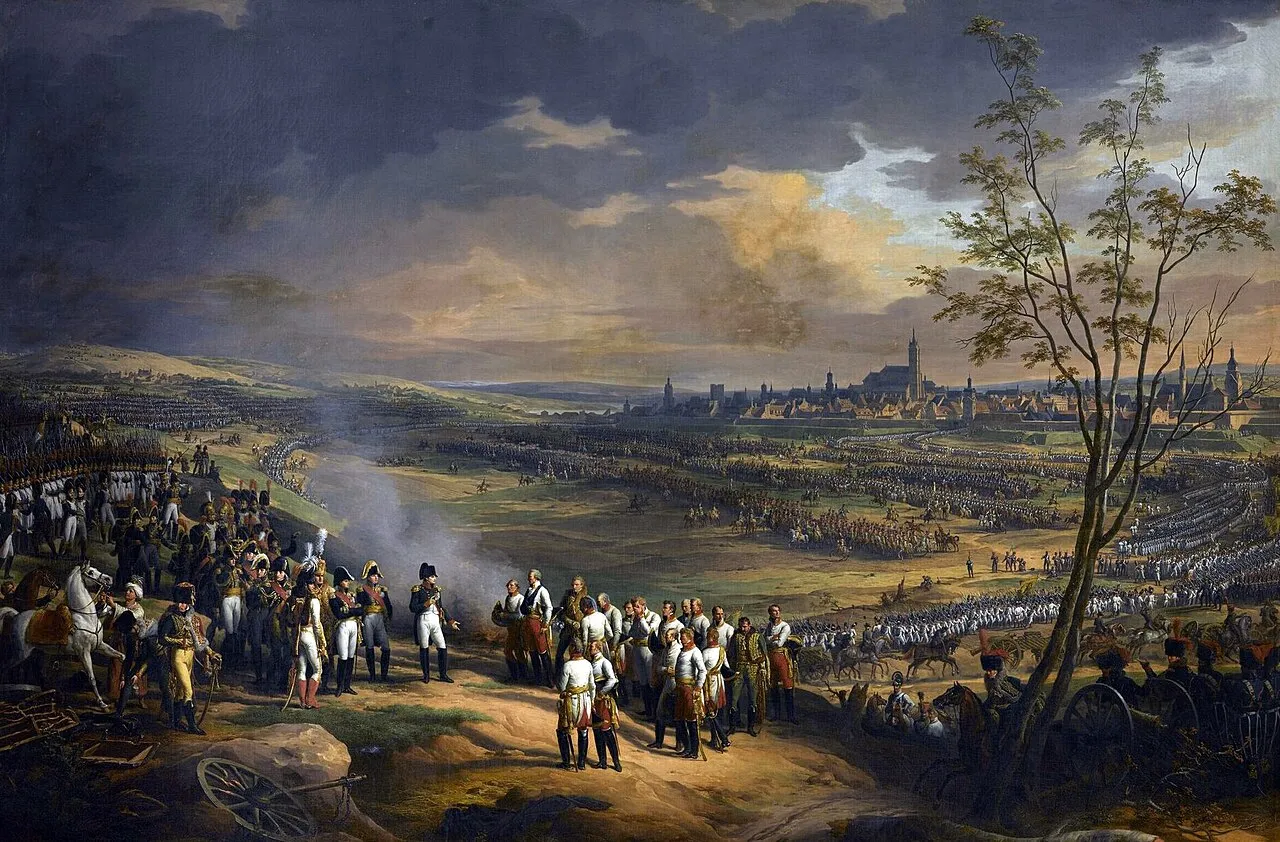 Napoleon receives the capitulation of General Mack at Ulm, 20 October 1805, painting by Charles ThéveninWikimedia Commons, Charles Thévenin, Public domain (Charles Thévenin - Reddition de la ville d'Ulm.jpg)
On 15 October Ney’s troops storm the camps on the Michelsberg, and the next day the French bombard Ulm. On 17 October Mack signs a convention with Napoleon’s envoy Ségur to surrender on 25 October if no help arrives. Murat’s pursuit overtakes Werneck, who surrenders at Trochtelfingen on 18 October with 8,000 men by one account and 15,000 by another. Only Ferdinand and a few squadrons reach Bohemia.
Hearing of Werneck’s surrender, Mack capitulates on 20 October. The next day the garrison, 23,000 to 25,000 men with 18 generals and 60 to 65 guns, marches out and lays down its arms before the Grande Armée drawn up in a half circle. In about three weeks the campaign has cost Austria some 60,000 prisoners, and the French about 500 killed and 1,000 wounded at Ulm. Mack is later court-martialled and sentenced to two years in prison.
Sources
- David G. Chandler, The Campaigns of Napoleon (1966).
- F. N. Maude, The Ulm Campaign, 1805 (1912).
- Alistair Horne, Napoleon: Master of Europe, 1805–1807 (1979).
Prev: Ney crosses at ElchingenNext: The combined fleet